Asle Toje – författare
Visar alla böcker från författaren Asle Toje. Handla med fri frakt och snabb leverans.
8 produkter
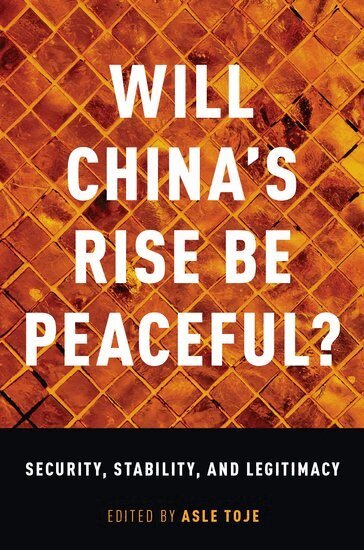
Will China's Rise Be Peaceful?
Security, Stability, and Legitimacy
Inbunden, 2018
2352 kr
Lägg i varukorg
The rise of China will undoubtedly be one of the great spectacles of the twenty-first century. More than a dramatic symbol of the redistribution of global wealth, the event has marked the end of the unipolar international system and the arrival of a new era in world politics. How the security, …
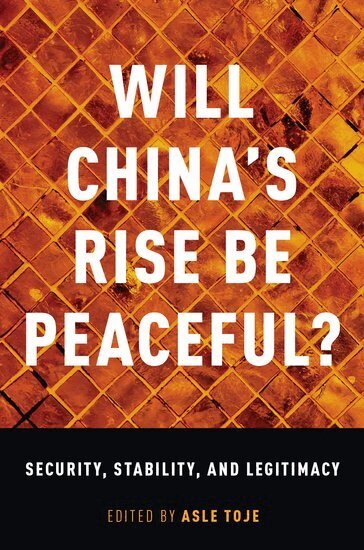
Will China's Rise Be Peaceful?
Security, Stability, and Legitimacy
Av Asle Toje
Häftad, 2018
804 kr
Lägg i varukorg
The rise of China will undoubtedly be one of the great spectacles of the twenty-first century. More than a dramatic symbol of the redistribution of global wealth, the event has marked the end of the unipolar international system and the arrival of a new era in world politics. How the security, …
Will China's Rise Be Peaceful?
Security, Stability, and Legitimacy
Av Asle Toje
E-bok, 2018
569 kr
Lägg i varukorg
The rise of China will undoubtedly be one of the great spectacles of the twenty-first century. More than a dramatic symbol of the redistribution of global wealth, the event has marked the end of the unipolar international system and the arrival of a new era in world politics. How the security, …
Will China's Rise Be Peaceful?
Security, Stability, and Legitimacy
Av Asle Toje
E-bok, 2018
569 kr
Lägg i varukorg
The rise of China will undoubtedly be one of the great spectacles of the twenty-first century. More than a dramatic symbol of the redistribution of global wealth, the event has marked the end of the unipolar international system and the arrival of a new era in world politics. How the security, …
America, the EU and Strategic Culture
Renegotiating the Transatlantic Bargain
Av Asle Toje
Inbunden, 2008
2510 kr
Lägg i varukorg
This book provides a provocative analysis of relations between Europe and America during the tempestuous years 1998-2004. Analysing EU foreign policy, it concludes that the lessons learnt in interacting with America have been crucial in shaping the emerging EU strategic culture.The book challenges …
America, the EU and Strategic Culture
Renegotiating the Transatlantic Bargain
Av Asle Toje
Häftad, 2008
909 kr
Lägg i varukorg
This book provides a provocative analysis of relations between Europe and America during the tempestuous years 1998-2004. Analysing EU foreign policy, it concludes that the lessons learnt in interacting with America have been crucial in shaping the emerging EU strategic culture.The book challenges …
America, the EU and Strategic Culture
Renegotiating the Transatlantic Bargain
Av Asle Toje
E-bok, 2008
1051 kr
Lägg i varukorg
This book provides a provocative analysis of relations between Europe and America during the tempestuous years 1998-2004. Analysing EU foreign policy, it concludes that the lessons learnt in interacting with America have been crucial in shaping the emerging EU strategic culture.The book challenges …
Neoclassical Realism in European Politics
Bringing Power Back in
Inbunden, 2012
1188 kr
Tillfälligt slut
Realism is making a comeback in Europe. This book brings together a new generation of realist scholars. It provides a rigorous survey for specialists seeking to understand the dynamics of international relations in a time of change. The volume thus seeks to explore the European dimension to …