Atsushi Shimojima – författare
Visar alla böcker från författaren Atsushi Shimojima. Handla med fri frakt och snabb leverans.
5 produkter
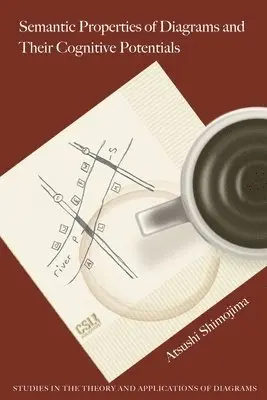
Semantic Properties of Diagrams and Their Cognitive Potentials
Häftad, 2015
248 kr
Lägg i varukorg
Why are diagrams sometimes so useful, facilitating our understanding and thinking, while at other times they can be unhelpful and even misleading? Drawing on a comprehensive survey of modern research in philosophy, logic, artificial intelligence, cognitive psychology, and graphic design, Semantic …
Diagrammatic Representation and Inference
15th International Conference, Diagrams 2026, Tallinn, Estonia, August 25–28, 2026, Proceedings
Av Paweł Sobociński, Francesco Bellucci m. fl.
Häftad, 2026
923 kr
Lägg i varukorg
This book constitutes the refereed proceedings of the 15th International Conference on the Theory and Application of Diagrams, Diagrams 2026, held in Tallinn, Estonia, during August 25–28, 2026.The 14 full papers, 20 short papers and 9 posters included in this book were carefully reviewed and …
Diagrammatic Representation and Inference
15th International Conference, Diagrams 2026, Tallinn, Estonia, August 25-28, 2026, Proceedings
Av Reetu Bhattacharjee, Erica de Vries m. fl.
E-bok, 2026
1175 kr
Lägg i varukorg
This book constitutes the refereed proceedings of the 15th International Conference on the Theory and Application of Diagrams, Diagrams 2026, held in Tallinn, Estonia, during August 25–28, 2026.The 14 full papers, 20 short papers and 9 posters included in this book were carefully reviewed and …
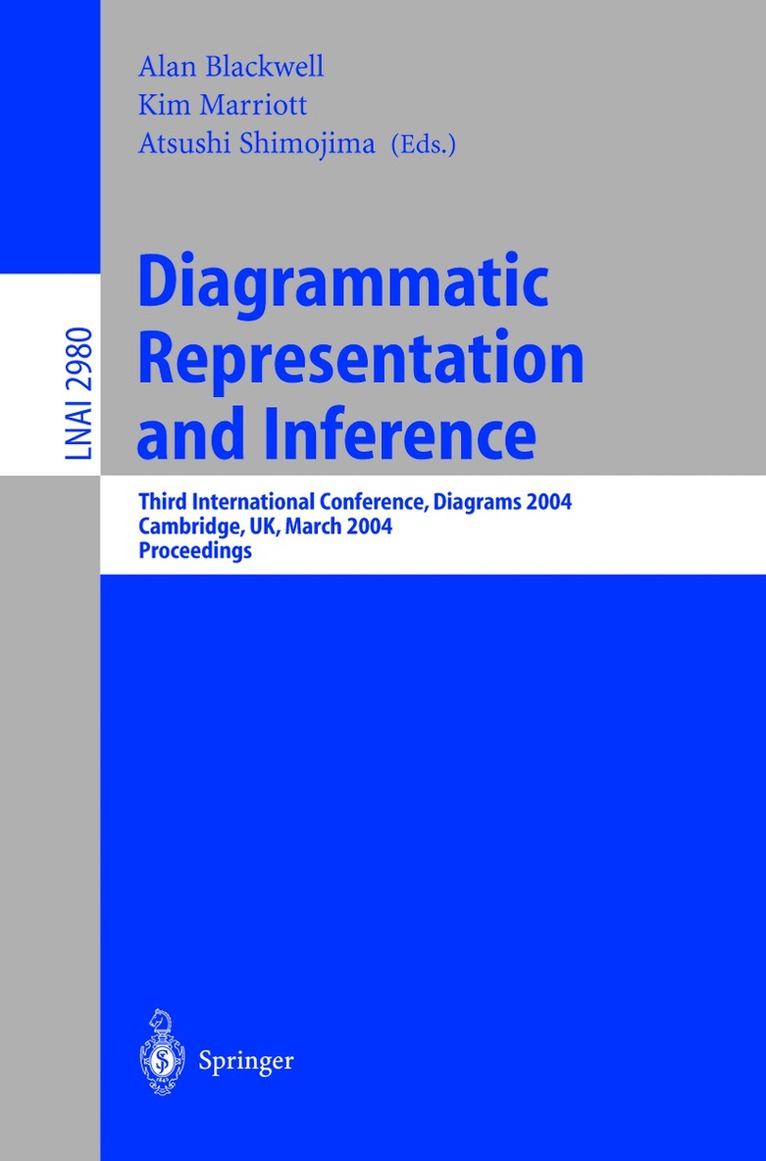
Diagrammatic Representation and Inference
Third International Conference, Diagrams 2004, Cambridge, UK, March 22-24, 2004, Proceedings
Av Alan Blackwell, Kim Marriott m. fl.
Häftad, 2004
568 kr
Lägg i varukorg
Although diagrammatic representations have been a feature of human com- nication from early history, recent advances in printing and electronic media technologyhaveintroducedincreasinglysophisticatedvisualrepresentationsinto everydaylife. We need to improve our understanding of the role of …
Diagrammatic Representation and Inference
Third International Conference, Diagrams 2004, Cambridge, UK, March 22-24, 2004, Proceedings
Av Atsushi Shimojima, Kim Marriott m. fl.
E-bok, 2004
739 kr
Lägg i varukorg