B. Weiss - Böcker
Visar alla böcker från författaren B. Weiss. Handla med fri frakt och snabb leverans.
7 produkter
7 produkter
Del 277 - London Mathematical Society Lecture Note Series
Descriptive Set Theory and Dynamical Systems
Häftad, Engelska, 2000
1 008 kr
Skickas inom 7-10 vardagar
In recent years there has been a growing interest in the interactions between descriptive set theory and various aspects of the theory of dynamical systems, including ergodic theory and topological dynamics. This volume, first published in 2000, contains a collection of survey papers by leading researchers covering a wide variety of recent developments in these subjects and their interconnections. This book provides researchers and graduate students interested in either of these areas with a guide to work done in the other, as well as with an introduction to problems and research directions arising from their interconnections.
540 kr
Skickas inom 3-6 vardagar
At the center of this subtle ethnographic account of the Haya communities of Northwest Tanzania is the idea of a lived world as both the product and the producer of everyday practices. Drawing on his experience living with the Haya, Brad Weiss explores Haya ways of constructing and inhabiting their community, and examines the forces that shape and transform these practices over time. In particular, he shows how the Haya, a group at the fringe of the global economy, have responded to the processes and material aspects of money, markets, and commodities as they make and remake their place in a changing world. Grounded in a richly detailed ethnography of Haya practice, Weiss' analysis considers the symbolic qualities and values embedded in goods and transactions across a wide range of cultural activity: agricultural practice and food preparation, the body's experience of epidemic disease from AIDS to the infant affliction of plastic teeth, and long-standing forms of social movement and migration. Weiss emphasizes how Haya images of consumption describe the relationship between their local community and the global economy.Throughout, he demonstrates that particular commodities and more general market processes are always material and meaningful forces with the potential for creativity as well as disruption in Haya social life. By calling attention to the productive dimensions of this spatial and temporal world, his work highlights the importance of human agency in not only the Haya but any sociocultural order. Offering a significant contribution to the anthropological theories of practice, embodiment, and agency, and enriching our understanding of the lives of a rural African people, The Making and Unmaking of the Haya Lived World will interest historians, anthropologists, ethnographers, and scholars of cultural studies.
536 kr
Skickas inom 10-15 vardagar
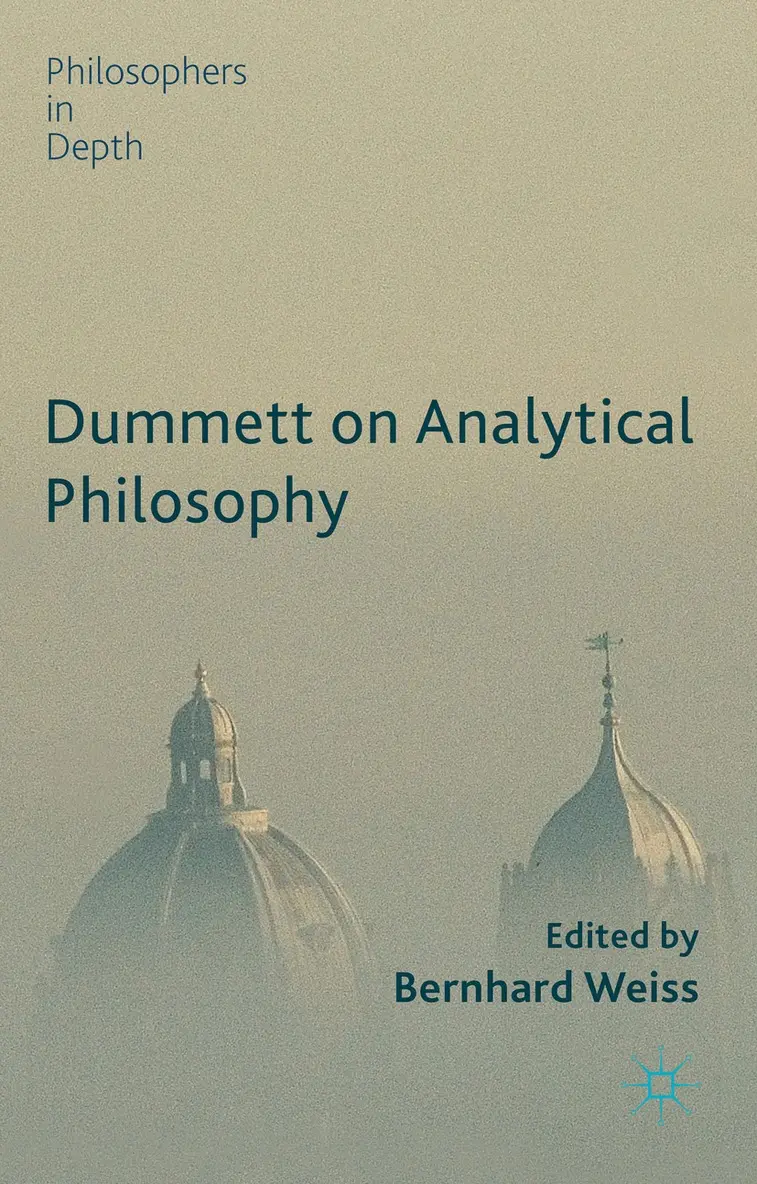
Dummett argues that the aim of philosophy is the analysis of thought and that, with Frege, analytical philosophy learned that the route to the analysis of thought is the analysis of language. Here are bold and deep readings of the subject's history and character, which form the topic of this volume.
536 kr
Skickas inom 10-15 vardagar
Dummett argues that the aim of philosophy is the analysis of thought and that, with Frege, analytical philosophy learned that the route to the analysis of thought is the analysis of language. Here are bold and deep readings of the subject's history and character, which form the topic of this volume.
1 578 kr
Skickas inom 10-15 vardagar
Systems biology has emerged as a highly interdisciplinary ?eld that has created broad enthusiasm in the scienti?c community. Systems biology is in vogue because of its potential to revolutionize not only biology but also medicine. Developments are anticipated that will change how we think about disease and how we approach therapeutic intervention. Perhaps the boldest vision of this future is presented by Dr. Leroy Hood, President of the Institute for Systems Biology in Seattle. He has been a protagonist and the main driving force of the underlying concept. - cording to Dr. Hood, systems biology will make possible a new era of medical care comprising predictive, preventive, personalized and part- ipatory (P4) medicine. While this vision appears futuristic, it has enticed both academic scienti?c communities and pharmaceutical industry R&D organizations. Systems biology ultimately attempts to understand biological s- tems at the molecular level. Examples of such systems are subcellular regulatory circuits with all their components, cells, organs, as well as - tire organisms. Over the past decade, technologies have been developed that enable systems-level interrogations, e.g., gene expression pro?ling, proteomics, and metabonomics, to name a few. Scientists have used such platforms to accumulate a tremendous amount of data. Although we have learned a great deal by collecting such detailed information, it seems our understanding has not similarly increased.
1 625 kr
Skickas inom 10-15 vardagar
Systems biology has emerged as a highly interdisciplinary ?eld that has created broad enthusiasm in the scienti?c community. Systems biology is in vogue because of its potential to revolutionize not only biology but also medicine. Developments are anticipated that will change how we think about disease and how we approach therapeutic intervention. Perhaps the boldest vision of this future is presented by Dr. Leroy Hood, President of the Institute for Systems Biology in Seattle. He has been a protagonist and the main driving force of the underlying concept. - cording to Dr. Hood, systems biology will make possible a new era of medical care comprising predictive, preventive, personalized and part- ipatory (P4) medicine. While this vision appears futuristic, it has enticed both academic scienti?c communities and pharmaceutical industry R&D organizations. Systems biology ultimately attempts to understand biological s- tems at the molecular level. Examples of such systems are subcellular regulatory circuits with all their components, cells, organs, as well as - tire organisms. Over the past decade, technologies have been developed that enable systems-level interrogations, e.g., gene expression pro?ling, proteomics, and metabonomics, to name a few. Scientists have used such platforms to accumulate a tremendous amount of data. Although we have learned a great deal by collecting such detailed information, it seems our understanding has not similarly increased.
1 096 kr
Skickas inom 10-15 vardagar
Bioinformatics is emerging as a field with ever-increasing promise, ur- gency, and necessity. All three of these facets can be seen in the con- text of the recent sequencing of the human genome. The creation of a novel algorithm for the assembly of whole genome shotgun data sets accelerated the project and resulted in its near completion in 2001. The urgency became apparent with the landslide of data that ensued and the realization that current databases and tool sets are not up to the task. Finally, the necessity of bioinformatics as a facet of molecular biologi- cal research becomes evident in the impossibility of individual human comprehension of all the details of the functioning of a cell at the mo- lecular level, especially now that we stand on the edge of this preci- pice. We find ourselves at a time when we have the essentially complete genomes of human and mouse, and the completed sequences of Droso- phila melanogaster, Caenorhabditis elegans, several fungi including Saccharomyces cerevisiae, and many bacteria including Escherichia coli.There are volumes of mRNA expression data sets, high-density maps of highly variable SNPs for both human and mouse, physical marker maps for many other important agricultural and drug trial ani- mals, and a complete knock-out survey of yeast. In addition, the se- quencing of D. pseudoobscura and Caenorhabditis briggsae in the near future will provide unusual comparative genomic insights.