B.A.M Bouman - Böcker
Visar alla böcker från författaren B.A.M Bouman. Handla med fri frakt och snabb leverans.
6 produkter
6 produkter
Del 4 - System Approaches for Sustainable Agricultural Development
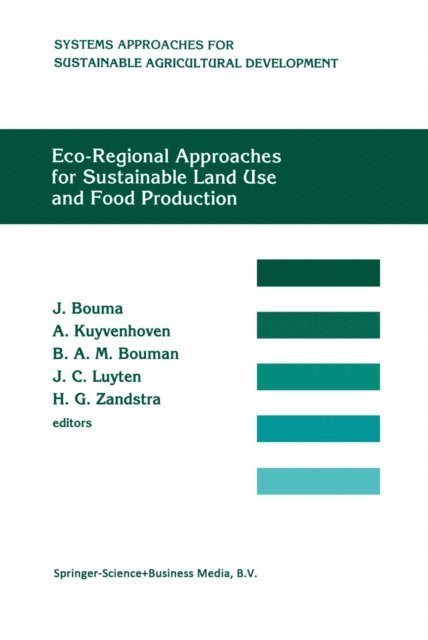
Eco-regional approaches for sustainable land use and food production
Proceedings of a symposium on eco-regional approaches in agricultural research, 12–16 December 1994, ISNAR, The Hague
Inbunden, Engelska, 1995
2 116 kr
Skickas inom 10-15 vardagar
In the coming decades the world will need to more than double its food and feed production, almost all of the increase being needed in developing countries. This has socioeconomic and biophysical implications. Rural development needs an eco-regional approach that integrates biophysical and socioeconomic work on cropping systems, livestock, the environment and natural resources. This book contains the papers, response papers and discussion report of a five-day seminar on eco-regional approaches. It assesses the recent progress in systems approaches applied to eco-regional problems, presenting and discussing a number of case studies. Future research needs are documented, as well as ways to improve collaboration between research institutes. The seminar on which the book is based was organized on behalf of the Directorate General for International Cooperation of the Netherlands Ministry of Foreign Affairs by the Research Institute for Agrobiology and Soil Fertility (AB-DLO), the Wageningen Agricultural University (WAU), and the International Potato Centre (CIP).It was held at the International Service for National Agricultural Research (ISNAR), and was attended by participants from all CGIAR centres, among others.
2 116 kr
Skickas inom 10-15 vardagar
Systems approaches for agricultural development are needed to determine rational strategies for the role of agriculture in national development. Mathematical models and computer simulation provide objective tools for applying science to determine and evaluate options for resource management at field, farm and regional scales. However, these tools would not be fully utilizable without incorporating social and economic dimensions into their application. The second international symposium, Systems Approaches for Agricultural Development (SAAD), held in Los Banos, 6-8 December 1995, fostered this link between the biophysical sciences and the social sciences in the selection of keynote papers and oral presentations, a selection of which are included in this volume. The contents further reflect how systems approaches have definitely moved beyond the research mode into the application mode. The large number and high quality of interdisciplinary research projects reported from different parts of the globe, to determine land use options that will meet multiple goals and yet sustain natural resource bases, is a key indicator of this `coming of age'.At the farm level, where trade-off decisions between processes and products (commodities) feature strongly, much progress is also evident in the development of systems-based tools for decision making. At the field level optimization of resource use and minimizing environmental effects has become of major concern for which systems approaches are indispensable.
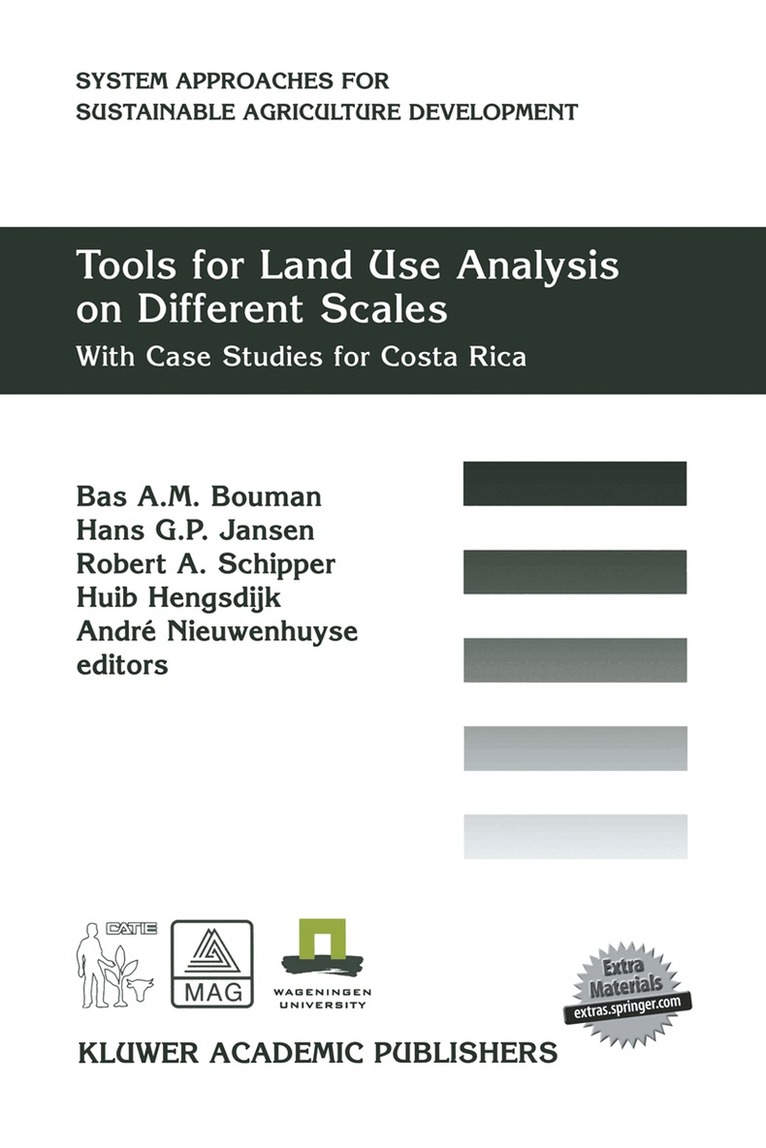
Tools for Land Use Analysis on Different Scales
With Case Studies for Costa Rica
Inbunden, Engelska, 2000
1 589 kr
Skickas inom 10-15 vardagar
Regional development is intrinsically related to the way in which the land is used. Given the rising awareness of the multifunctionality of the world's land resources, policy makers now face the complex task of accommodating multiple objectives of an increasing number of stakeholders in regional development. This implies a need for tools that can be employed to provide insights into the opportunities and limitations of land use. Those tools should be capable of quantifying trade-offs between socio-economic, sustainability, and environment-related policy objectives. This book offers a detailed account of a range of interdisciplinary methodologies for land use analysis, developed over a 12 year period (1986-1998) in Costa Rica, through collaborative research between three institutions: one from the North (Wageningen Agricultural University of The Netherlands), and two from the South (the Tropical Agricultural Research and Higher Education Center [CATIE] and the Ministry of Agriculture and Livestock [MAG]). The methodologies span a number of spatial scales, ranging from the field level all the way to the national level.Concepts of systems analysis and information technology play a pivotal role in each of the methodologies. Together, they form a unique toolbox that deserves ample use in the process of agricultural policy design. With the book, a complimentary CD-ROM is provided which contains a practical account of the methodologies presented, including a full documentation of models, manuals, a number of introductory exercises, as well as previously unavailable data sets. In this way, the CD-ROM offers an opportunity for familiarization with the methodologies by students, research specialists, and decision-makers alike.
2 116 kr
Skickas inom 10-15 vardagar
Systems approaches for agricultural development are needed to determine rational strategies for the role of agriculture in national development. Mathematical models and computer simulation provide objective tools for applying science to determine and evaluate options for resource management at field, farm and regional scales. However, these tools would not be fully utilizable without incorporating social and economic dimensions into their application. The second international symposium, Systems Approaches for Agricultural Development (SAAD), held in Los Banos, 6-8 December 1995, fostered this link between the biophysical sciences and the social sciences in the selection of keynote papers and oral presentations, a selection of which are included in these books. The contents further reflect how systems approaches have definitely moved beyond the research mode into the application mode. The large number and high quality of interdisciplinary research projects reported from different parts of the globe, to determine land use options that will meet multiple goals and yet sustain natural resource bases, is a key indicator of this 'coming of age'.At the farm level, where trade-off decisions between processes and products (commodities) feature strongly, much progress is also evident in the development of systems-based tools for decision making. At the field level optimization of resource use and minimizing environmental effects has become of major concern for which systems approaches are indispensable. The books, of which Volume I deals with regional and farm studies level and Volume II with field level studies, will be of particular interest to all agricultural scientists and planners, as well as students interested in multidisciplinary and holistic approaches to agricultural development.
Eco-regional approaches for sustainable land use and food production
Proceedings of a symposium on eco-regional approaches in agricultural research, 12–16 December 1994, ISNAR, The Hague
Häftad, Engelska, 2013
2 116 kr
Skickas inom 10-15 vardagar
In the coming decades the world will need to more than double its food and feed production, almost all of the increase being needed in developing countries. This has socioeconomic and biophysical implications. Traditional component and commodity research addresses overly narrow issues at too small a scale. Rural development needs an eco-regional approach that integrates biophysical and socioeconomic work on cropping systems, livestock, the environment, and natural resources. This book contains the papers, response papers and discussion report of a five-day seminar on eco-regional approaches. It assesses the state of the art of systems approaches applied to eco-regional problems, presenting and discussing a number of case studies. Future research needs are discussed, as well as ways to improve collaboration between research institutes. The seminar on which the book is based was organised on behalf of the Directorate General for International Cooperation of the Netherlands Ministry of Foreign Affairs by the Research Institute for Agrobiology and Soil Fertility (AB-DLO), the Wageningen Agricultural University (WAU), and the International Potato Centre (CIP). It was held at the International Service for National Agricultural Research (ISNAR), and was attended by participants from all CGIAR centres, among others.
Tools for Land Use Analysis on Different Scales
With Case Studies for Costa Rica
Häftad, Engelska, 2013
1 589 kr
Skickas inom 10-15 vardagar
Regional development is intrinsically related to the way in which the land is used. Given the rising awareness of the multifunctionality of the world's land resources, policy makers now face the complex task of accommodating multiple objectives of an increasing number of stakeholders in regional development. This implies a need for tools that can be employed to provide insights into the opportunities and limitations of land use. Those tools should be capable of quantifying trade-offs between socio-economic, sustainability, and environment-related policy objectives. This book offers a detailed account of a range of interdisciplinary methodologies for land use analysis, developed over a twelve-year period (1986-1998) in Costa Rica, through collaborative research between three institutions: one from the North (Wageningen Agricultural University of The Netherlands), and two from the South (the Tropical Agricultural Research and Higher Education Center [CATIE] and the Ministry of Agriculture and Livestock [MAG]). The methodologies span a number of spatial scales, ranging from the field level all the way to the national level. Concepts of systems analysis and information technology play a pivotal role in each of the methodologies. Together, they form a unique toolbox that deserves ample use in the process of agricultural policy design.