Behrooz Mahmoodi-Bakhtiari – författare
410 kr
Skickas inom 10-15 vardagar
439 kr
Läs direkt efter köp
439 kr
Läs direkt efter köp
1 189 kr
Skickas inom 10-15 vardagar
406 kr
Läs direkt efter köp
This study is the first to introduce evidentiality to the stylistic analysis of literary works, specifically that of the great Persian writer Sa''dī, focusing on how he used linguistic means to illustrate a real or ideational world.
The authors begin by introducing the concept of evidentiality; its definition, its coding in Persian, the rationale behind evidentiality analysis, and semantic-pragmatic functions of evidentiality. The book highlights how evidentiality can be accounted for as a stylistic device to reveal the validity of a narration, as well as the author’s commitment and contribution to it. Three of Sa''dī’s major works are analyzed – Būstān, Golestān and Sonnets – using Krippendoff''s frequency approach. It is argued that Sa''dī deployed an array of evidentials in his work, from direct visual evidentials in Golestān and Sonnets to heard and quoted evidentials in Būstān. To illustrate this, the book includes translations of Sa''dī’s poetry and prose. In addition, the authors consider historical and contemporary manifestations of the Persian narrative style, as well as exploring the cultural concerns of the Persian speech community.
The book will appeal to general linguists, practitioners of pragmatics and stylistics, literary critics, and those interested in contrastive analysis of literature and cultural studies.
406 kr
Läs direkt efter köp
This study is the first to introduce evidentiality to the stylistic analysis of literary works, specifically that of the great Persian writer Sa''dī, focusing on how he used linguistic means to illustrate a real or ideational world.
The authors begin by introducing the concept of evidentiality; its definition, its coding in Persian, the rationale behind evidentiality analysis, and semantic-pragmatic functions of evidentiality. The book highlights how evidentiality can be accounted for as a stylistic device to reveal the validity of a narration, as well as the author’s commitment and contribution to it. Three of Sa''dī’s major works are analyzed – Būstān, Golestān and Sonnets – using Krippendoff''s frequency approach. It is argued that Sa''dī deployed an array of evidentials in his work, from direct visual evidentials in Golestān and Sonnets to heard and quoted evidentials in Būstān. To illustrate this, the book includes translations of Sa''dī’s poetry and prose. In addition, the authors consider historical and contemporary manifestations of the Persian narrative style, as well as exploring the cultural concerns of the Persian speech community.
The book will appeal to general linguists, practitioners of pragmatics and stylistics, literary critics, and those interested in contrastive analysis of literature and cultural studies.
804 kr
Skickas inom 10-15 vardagar
349 kr
Skickas inom 10-15 vardagar
2 222 kr
Kommande
618 kr
Kommande
1 791 kr
Skickas inom 5-8 vardagar
1 926 kr
Läs direkt efter köp
The Iranian languages are one of the world''s major language families. With an estimated 150 to 200 million native speakers, these languages constitute the western group of the larger Indo-Iranian family, which represents a major eastern branch of the Indo-European languages. Geographically, the Iranian Languages are spoken from Central Turkey, Syria and Iraq in the West to Pakistan and western edged of Xinjiang Uygur Autonomous Region of China in the east. Iranian languages have long been among the major interests of the philologists and general linguists, and European scholars have made tremendous contributions to the study of this language family. In light of such efforts, now we know that the Iranian languages can be historically divided into three phases, that are old, middle and new Iranian languages, and the new Iranian languages may be generally grouped as Eastern and Western. In recent years, the orientation towards typology has led to the appearance of somewhat more ponderance on the subject but the work has not included description of some of the very important languages of the Caspian, and or of the religious minorities (such as those of the Zoroastrians or the Jewish community), of the four-fold Central Plateau dial.
1 926 kr
Läs direkt efter köp
The Iranian languages are one of the world''s major language families. With an estimated 150 to 200 million native speakers, these languages constitute the western group of the larger Indo-Iranian family, which represents a major eastern branch of the Indo-European languages. Geographically, the Iranian Languages are spoken from Central Turkey, Syria and Iraq in the West to Pakistan and western edged of Xinjiang Uygur Autonomous Region of China in the east. Iranian languages have long been among the major interests of the philologists and general linguists, and European scholars have made tremendous contributions to the study of this language family. In light of such efforts, now we know that the Iranian languages can be historically divided into three phases, that are old, middle and new Iranian languages, and the new Iranian languages may be generally grouped as Eastern and Western. In recent years, the orientation towards typology has led to the appearance of somewhat more ponderance on the subject but the work has not included description of some of the very important languages of the Caspian, and or of the religious minorities (such as those of the Zoroastrians or the Jewish community), of the four-fold Central Plateau dial.
1 881 kr
Skickas inom 5-8 vardagar
1 939 kr
Läs direkt efter köp
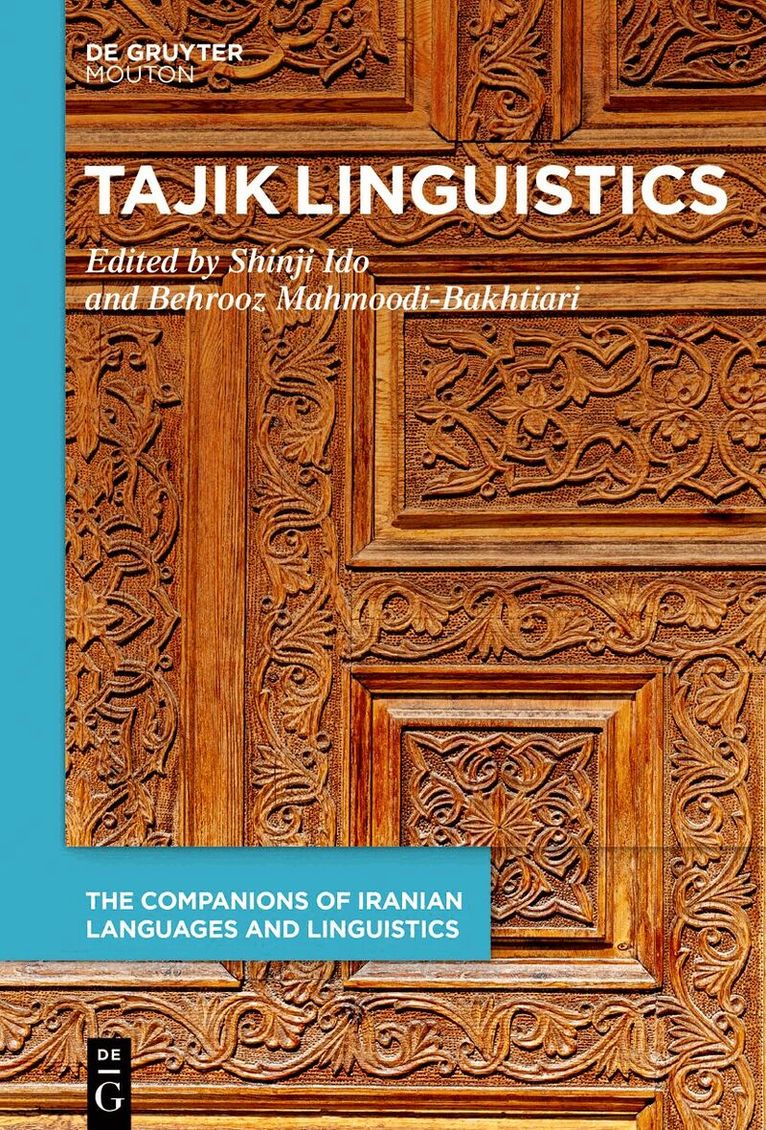
It is hardly an overstatement to say that Soviet linguists had a monopoly over Tajik linguistics before the dissolution of the Soviet Union, when most studies on the language were accessible exclusively through Russian and Tajik. Today, however, linguists dealing with Tajik are diverse not only in terms of their location but also in terms of their disciplinary orientation within linguistics, making it difficult for the general linguist to work out the state of the art of the linguistic study of Tajik.
This volume aims to address this difficulty by collecting in a handbook format recent (post-Soviet) developments in the study of Tajik that now lie scattered in different subdisciplines of linguistics. The volume thus showcases the state of the art of post-Soviet Tajik linguistics and can be used as a guide for linguists interested in the language.
1 939 kr
Läs direkt efter köp
It is hardly an overstatement to say that Soviet linguists had a monopoly over Tajik linguistics before the dissolution of the Soviet Union, when most studies on the language were accessible exclusively through Russian and Tajik. Today, however, linguists dealing with Tajik are diverse not only in terms of their location but also in terms of their disciplinary orientation within linguistics, making it difficult for the general linguist to work out the state of the art of the linguistic study of Tajik.
This volume aims to address this difficulty by collecting in a handbook format recent (post-Soviet) developments in the study of Tajik that now lie scattered in different subdisciplines of linguistics. The volume thus showcases the state of the art of post-Soviet Tajik linguistics and can be used as a guide for linguists interested in the language.
1 423 kr
Skickas inom 10-15 vardagar
1 955 kr
Läs direkt efter köp
This book is the first of its kind in providing a lexicon of kinship terms prevalent in the Western dialects of Iran, with a parallel glossary in English. It engages the dialects and their terminology in the English language to bring to purview how language imitates life, particularly in rural settings. Subsequently, it gives a glimpse into the irrefutable relation that exists between culture and word usage. In doing so, it serves as a cultural manifesto as it pertains to Persian language, poetics, and applied linguistics and is relevant to linguists, cultural scholars, Anthropologists and students in Persian language, literature, and culture and certainly all Iranian languages.
1 659 kr
Skickas inom 10-15 vardagar
2 004 kr
Skickas inom 10-15 vardagar
2 599 kr
Läs direkt efter köp
2 004 kr
Skickas inom 10-15 vardagar