Bernhard K. Aichernig – författare
Visar alla böcker från författaren Bernhard K. Aichernig. Handla med fri frakt och snabb leverans.
7 produkter
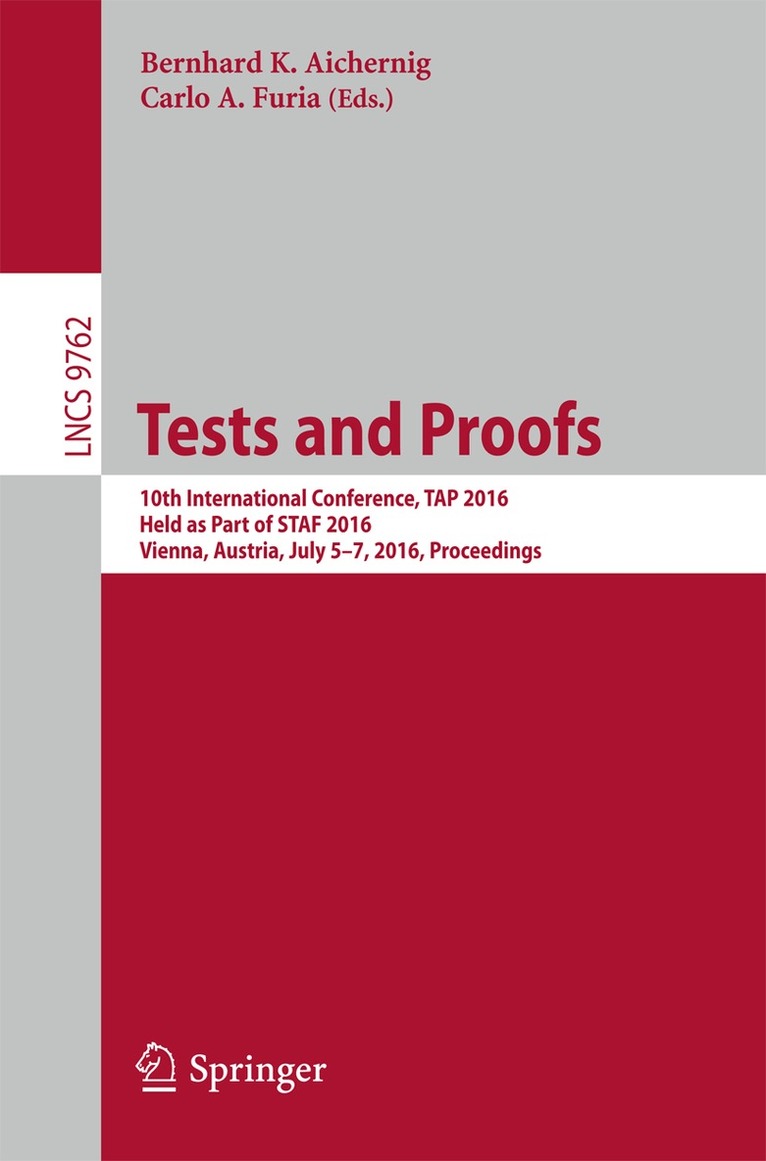
Tests and Proofs
10th International Conference, TAP 2016, Held as Part of STAF 2016, Vienna, Austria, July 5-7, 2016, Proceedings
Av Bernhard K. Aichernig, Carlo A. Furia
Häftad, 2016
566 kr
Lägg i varukorg
This book constitutes the refereed proceedings of the 10th International Conference on Tests and Proofs, TAP 2016, held as part of STAF 2016, in Vienna, Austria, in July 2016.The 8 full papers, 2 short papers, and 1 tool demonstration paper presented in this volume were carefully reviewed and …
Tests and Proofs
10th International Conference, TAP 2016, Held as Part of STAF 2016, Vienna, Austria, July 5-7, 2016, Proceedings
Av Carlo A. Furia, Bernhard K. Aichernig
E-bok, 2016
755 kr
Lägg i varukorg
This book constitutes the refereed proceedings of the 10th International Conference on Tests and Proofs, TAP 2016, held as part of STAF 2016, in Vienna, Austria, in July 2016. The 8 full papers, 2 short papers, and 1 tool demonstration paper presented in this volume were carefully reviewed and …
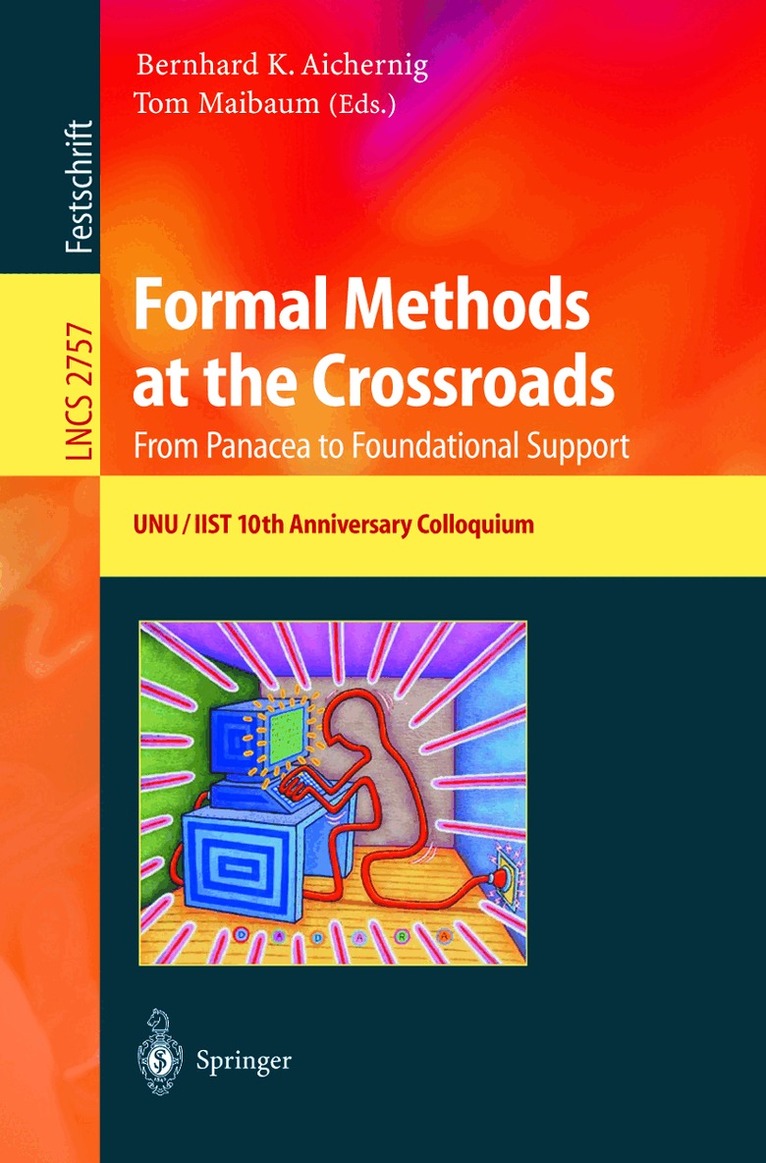
Formal Methods at the Crossroads. From Panacea to Foundational Support
10th Anniversary Colloquium of UNU/IIST, the International Institute for Software Technology of The United Nations University, Lisbon, Portugal, March 18-20, 2002, Revised Papers
Av Bernhard K. Aichernig, Tom Maibaum
Häftad, 2003
566 kr
Lägg i varukorg
This volume records the 10th Anniversary Colloquium of UNU/IIST, the Int- nationalInstituteforSoftwareTechnologyoftheUnitedNationsUniversity,held in Lisbon, Portugal, March 18-21, 2002. Armando Haeberer, then Chairman of the board of UNU/IIST, conceived the idea of an international meeting in ce- …
Formal Methods at the Crossroads. From Panacea to Foundational Support
10th Anniversary Colloquium of UNU/IIST, the International Institute for Software Technology of The United Nations University, Lisbon, Portugal, March 18-20, 2002, Revised Papers
Av Tom Maibaum, Bernhard K. Aichernig
E-bok, 2011
755 kr
Lägg i varukorg
Formal Methods for Components and Objects
9th International Symposium, FMCO 2010, Graz, Austria, November 29 - December 1, 2010
Av Bernhard K. Aichernig, Frank S. de Boer m. fl.
Häftad, 2011
566 kr
Lägg i varukorg
The focus in development methodologies of large and complex software systems has switched in the last two decades from functional issues to structural issues; this holds for both the object-oriented and the more recent component-based software engineering paradigms. Formal methods have been applied …
Formal Methods for Components and Objects
9th International Symposium, FMCO 2010, Graz, Austria, November 29 - December 1, 2010
Av Marcello M. Bonsangue, Frank S. de Boer m. fl.
E-bok, 2011
734 kr
Lägg i varukorg
The focus in development methodologies of large and complex software systems has switched in the last two decades from functional issues to structural issues; this holds for both the object-oriented and the more recent component-based software engineering paradigms. Formal methods have been applied …