Bernhard Walchli – författare
2 779 kr
Läs direkt efter köp
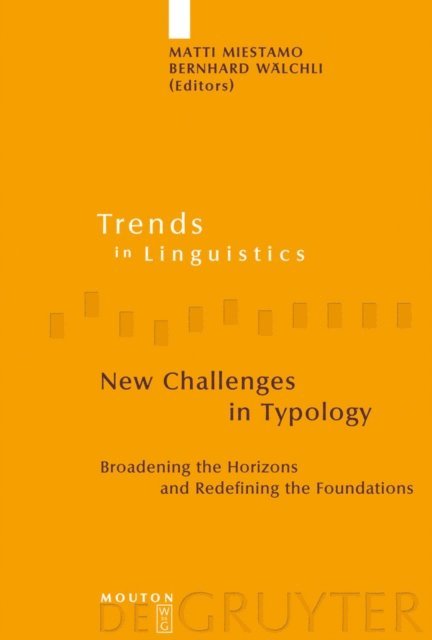
The sixteen chapters in this volume are written by typologists and typologically oriented field linguists who have completed their Ph.D. theses in the first four years of this millennium. The authors address selected theoretical questions of general linguistic relevance drawing from a wealth of data hitherto unfamiliar to the general linguistic audience. The general aim is to broaden the horizons of typology by revisiting existing typologies with larger language samples, exploring domains not considered in typology before, taking linguistic diversity more seriously, strengthening the connection between typology and areal linguistics, and bridging the gap to other fields, such as historical linguistics and sociolinguistics.
The papers cover grammatical phenomena from phonology, morphology up to the syntax of complex sentences. The linguistic phenomena scrutinized include the following: foot and stress, tone, infixation, inflection vs. derivation, word formation, polysynthesis, suppletion, person marking, reflexives, alignment, transitivity, tense-aspect-mood systems, negation, interrogation, converb systems, and complex sentences. More general methodological and theoretical issues, such as reconstruction, markedness, semantic maps, templates, and use of parallel corpora, are also addressed.
The contributions in this volume draw from many traditional fields of linguistics simultaneously, and show that it is becoming harder and maybe also less desirable to keep them separate, especially when taking a broadly cross-linguistic approach to language. The book is of interest to typologists and field linguists, as well as to any linguists interested in theoretical issues in different subfields of linguistics.
2 198 kr
Läs direkt efter köp
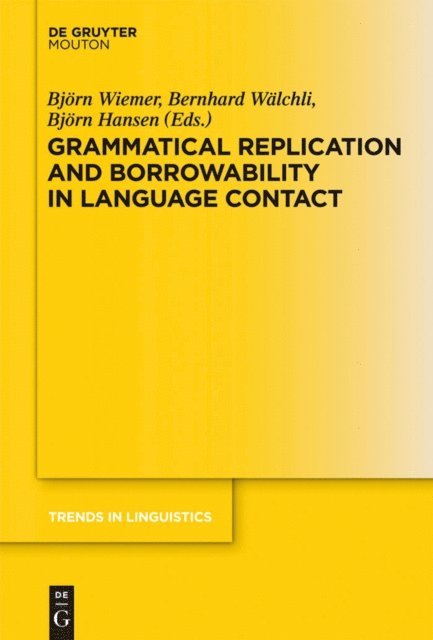
The volume presents new insights into two basic theoretical issues hotly debated in recent work on grammaticalization and language contact: grammatical replication and grammatical borrowability. The key issues are: How can grammatical replication be distinguished from other, superficially similar processes of contact-induced linguistic change, and under what conditions does it take place? Are there grammatical morphemes or constructions that are more easily borrowed than others, and how can language contact account for areal biases in the borrowing (vs. calquing) of grammatical formatives? The book is a major contribution to the ongoing theoretical discussion concerning the relationship between grammaticalization and language contact on a broad empirical basis.
2 439 kr
Skickas inom 5-8 vardagar
2 091 kr
Läs direkt efter köp
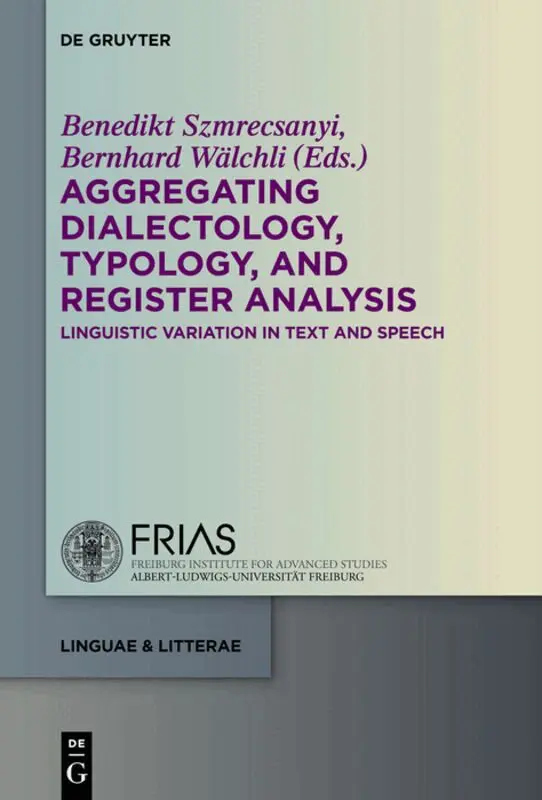
This volume aims to overcome sub-disciplinary boundaries in the study of linguistic variation - be it language-internal or cross-linguistic. Even though dialectologists, register analysts, typologists, and quantitative linguists all deal with linguistic variation, there is astonishingly little interaction across these fields. But the fourteen contributions in this volume show that these subdisciplines actually share many interests and methodological concerns in common. The chapters specifically converge in the following ways: First, they all seek to explore linguistic variation, within or across languages. Second, they are based on usage data, that is, on corpora of (more or less) authentic text or speech of different languages or language varieties. Third, all chapters are concerned with the joint analysis (also sometimes known as “aggregation” or “data synthesis”) of multiple phenomena, features, or measurements of some sort. And lastly, the contributors all marshal quantitative analysis techniques to analyse the data. In short, the volume explores the text-feature-aggregation pipeline in variation studies, demonstrating that there is much mutual inspiration to be had by thinking outside the disciplinary box.
2 110 kr
Läs direkt efter köp
This volume aims to overcome sub-disciplinary boundaries in the study of linguistic variation - be it language-internal or cross-linguistic. Even though dialectologists, register analysts, typologists, and quantitative linguists all deal with linguistic variation, there is astonishingly little interaction across these fields. But the fourteen contributions in this volume show that these subdisciplines actually share many interests and methodological concerns in common. The chapters specifically converge in the following ways: First, they all seek to explore linguistic variation, within or across languages. Second, they are based on usage data, that is, on corpora of (more or less) authentic text or speech of different languages or language varieties. Third, all chapters are concerned with the joint analysis (also sometimes known as “aggregation” or “data synthesis”) of multiple phenomena, features, or measurements of some sort. And lastly, the contributors all marshal quantitative analysis techniques to analyse the data. In short, the volume explores the text-feature-aggregation pipeline in variation studies, demonstrating that there is much mutual inspiration to be had by thinking outside the disciplinary box.