B.J. Lum – författare
Visar alla böcker från författaren B.J. Lum. Handla med fri frakt och snabb leverans.
3 produkter
3 produkter
Del 67 - Philosophical Studies Series
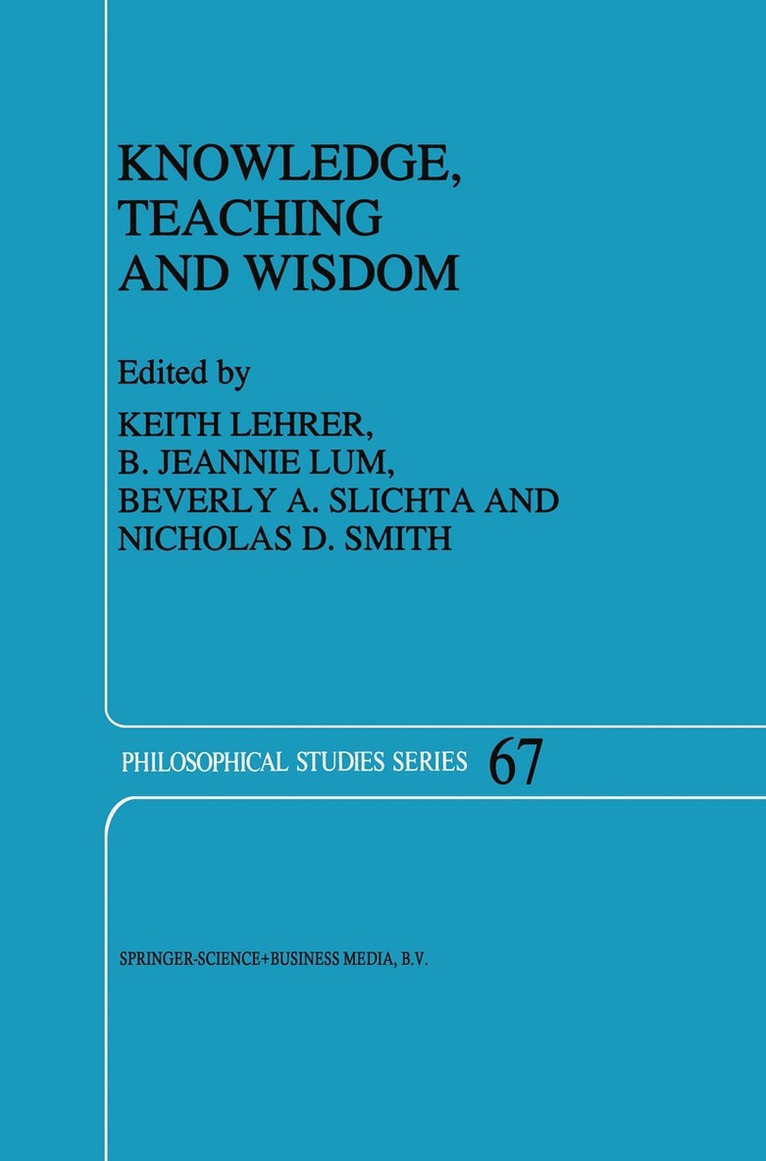
Knowledge, Teaching and Wisdom
Inbunden, Engelska, 1996
1 616 kr
Skickas inom 10-15 vardagar
This book derives from a 1993 National Endowment for the Humanities Summer Institute on Knowledge, Teaching, and Wisdom. The Institute took place at the University of California, Berkeley, and was co-directed by Keith Lehrer and Nicholas D. Smith. The aims of the Institute were several: we sought to reintroduce wisdom as a topic of discussion among contemporary philosophers, to undertake an historical investigation of how and when and why it was that wisdom faded from philosophical view, and to ask how contemporary epistemological theories might apply to the obviously related subjects of teaching and wisdom. In recruiting participants, Lehrer and Smith put the greatest emphasis on those with professional interests in epistemology and the history of philosophy, of the ancient Greeks especially ancient Greek philosophy (because in the writings all three subjects of the Institute were explicitly related and discussed). But in addition to these two groups, some effort was made also to include others, with academic specializations in a variety of fields other than epistemology and the history of philosophy, to ensure that a broad perspective could be achieved in our discussions. To an obvious extent, the papers in this book reflect the recruitment emphases and variety. They also testify to the extent that the Institute managed to bring life to our subjects, and to raise very old questions in a contemporary context.
Del 67 - Philosophical Studies Series
Knowledge, Teaching and Wisdom
Häftad, Engelska, 2010
1 616 kr
Skickas inom 10-15 vardagar
This book derives from a 1993 National Endowment for the Humanities Summer Institute on Knowledge, Teaching, and Wisdom. The Institute took place at the University of California, Berkeley, and was co-directed by Keith Lehrer and Nicholas D. Smith. The aims of the Institute were several: we sought to reintroduce wisdom as a topic of discussion among contemporary philosophers, to undertake an historical investigation of how and when and why it was that wisdom faded from philosophical view, and to ask how contemporary epistemological theories might apply to the obviously related subjects of teaching and wisdom. In recruiting participants, Lehrer and Smith put the greatest emphasis on those with professional interests in epistemology and the history of philosophy, of the ancient Greeks especially ancient Greek philosophy (because in the writings all three subjects of the Institute were explicitly related and discussed). But in addition to these two groups, some effort was made also to include others, with academic specializations in a variety of fields other than epistemology and the history of philosophy, to ensure that a broad perspective could be achieved in our discussions. To an obvious extent, the papers in this book reflect the recruitment emphases and variety. They also testify to the extent that the Institute managed to bring life to our subjects, and to raise very old questions in a contemporary context.
E-bok
PDF, Engelska, 20132 049 kr
Läs direkt efter köp
This book derives from a 1993 National Endowment for the Humanities Summer Institute on Knowledge, Teaching, and Wisdom. The Institute took place at the University of California, Berkeley, and was co-directed by Keith Lehrer and Nicholas D. Smith. The aims of the Institute were several: we sought to reintroduce wisdom as a topic of discussion among contemporary philosophers, to undertake an historical investigation of how and when and why it was that wisdom faded from philosophical view, and to ask how contemporary epistemological theories might apply to the obviously related subjects of teaching and wisdom. In recruiting participants, Lehrer and Smith put the greatest emphasis on those with professional interests in epistemology and the history of philosophy, of the ancient Greeks especially ancient Greek philosophy (because in the writings all three subjects of the Institute were explicitly related and discussed). But in addition to these two groups, some effort was made also to include others, with academic specializations in a variety of fields other than epistemology and the history of philosophy, to ensure that a broad perspective could be achieved in our discussions. To an obvious extent, the papers in this book reflect the recruitment emphases and variety. They also testify to the extent that the Institute managed to bring life to our subjects, and to raise very old questions in a contemporary context.