Boris Gasparov – författare
Visar alla böcker från författaren Boris Gasparov. Handla med fri frakt och snabb leverans.
12 produkter
Beyond Pure Reason
Ferdinand de Saussure's Philosophy of Language and Its Early Romantic Antecedents
Inbunden, 2012
651 kr
Lägg i varukorg
The Swiss linguist Ferdinand de Saussure (1857-1913) revolutionized the study of language, signs, and discourse in the twentieth century. He successfully reconstructed the proto-Indo-European vowel system, advanced a conception of language as a system of arbitrary signs made meaningful through …
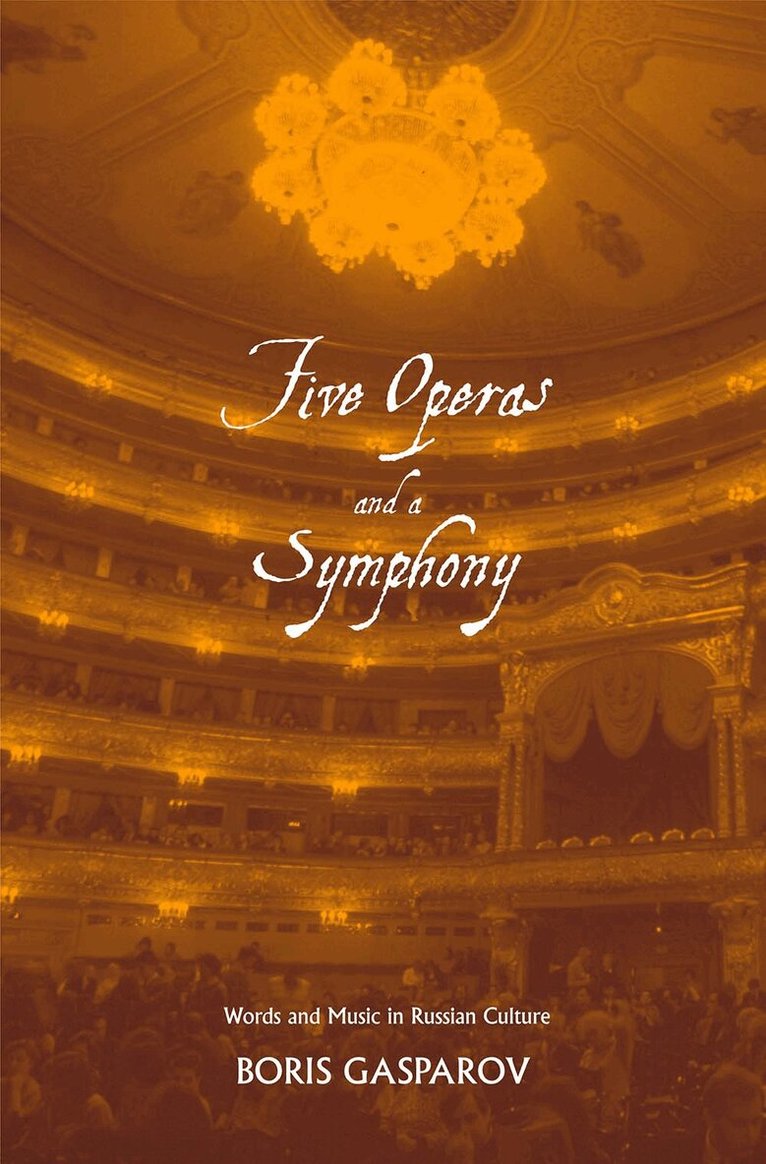
Five Operas and a Symphony
Word and Music in Russian Culture
Inbunden, 2005
884 kr
Lägg i varukorg
In this eagerly anticipated book, Boris Gasparov gazes through the lens of music to find an unusual perspective on Russian cultural and literary history. He discusses six major works of Russian music from the nineteenth and twentieth centuries, showing the interplay of musical texts with their …
Christianity and the Eastern Slavs, Volume I
Slavic Cultures in the Middle Ages
Av Boris Gasparov, Olga Raevsky-Hughes
Häftad, 2018
500 kr
Lägg i varukorg
This publication in three volumes originated in papers delivered at two conferences held in May 1988 at the University of California, Berkeley, and the Kennan Institute for Advanced Russian Studies in Washington, DC. Like many other conferences organized that year in the United States, Europe, and …
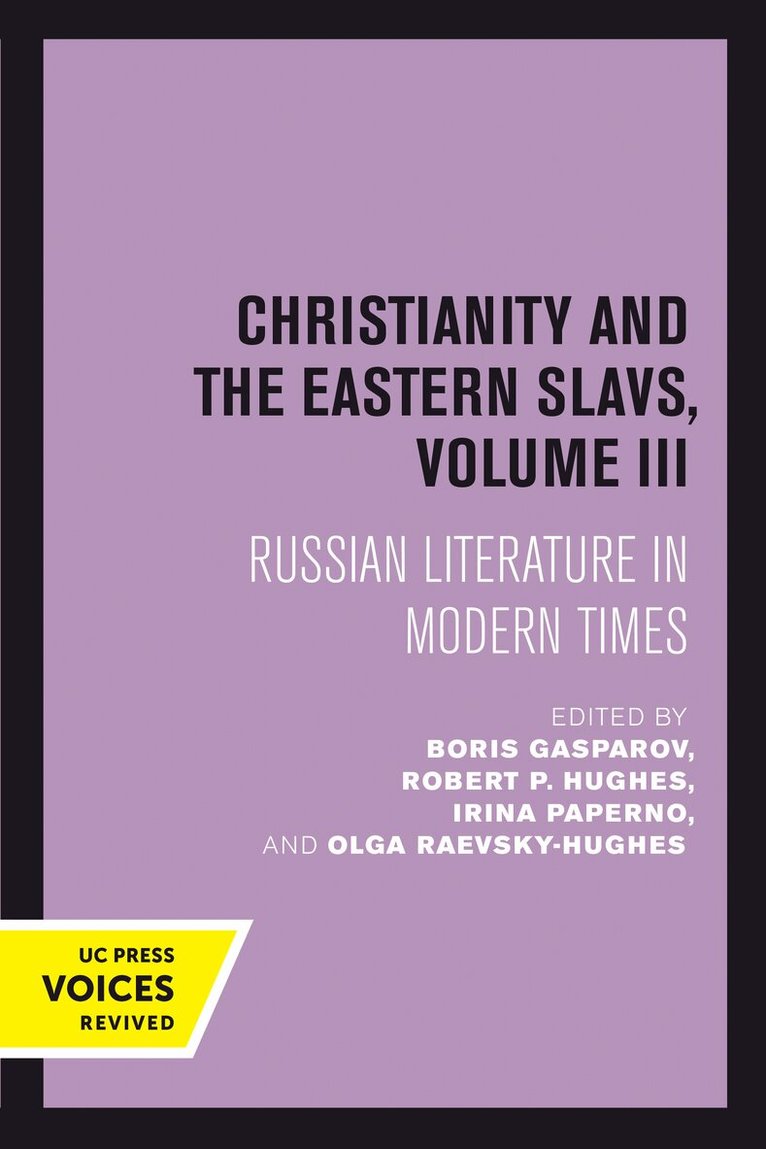
Christianity and the Eastern Slavs, Volume III
Russian Literature in Modern Times
Av Boris Gasparov, Robert P. Hughes m. fl.
Häftad, 2018
402 kr
Lägg i varukorg
This publication in three volumes originated in papers delivered at two conferences held in May 1988 at the University of California, Berkeley, and the Kennan Institute for Advanced Russian Studies in Washington, DC. Like many other conferences organized that year in the United States, Europe, and …
California Slavic Studies, Volume XVI
Slavic Culture in the Middle Ages
Av Boris Gasparov, Olga Raevsky-Hughes
Häftad, 1993
632 kr
Lägg i varukorg
Christianity and the Eastern Slavs, Volume I: Slavic Cultures in the Middle Ages offers an in-depth exploration of the cultural and historical developments of Eastern Slavic societies under the influence of Christianity, starting from the Christianization of Kievan Rus' in 988. Edited by Boris …
California Slavic Studies, Volume XVI
Slavic Culture in the Middle Ages
Av Boris Gasparov, Olga Raevsky-Hughes
Inbunden, 1993
1190 kr
Lägg i varukorg
Christianity and the Eastern Slavs, Volume I: Slavic Cultures in the Middle Ages offers an in-depth exploration of the cultural and historical developments of Eastern Slavic societies under the influence of Christianity, starting from the Christianization of Kievan Rus' in 988. Edited by Boris …
Christianity and the Eastern Slavs, Volume I
Slavic Cultures in the Middle Ages
Av Olga Raevsky-Hughes, Boris Gasparov
E-bok, 2024
347 kr
Lägg i varukorg
This publication in three volumes originated in papers delivered at two conferences held in May 1988 at the University of California, Berkeley, and the Kennan Institute for Advanced Russian Studies in Washington, DC. Like many other conferences organized that year in the United States, Europe, and …
Christianity and the Eastern Slavs, Volume III
Russian Literature in Modern Times
Av Olga Raevsky-Hughes, Irina Paperno m. fl.
E-bok, 2024
399 kr
Lägg i varukorg
This publication in three volumes originated in papers delivered at two conferences held in May 1988 at the University of California, Berkeley, and the Kennan Institute for Advanced Russian Studies in Washington, DC. Like many other conferences organized that year in the United States, Europe, and …
Christianity and the Eastern Slavs, Volume I
Slavic Cultures in the Middle Ages
Av Boris Gasparov, Olga Raevsky-Hughes
Inbunden, 2024
1537 kr
Lägg i varukorg
This publication in three volumes originated in papers delivered at two conferences held in May 1988 at the University of California, Berkeley, and the Kennan Institute for Advanced Russian Studies in Washington, DC. Like many other conferences organized that year in the United States, Europe, and …
Christianity and the Eastern Slavs, Volume III
Russian Literature in Modern Times
Av Boris Gasparov, Robert P. Hughes m. fl.
Inbunden, 2024
1767 kr
Lägg i varukorg
This publication in three volumes originated in papers delivered at two conferences held in May 1988 at the University of California, Berkeley, and the Kennan Institute for Advanced Russian Studies in Washington, DC. Like many other conferences organized that year in the United States, Europe, and …
Speech, Memory, and Meaning
Intertextuality in Everyday Language
Inbunden, 2010
2338 kr
Lägg i varukorg
The book pursues a usage-oriented strategy of language description by infusing it with the central concept of post-structural semiotics and literary theory - that of intertextual memory. Its principal claim is that all new facts of language are grounded in the speakers' memory of previous …
Speech, Memory, and Meaning
Intertextuality in Everyday Language
E-bok, 2010
2416 kr
Lägg i varukorg
The book pursues a usage-oriented strategy of language description by infusing it with the central concept of post-structural semiotics and literary theory - that of intertextual memory. Its principal claim is that all new facts of language are grounded in the speakers'' memory of previous …