Brian Nation – författare
Visar alla böcker från författaren Brian Nation. Handla med fri frakt och snabb leverans.
3 produkter
3 produkter
E-bok
Engelska, 2019110 kr
Läs direkt efter köp
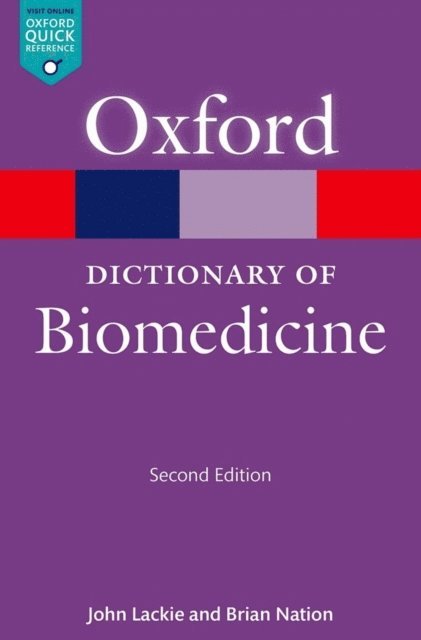
This second edition of A Dictionary of Biomedicine fills the need to define the specialist language used within an evolving field by offering clear, concise definitions of even the most complex biomedical terms. It includes more than 10,000 A-Z entries on all areas of biomedicine, focusing on areas that have developed since the first edition, such as genomics and biomedical science. Entries are authoritative and wide-ranging, covering terms from the related areas of anatomy, genetics, molecular bioscience, pathology, pharmacology, and clinical medicine.Supplementary material includes appendices on the Greek Alphabet, SI Units and single letter codes for Amino Acids. Fully cross-referenced, the dictionary also features useful navigational entries for types of diseases and disorders--for example renal disorders--that list all related entries in the dictionary so the reader can find them quickly.Aimed primarily at molecular bioscientists, clinicians, and students of biomedical courses, the dictionary is also a useful resource for patients and journalists wishing to research a particular disease.
Häftad, Engelska, 2017
736 kr
Skickas inom 5-8 vardagar
Biomedical scientists are the foundation of modern healthcare, from cancer screening to diagnosing HIV, from blood transfusion for surgery to food poisoning and infection control. Without biomedical scientists the diagnosis of disease, the evaluation of the effectiveness of treatment, and research into the causes and cures of disease would not be possible.The Fundamentals of Biomedical Science series has been written to reflect the challenges of practicing biomedical science today. It draws together essential basic science with insights into laboratory practice to show how an understanding of the biology of disease is coupled to the analytical approaches that lead to diagnosis. Assuming only a minimum of prior knowledge, the series reviews the full range of disciplines to which a Biomedical Scientist may be exposed—from microbiology to cytopathology to transfusion science.Histopathology describes the processes and practices that are central to the role of the histopathology biomedical scientist, from presampling to diagnosis to laboratory management. It demonstrates throughout how an understanding of cell and tissue physiology is vital to the successful identification of clinical conditions.
Häftad, Engelska, 2014
838 kr
Skickas
Biomedical scientists are the foundation of modern healthcare, from cancer screening to diagnosing HIV, from blood transfusion for surgery to food poisoning and infection control. Without biomedical scientists, the diagnosis of disease, the evaluation of the effectiveness of treatment, and research into the causes and cures of disease would not be possible.The Fundamentals of Biomedical Science series is written to reflect the challenges of practicing biomedical science today. It draws together essential basic science with insights into laboratory practice to show how an understanding of the biology of disease is coupled to the analytical approaches that lead to diagnosis. Assuming only a minimum of prior knowledge, the series reviews the full range of disciplines to which a Biomedical Scientist may be exposed - from microbiology to cytopathology to transfusion science. Alongside volumes exploring specific biomedical themes and related laboratory diagnosis, an overarching Biomedical Science Practice volume gives a grounding in the professional and experimental skills with which any Biomedical Scientist must be equipped.The series:· Understands the complex roles of Biomedical Scientists in the modern practice of medicine· Understands the development needs of employers and the Profession· Addresses the need for understanding of a range of fundamental sciences in the context of Biomedicine· Places the theoretical aspects of Biomedical Science in their practical contextThe series is developed in partnership with and endorsed by the Institute of Biomedical Science. Visit www.ibms.org for more information.Cell Structure and Function describes the structural and functional features of the various types of cell from which the human body is formed. Focusing on normal cellular structure and function, it gives students and trainees a firm grounding in the appearance and behaviour of healthy cells and tissues on which can be built a robust understanding of cellular pathology. With cell structure and function correlated with clinical contexts throughout, Cell Structure and Function is the ideal introduction to cellular biology for any student of biomedical science.Online Resource CentreThe Online Resource Centre to accompany the Fundamentals of Biomedical Science series features:For registered adopters of the book:· Figures from each book, available to downloadFor students:· An interactive Virtual Microscope, encouraging the exploration of tissue samples· Video podcasts including interviews with practicing biomedical scientists, and 'in the lab' footage showing biomedical science in practice