Brian Otis - Böcker
Visar alla böcker från författaren Brian Otis. Handla med fri frakt och snabb leverans.
4 produkter
4 produkter
1 064 kr
Skickas inom 10-15 vardagar
transconductance e?ciency of all critical devices in order to reduce the n- essary bias current. However, reducing the current density also results in a severely decreased device f . An optimization of the current density is re- T quired to provide the correct balance between transconductance e?ciency and bandwidth. Plots such as Figure 2. 1 are useful tools for designers when choosing appropriate transistor bias points. Technology scaling allows greatly increased f realization for a given IC. Thus, weak inversion biasing for RF T design will become increasingly useful in future technology nodes. Throughout this work, the IC of critical transistors will be discussed. Most of the RF devices are biased in moderate to weak inversion to achieve enhanced transconductance e?ciency and reduced bias current. 2. 2 MEMS Background The relatively new ?eld of Radio Frequency Microelectro Mechanical Systems (RF MEMS) provides unique opportunities for RF transceiver designers. This section provides background on RF MEMS and provides insight into the - portunities presented by these new technologies. The ?eld of RF MEMS - cludes the design and utilization of RF ?lters, resonators, switches, and other passive mechanical structures constructed using bulk processed integrated c- cuit fabrication techniques. To date, these devices have been commercially used as discrete board-mounted components, primarily used to enhance the miniaturization of mobile phones. However, RF MEMS components have the potential to be batch fabricated using existing integrated circuit fabrication techniques.
1 474 kr
Skickas inom 10-15 vardagar
transconductance e?ciency of all critical devices in order to reduce the n- essary bias current. However, reducing the current density also results in a severely decreased device f . An optimization of the current density is re- T quired to provide the correct balance between transconductance e?ciency and bandwidth. Plots such as Figure 2. 1 are useful tools for designers when choosing appropriate transistor bias points. Technology scaling allows greatly increased f realization for a given IC. Thus, weak inversion biasing for RF T design will become increasingly useful in future technology nodes. Throughout this work, the IC of critical transistors will be discussed. Most of the RF devices are biased in moderate to weak inversion to achieve enhanced transconductance e?ciency and reduced bias current. 2. 2 MEMS Background The relatively new ?eld of Radio Frequency Microelectro Mechanical Systems (RF MEMS) provides unique opportunities for RF transceiver designers. This section provides background on RF MEMS and provides insight into the - portunities presented by these new technologies. The ?eld of RF MEMS - cludes the design and utilization of RF ?lters, resonators, switches, and other passive mechanical structures constructed using bulk processed integrated c- cuit fabrication techniques. To date, these devices have been commercially used as discrete board-mounted components, primarily used to enhance the miniaturization of mobile phones. However, RF MEMS components have the potential to be batch fabricated using existing integrated circuit fabrication techniques.
1 064 kr
Skickas inom 10-15 vardagar
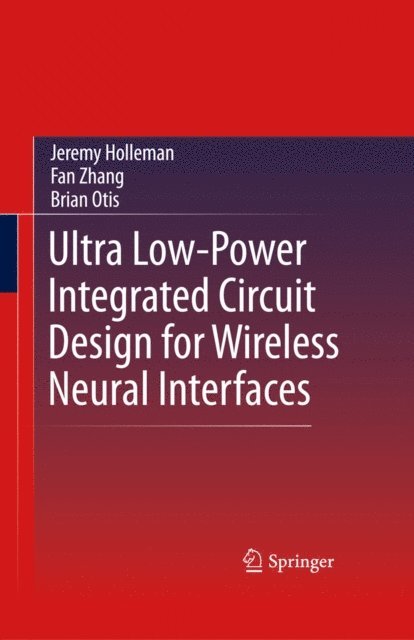
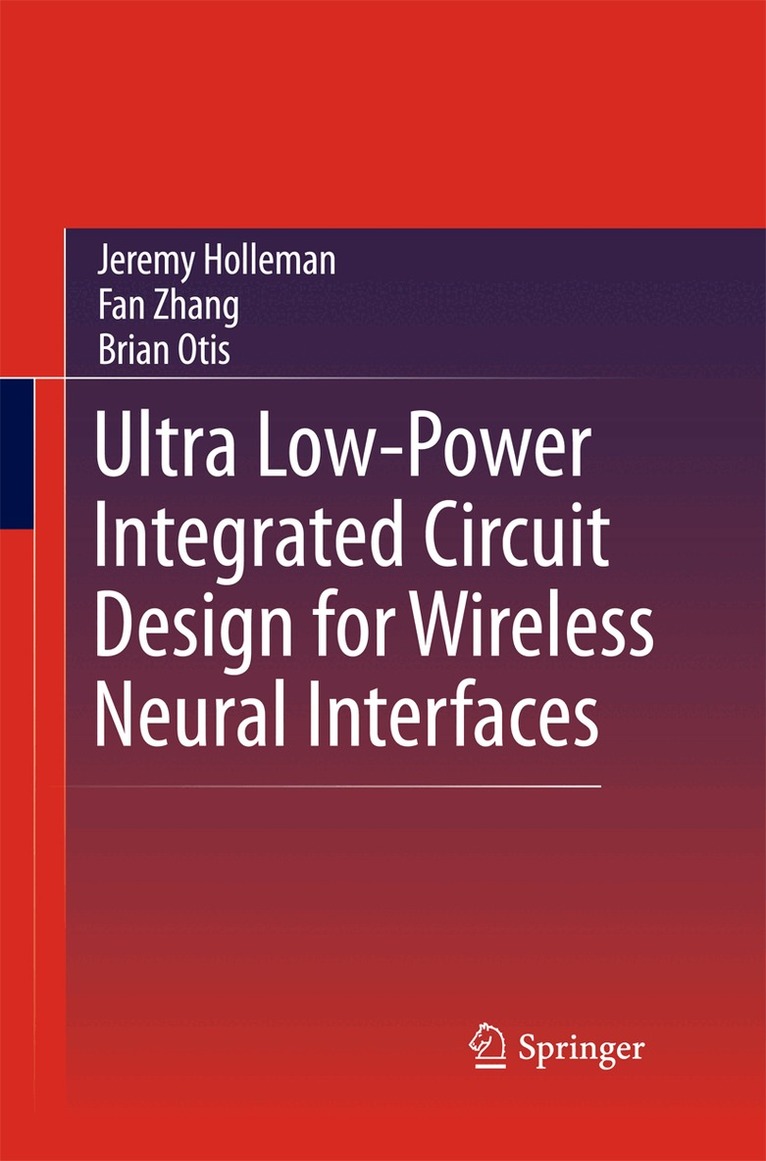
This book will describe ultra low-power, integrated circuits and systems designed for the emerging field of neural signal recording and processing, and wireless communication. Since neural interfaces are typically implanted, their operation is highly energy-constrained. This book introduces concepts and theory that allow circuit operation approaching the fundamental limits. Design examples and measurements of real systems are provided. The book will describe circuit designs for all of the critical components of a neural recording system, including:Amplifiers which utilize new techniques to improve the trade-off between good noise performance and low power consumption.Analog and mixed-signal circuits which implement signal processing tasks specific to the neural recording application:Detection of neural spikes Extraction of features that describe the spikesClustering, a machine learning technique for sorting spikes Weak-inversion operation of analog-domain transistors, allowing processing circuits that reduce the requirements for analog-digital conversion and allow low system-level power consumption. Highly-integrated, sub-mW wireless transmitter designed for the Medical Implant Communications Service (MICS) and ISM bands.
1 192 kr
Skickas inom 10-15 vardagar
This book will describe ultra low-power, integrated circuits and systems designed for the emerging field of neural signal recording and processing, and wireless communication. Since neural interfaces are typically implanted, their operation is highly energy-constrained. This book introduces concepts and theory that allow circuit operation approaching the fundamental limits. Design examples and measurements of real systems are provided. The book will describe circuit designs for all of the critical components of a neural recording system, including:Amplifiers which utilize new techniques to improve the trade-off between good noise performance and low power consumption.Analog and mixed-signal circuits which implement signal processing tasks specific to the neural recording application:Detection of neural spikes Extraction of features that describe the spikesClustering, a machine learning technique for sorting spikes Weak-inversion operation of analog-domain transistors, allowing processing circuits that reduce the requirements for analog-digital conversion and allow low system-level power consumption. Highly-integrated, sub-mW wireless transmitter designed for the Medical Implant Communications Service (MICS) and ISM bands.