Bruno Turnheim - Böcker
Visar alla böcker från författaren Bruno Turnheim. Handla med fri frakt och snabb leverans.
4 produkter
4 produkter
The Great Reconfiguration
A Socio-Technical Analysis of Low-Carbon Transitions in UK Electricity, Heat, and Mobility Systems
Häftad, Engelska, 2022
536 kr
Skickas inom 7-10 vardagar
This book is intended for researchers, policymakers, and practitioners interested in the dynamics and governance of low-carbon transitions. Drawing on the Multi-Level Perspective, it develops a whole system reconfiguration approach that explains how the incorporation of multiple innovations can cumulatively reconfigure existing systems. The book focuses on UK electricity, heat, and mobility systems, and it systematically analyses interactions between radical niche-innovations and existing (sub)systems across techno-economic, policy, and actor dimensions in the past three decades. Comparative analysis explains why the unfolding low-carbon transitions in these three systems vary in speed, scope, and depth. It evaluates to what degree these transitions qualify as Great Reconfigurations and assesses the future potential for, and barriers to, deeper low-carbon system transitions. Generalising across these systems, broader lessons are developed about the roles of incumbent firms, governance and politics, user engagement, wider public, and civil society organisations. This title is also available as Open Access on Cambridge Core.
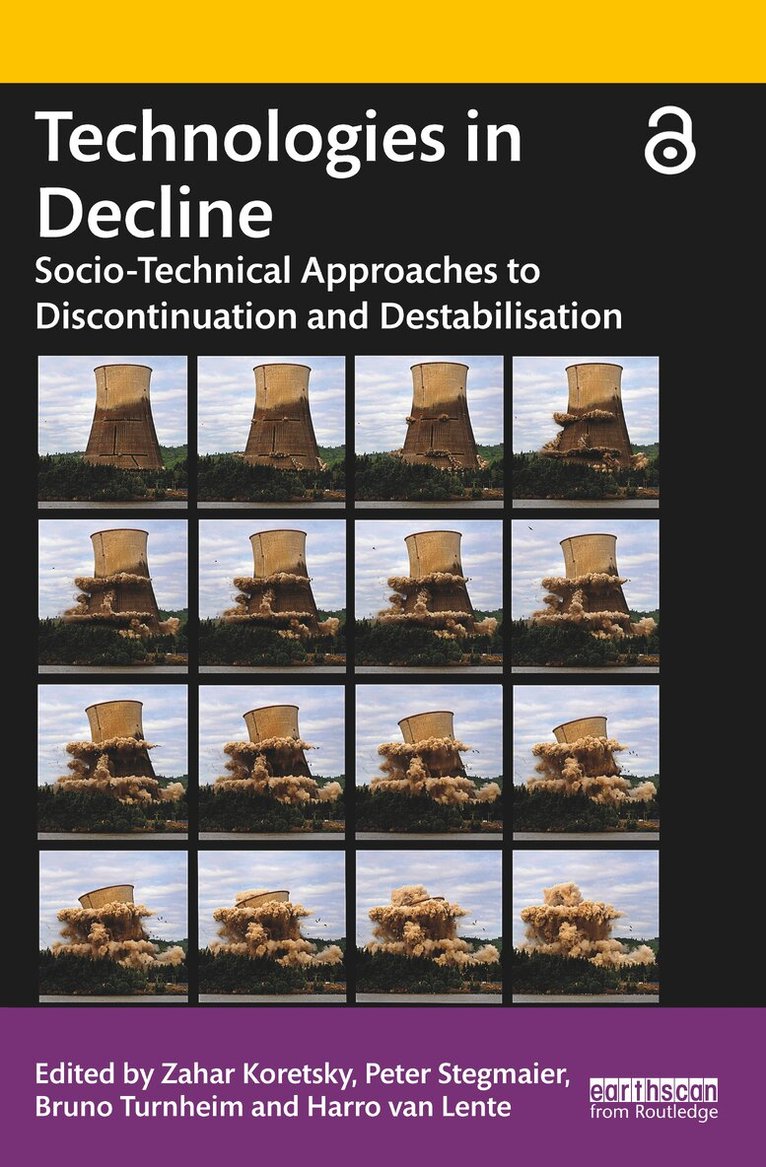
Technologies in Decline
Socio-Technical Approaches to Discontinuation and Destabilisation
Häftad, Engelska, 2022
495 kr
Skickas inom 10-15 vardagar
The central questions of this book are how technologies decline, how societies deal with technologies in decline, and how governance may be explicitly oriented towards parting with ‘undesirable’ technology.Surprisingly, these questions are fairly novel. Thus far, the dominant interest in historical, economic, sociological and political studies of technology has been to understand how novelty emerges, how innovation can open up new opportunities and how such processes may be supported. This innovation bias reflects how in the last centuries modern societies have embraced technology as a vehicle of progress. It is timely, however, to broaden the social study of technology and society: next to considering the rise of technologies, their fall should be addressed, too. Dealing with technologies in decline is an important challenge or our times, as socio-technical systems are increasingly part of the problems of climate change, biodiversity loss, social inequalities and geo-political tensions. This volume presents empirical studies of technologies in decline, as well as conceptual clarifications and theoretical deepening. Technologies in Decline presents an emerging research agenda for the study of technological decline, emphasising the need for a plurality of perspectives.Given that destabilisation and discontinuation are seen as a way to accelerate sustainability transitions, this book will be of interest to academics, students and policy makers researching and working in the areas of sustainability science and policy, economic geography, innovation studies, and science and technology studies.The Open Access version of this book, available at http://www.taylorfrancis.com, has been made available under a Creative Commons [Attribution-Non Commercial-No Derivatives (CC-BY-NC-ND)] 4.0 license.
Technologies in Decline
Socio-Technical Approaches to Discontinuation and Destabilisation
Inbunden, Engelska, 2022
1 886 kr
Skickas inom 10-15 vardagar
The central questions of this book are how technologies decline, how societies deal with technologies in decline, and how governance may be explicitly oriented towards parting with ‘undesirable’ technology.Surprisingly, these questions are fairly novel. Thus far, the dominant interest in historical, economic, sociological and political studies of technology has been to understand how novelty emerges, how innovation can open up new opportunities and how such processes may be supported. This innovation bias reflects how in the last centuries modern societies have embraced technology as a vehicle of progress. It is timely, however, to broaden the social study of technology and society: next to considering the rise of technologies, their fall should be addressed, too. Dealing with technologies in decline is an important challenge or our times, as socio-technical systems are increasingly part of the problems of climate change, biodiversity loss, social inequalities and geo-political tensions. This volume presents empirical studies of technologies in decline, as well as conceptual clarifications and theoretical deepening. Technologies in Decline presents an emerging research agenda for the study of technological decline, emphasising the need for a plurality of perspectives.Given that destabilisation and discontinuation are seen as a way to accelerate sustainability transitions, this book will be of interest to academics, students and policy makers researching and working in the areas of sustainability science and policy, economic geography, innovation studies, and science and technology studies.The Open Access version of this book, available at http://www.taylorfrancis.com, has been made available under a Creative Commons [Attribution-Non Commercial-No Derivatives (CC-BY-NC-ND)] 4.0 license.
1 400 kr
Skickas inom 7-10 vardagar
After the perceived failure of global approaches to tackling climate change, enthusiasm for local climate initiatives has blossomed world-wide, suggesting a more experimental approach to climate governance. Innovating Climate Governance: Moving Beyond Experiments looks critically at climate governance experimentation, focusing on how experimental outcomes become embedded in practices, rules and norms. Policy which encourages local action on climate change, rather than global burden-sharing, suggests a radically different approach to tackling climate issues. This book reflects on what climate governance experiments achieve, as well as what happens after and beyond these experiments. A bottom-up, polycentric approach is analyzed, exploring the outcomes of climate experiments and how they can have broader, transformative effects in society. Contributions offer a wide range of approaches and cover more than fifty empirical cases internationally, making this an ideal resource for academics and practitioners involved in studying, developing and evaluating climate governance.