Carenza Lewis – författare
Visar alla böcker från författaren Carenza Lewis. Handla med fri frakt och snabb leverans.
2 produkter
2 produkter
Häftad, Engelska, 2019
848 kr
Skickas
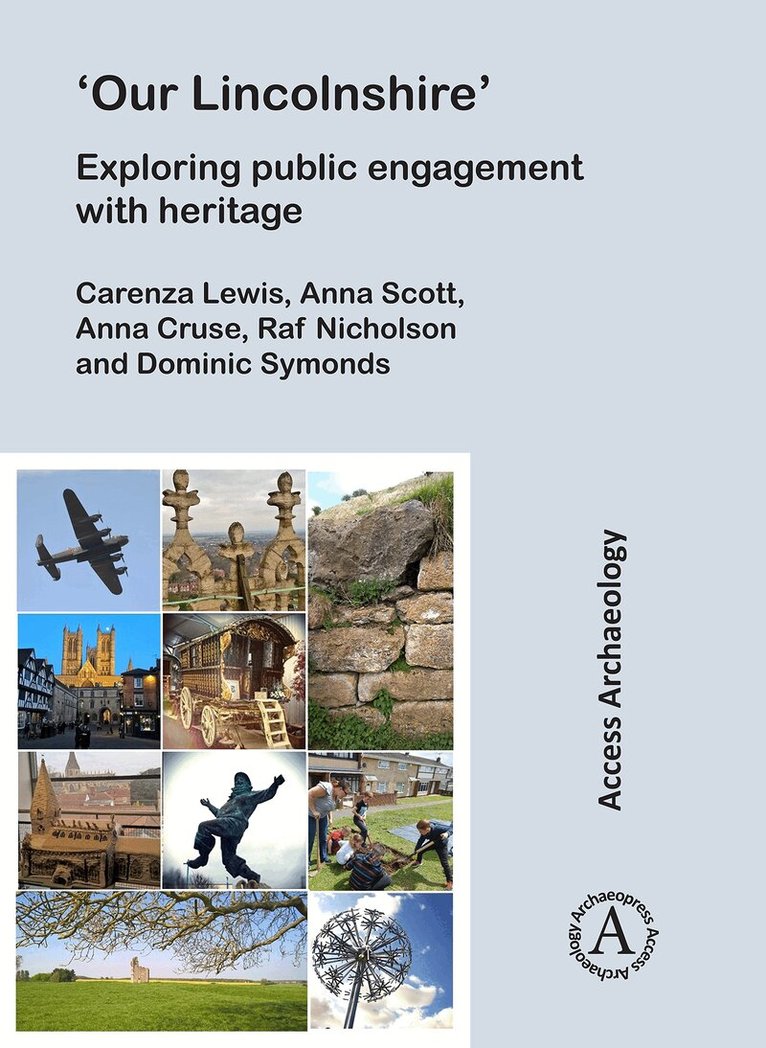
‘Our Lincolnshire’ (2015-16) was devised as a robust, multi-vocally informed exploration of the attitudes of residents and visitors in Lincolnshire to the county’s heritage and the ways in which they engage with it. The context for this was the recognition amongst the county heritage sector of a disconnect between citizens of Lincolnshire and heritage beyond the city of Lincoln which presents challenges when the purpose and function of museums and heritage services need to be reviewed, especially when funding issues are impacting on this process. Understanding attitudes and re-connecting the various audiences in Lincolnshire with their rural heritage in a meaningful and creative way is thus required to ensure the continued collection, curation and presentation of heritage assets is effective in caring for heritage now and for future generations and ensuring the heritage resource reflects, meets and advances the interests, needs and aspirations of Lincolnshire’s residents and visitors today. This volume outlines the methods, data, outcomes and recommendations that generated from this multi-dimensional and innovative research and engagement process.
Häftad, Engelska, 2026
695 kr
Skickas
This volume provides a unique new Europe-wide perspective on the impact of infrastructure‑led archaeology on our knowledge of medieval rural settlement.Across the 5th–16th centuries, most of Europe’s population lived and worked in the countryside, based in villages, hamlets, farms and small towns. Some of these medieval settlements persist today, but many others were abandoned and, over time, erased from memory. Good infrastructure is essential for modern society to function well, but its construction can be immensely destructive of archaeological sites including medieval settlements whose remains are rarely sufficiently monumental to warrant costly redesign to preserve them intact. However, since the adoption across Europe of the ‘polluter pays’ principle obliging developers to fund the identification, investigation and recording for posterity of at-risk archaeological remains, our understanding of the extent and range of medieval settlement remains in the landscape has expanded substantially.The volume explores the paradox that ‘While large‑scale infrastructure projects represent a major challenge for archaeology, they also offer opportunities to expand scientific knowledge’ (Rácz & Sárosi, this volume). Fifteen new reviews by experts in medieval archaeology and heritage management in Austria, Belgium, Bulgaria, Croatia, Czech Republic, Denmark, England, France, Germany, Hungary, Ireland, Italy, Poland, Scotland and Spain consider the impact of discoveries from infrastructure-led archaeology on knowledge of rural settlement in the past, and on archaeological practice today. The volume culminates in a synthesising overview distilling transnational themes and identifying ten key actions shown by experience across these fifteen different states to maximise the knowledge dividend of infrastructure archaeology.This volume is essential reading for anyone interested in the historic countryside, heritage management or impactful archaeological investigation.