Carl de Boor – författare
Visar alla böcker från författaren Carl de Boor. Handla med fri frakt och snabb leverans.
16 produkter
16 produkter
Inbunden, Engelska, 1993
544 kr
Skickas inom 10-15 vardagar
This book on box splines is the first book giving a complete development for any kind of multivariate spline. Box splines give rise to an intriguing and beautiful mathematical theory that is much richer and more intricate than the univariate case because of the complexity of smoothly joining polynomial pieces on polyhedral cells. The purpose of this book is to provide the basic facts about box splines in a cohesive way with simple, complete proofs, many illustrations, and with an up-to-date bibliography. It is not the book's intention to be encyclopedic about the subject, but rather to provide the fundamental knowledge necessary to familiarize graduate students and researchers in analysis, numerical analysis, and engineering with a subject that surely will have as many widespread applications as its univariate predecessor. This book will be used as a supplementary text for graduate courses. The book begins with chapters on box splines defined, linear algebra of box spline spaces, and quasi-interpolants and approximation power. It continues with cardinal interpolation and difference equations, approximation by cardinal splines and wavelets.The book concludes with discrete box splines and linear diophantine equations, and subdivision algorithms.
Del 27 - Applied Mathematical Sciences
Practical Guide to Splines
Inbunden, Engelska, 2001
1 082 kr
Skickas inom 10-15 vardagar
This book is based on the author's experience with calculations involving polynomial splines. It presents those parts of the theory that are especially useful in calculations and stresses the representation of splines as weighted sums of B-splines. This revised edition has been typeset, and all figures have been redrawn. In a major change, the B-spline theory is now developed directly from the recurrence relations without recourse to divided differences. Almost all formal statements are now provided with proofs, and many minor changes have been made throughout, including the correction of errors.
Inbunden, Klassisk grekiska, 2022
492 kr
Skickas inom 5-8 vardagar
Häftad, Klassisk grekiska, 2022
370 kr
Skickas inom 5-8 vardagar
Inbunden, Latin, 2023
345 kr
Skickas inom 5-8 vardagar
Inbunden, Klassisk grekiska, 2023
386 kr
Skickas inom 5-8 vardagar
Häftad, Latin, 2023
193 kr
Skickas inom 5-8 vardagar
Häftad, Klassisk grekiska, 2023
276 kr
Skickas inom 5-8 vardagar
Häftad, Engelska, 2010
544 kr
Skickas inom 10-15 vardagar
This book on box splines is the first book giving a complete development for any kind of multivariate spline. Box splines give rise to an intriguing and beautiful mathematical theory that is much richer and more intricate than the univariate case because of the complexity of smoothly joining polynomial pieces on polyhedral cells. The purpose of this book is to provide the basic facts about box splines in a cohesive way with simple, complete proofs, many illustrations, and with an up-to-date bibliography. It is not the book's intention to be encyclopedic about the subject, but rather to provide the fundamental knowledge necessary to familiarize graduate students and researchers in analysis, numerical analysis, and engineering with a subject that surely will have as many widespread applications as its univariate predecessor. This book will be used as a supplementary text for graduate courses. The book begins with chapters on box splines defined, linear algebra of box spline spaces, and quasi-interpolants and approximation power. It continues with cardinal interpolation and difference equations, approximation by cardinal splines and wavelets.The book concludes with discrete box splines and linear diophantine equations, and subdivision algorithms.
E-bok
PDF, Engelska, 2013687 kr
Läs direkt efter köp
Compactly supported smooth piecewise polynomial functions provide an efficient tool for the approximation of curves and surfaces and other smooth functions of one and several arguments. Since they are locally polynomial, they are easy to evaluate. Since they are smooth, they can be used when smoothness is required, as in the numerical solution of partial differential equations (in the Finite Element method) or the modeling of smooth sur faces (in Computer Aided Geometric Design). Since they are compactly supported, their linear span has the needed flexibility to approximate at all, and the systems to be solved in the construction of approximations are ''banded''. The construction of compactly supported smooth piecewise polynomials becomes ever more difficult as the dimension, s, of their domain G ~ IRs, i. e. , the number of arguments, increases. In the univariate case, there is only one kind of cell in any useful partition, namely, an interval, and its boundary consists of two separated points, across which polynomial pieces would have to be matched as one constructs a smooth piecewise polynomial function. This can be done easily, with the only limitation that the num ber of smoothness conditions across such a breakpoint should not exceed the polynomial degree (since that would force the two joining polynomial pieces to coincide). In particular, on any partition, there are (nontrivial) compactly supported piecewise polynomials of degree ~ k and in C(k-l), of which the univariate B-spline is the most useful example.
E-bok
PDF, Engelska, 2014756 kr
Läs direkt efter köp
Recent Advances in Numerical Analysis provides information pertinent to the developments in numerical analysis. This book covers a variety of topics, including positive functions, Sobolev spaces, computing paths, partial differential equations, and perturbation theory. Organized into 12 chapters, this book begins with an overview of stability conditions for numerical methods that can be expressed in the form that some associated function is positive. This text then examines the polynomial approximation theory having applications to finite element Galerkin methods. Other chapters consider the numerical condition of polynomials by examining three particular problem areas, namely, the representation of polynomials, algebraic equations, and the problem of orthogonalization. This book discusses as well a general theory that leads to a systematic way to prepare the initial data. The final chapter deals with the derivation of the Kronecker canonical form. This book is a valuable resource for applied mathematicians, numerical analysts, physicists, engineers, and research workers.
E-bok
PDF, Engelska, 2014756 kr
Läs direkt efter köp
Mathematical Aspects of Finite Elements in Partial Differential Equations addresses the mathematical questions raised by the use of finite elements in the numerical solution of partial differential equations. This book covers a variety of topics, including finite element method, hyperbolic partial differential equation, and problems with interfaces. Organized into 13 chapters, this book begins with an overview of the class of finite element subspaces with numerical examples. This text then presents as models the Dirichlet problem for the potential and bipotential operator and discusses the question of non-conforming elements using the classical Ritz- and least-squares-method. Other chapters consider some error estimates for the Galerkin problem by such energy considerations. This book discusses as well the spatial discretization of problem and presents the Galerkin method for ordinary differential equations using polynomials of degree k. The final chapter deals with the continuous-time Galerkin method for the heat equation. This book is a valuable resource for mathematicians.
Häftad, Engelska, 2018
946 kr
Skickas inom 5-8 vardagar
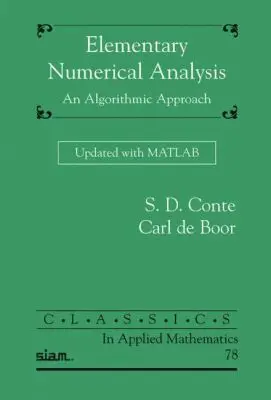
This book provides a thorough and careful introduction to the theory and practice of scientific computing at an elementary, yet rigorous, level, from theory via examples and algorithms to computer programs. The original FORTRAN programs have been rewritten in MATLAB and now appear in a new appendix and online, offering a modernized version of this classic reference for basic numerical algorithms.
E-bok
PDF, Engelska, 2012677 kr
Läs direkt efter köp
Häftad, Tyska, 2016
361 kr
Skickas inom 5-8 vardagar
Häftad, Engelska, 1990
537 kr
Skickas inom 10-15 vardagar
Der Begriff der Splinefunktionen wurde von I. J. Schoenberg 1946 eingefUhrt. "Spline" ist der Name eines Zeichengerates, welches auf mechanischem Weg Interpolatio- aufgaben lost. Dieses Gerat besteht aus einer flexiblen, oft mehrere Meter langen Latte, die auf dem Zeichenbrett aufliegt und dort an bestimmten Stellen durch Gewichte festgehalten wird. Die Form, die die Latte annimmt, hangt von den Elastizitatseigenschaften der Latte abo -, " , , , , , , \ , \ \ I , , , ," -"', , , , , J::>----" , I I , I I I , , , , , , , , , , , " ) Fig. 1: Latteninterpo1ation Po1ynominterpo1ation _ - - - - - - - --0 Wir konnen natUrlich versuchen, ein mathematisches Modell fUr dieses mechanische Zeichengerat zu machen, d. h. die Gestalt solcher Kurven mathematisch zu erfassen. - 2 - Die Theorie der Balkenbiegung verlangt, dass die mittlere 2 K quadratische KrUmmung, ("strain energy", Spannungs- J energie) minimiert wird.Lasst sich die Kurve als Graph einer Funktion f auf dem Intervall [a,b] schreiben, so erhalt man mit dem bekannten Ausdruck fUr die Krlimmung K [f" (t) P --------------dt ~ min (1) t [1 +f' (t)2J5/2 a Statt dieses schwierige Extremalproblem zu losen, begnUgt man sich damit, (2) zu minimieren. Die Extremalfunktion fUr das Funktional (2) ist stUckweise ein kubisches Polynom; die Polyn- stUcke gehen an den Bruchstellen so glatt ineinander Uber, dass die Funktion zweimal stetig differenzierbar ist.