Carlo Ratti - Böcker
Visar alla böcker från författaren Carlo Ratti. Handla med fri frakt och snabb leverans.
6 produkter
6 produkter
179 kr
Skickas inom 7-10 vardagar
An internationally renowned architect, urban planner, and scholar describes the major technological forces driving the future of citiesSince cities emerged ten thousand years ago, they have become one of the most impressive artifacts of humanity. But their evolution has been anything but linear—cities have gone through moments of radical change, turning points that redefine their very essence. In this book, a renowned architect and urban planner who studies the intersection of cities and technology argues that we are in such a moment. The authors explain some of the forces behind urban change and offer new visions of the many possibilities for tomorrow’s city. Pervasive digital systems that layer our cities are transforming urban life. The authors provide a front-row seat to this change. Their work at the MIT Senseable City Laboratory allows experimentation and implementation of a variety of urban initiatives and concepts, from assistive condition-monitoring bicycles to trash with embedded tracking sensors, from mobility to energy, from participation to production. They call for a new approach to envisioning cities: futurecraft, a symbiotic development of urban ideas by designers and the public. With such participation, we can collectively imagine, examine, choose, and shape the most desirable future of our cities.
331 kr
Skickas inom 7-10 vardagar
A fascinating exploration of how the growth of digital mapping, spurred by sensing technologies, is affecting cities and daily lives What have smart technologies taught us about cities? What lessons can we learn from today’s urbanites to make better places to live? Antoine Picon and Carlo Ratti argue that the answers are in the maps we make. For centuries, we have relied on maps to navigate the enormity of the city. Now, as the physical world combines with the digital world, we need a new generation of maps to navigate the city of tomorrow. Pervasive sensors allow anyone to visualize cities in entirely new ways—ebbs and flows of pollution, traffic, and internet connectivity. This book explores how the growth of digital mapping, spurred by sensing technologies, is affecting cities and daily lives. It examines how new cartographic possibilities aid urban planners, technicians, politicians, and administrators; how digitally mapped cities could reveal ways to make cities smarter and more efficient; how monitoring urbanites has political and social repercussions; and how the proliferation of open-source maps and collaborative platforms can aid activists and vulnerable populations. With its beautiful, accessible presentation of cutting-edge research, this book makes it easy for readers to understand the stakes of the new information age—and appreciate the timeless power of the city.
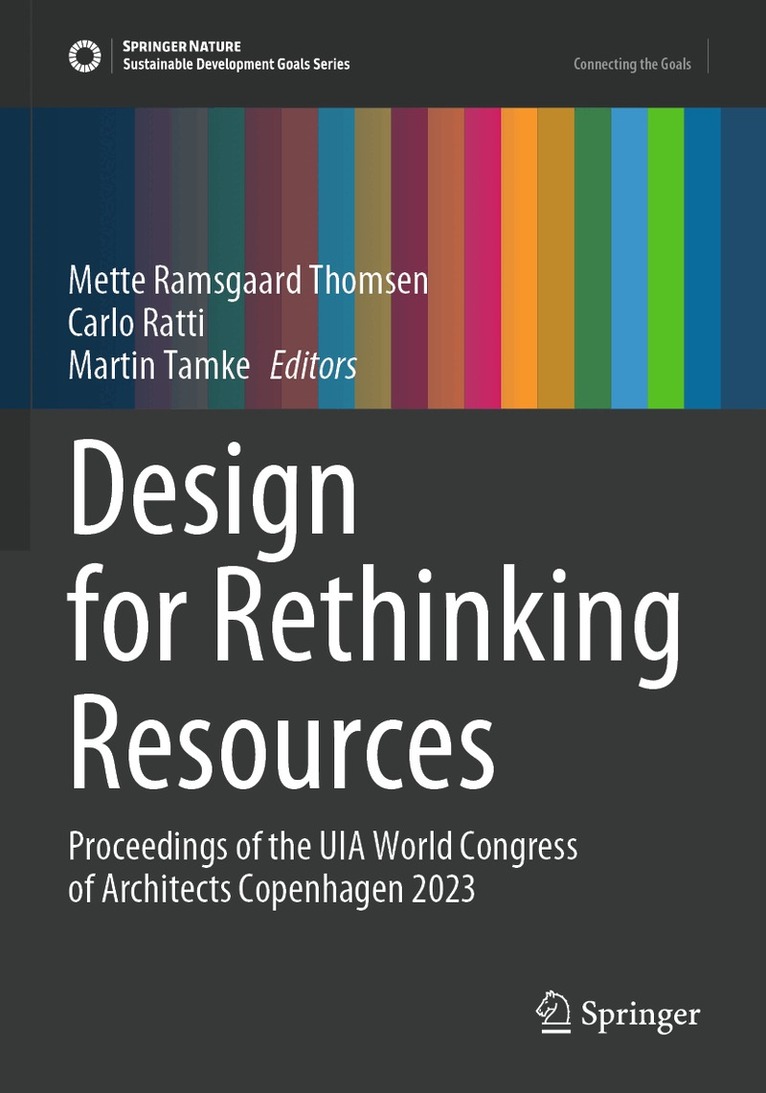
Design for Rethinking Resources
Proceedings of the UIA World Congress of Architects Copenhagen 2023
Inbunden, Engelska, 2023
3 761 kr
Skickas inom 7-10 vardagar
The book provides new perspectives from leading researchers accentuating and examining the central role of the built environment in conceiving and implementing multifaceted solutions for the complex challenges of our understanding of planetary resources and circularity, revealing critical potentials for architecture and design to contribute in more informed and long-term ways to the urgent transition of our society. The book offers a compilation of peer-reviewed papers that uniquely connects knowledge broadly across practice and academia; from the newest technologies and methods such as the role of digital modelling, analysis, and fabrication in circular design, i.e. material passports, cyber-physical augmentation, and LCA to the potentials of growing and harvesting biomass materials, engaging waste streams in material production and more, all in context of economic, social, and ecological potentials and consequences. The book is part of a series of six volumes that explore the agency of the built environment in relation to the SDGs through new research conducted by leading researchers. The series is led by editors Mette Ramsgaard Thomsen and Martin Tamke in collaboration with the theme editors: - Design for Climate Adaptation: Billie Faircloth and Maibritt Pedersen Zari- Design for Rethinking Resources: Carlo Ratti and Mette Ramsgaard Thomsen (Eds.)- Design for Resilient Communities: Anna Rubbo and Juan Du (Eds.)- Design for Health: Arif Hasan and Christian Benimana (Eds.)- Design for Inclusivity: Magda Mostafa and Ruth Baumeister (Eds.)- Design for Partnerships for Change: Sandi Hilal and Merve Bedir (Eds.)
Design for Rethinking Resources
Proceedings of the UIA World Congress of Architects Copenhagen 2023
Häftad, Engelska, 2024
3 761 kr
Skickas inom 10-15 vardagar
The book provides new perspectives from leading researchers accentuating and examining the central role of the built environment in conceiving and implementing multifaceted solutions for the complex challenges of our understanding of planetary resources and circularity, revealing critical potentials for architecture and design to contribute in more informed and long-term ways to the urgent transition of our society. The book offers a compilation of peer-reviewed papers that uniquely connects knowledge broadly across practice and academia; from the newest technologies and methods such as the role of digital modelling, analysis, and fabrication in circular design, i.e. material passports, cyber-physical augmentation, and LCA to the potentials of growing and harvesting biomass materials, engaging waste streams in material production and more, all in context of economic, social, and ecological potentials and consequences. The book is part of a series of six volumes that explore the agency of the built environment in relation to the SDGs through new research conducted by leading researchers. The series is led by editors Mette Ramsgaard Thomsen and Martin Tamke in collaboration with the theme editors: - Design for Climate Adaptation: Billie Faircloth and Maibritt Pedersen Zari- Design for Rethinking Resources: Carlo Ratti and Mette Ramsgaard Thomsen (Eds.)- Design for Resilient Communities: Anna Rubbo and Juan Du (Eds.)- Design for Health: Arif Hasan and Christian Benimana (Eds.)- Design for Inclusivity: Magda Mostafa and Ruth Baumeister (Eds.)- Design for Partnerships for Change: Sandi Hilal and Merve Bedir (Eds.)
738 kr
Skickas inom 3-6 vardagar
Hello, Robot. Design Between Human and Machine investigates how robotics is becoming part of our everyday lives. The exhibitions shows that design in its traditional function as a mediator is indispensable if robots are to become a visible reality and not just remain hidden in washing machines, cars and cash machines. The volume clarifies where we already encounter these intelligent machines and where we may come across them in the near future: in industry, in the military and in everyday settings; at nurseries and retirement homes; in our bodies and in the cloud; when shopping and having sex; in video games and, of course, in film and literature. In a series of in-depth essays and interviews, experts such as the science fiction author Bruce Sterling and the design duo Dunne & Raby explore the question of how we deal with our environment becoming increasingly digital, smarter and more autonomous. They highlight our often ambivalent relationship to new technologies and discuss the opportunities and challenges that are posed to us as individuals and as a society in this context. In this regard, Hello, Robot. broadens the scope of the discussion to the ethical and political questions with which we are faced today in the light of technological advances in robotics, whilst confronting us with the contradictions that are often found in the answers to these questions.
870 kr
Skickas inom 3-6 vardagar
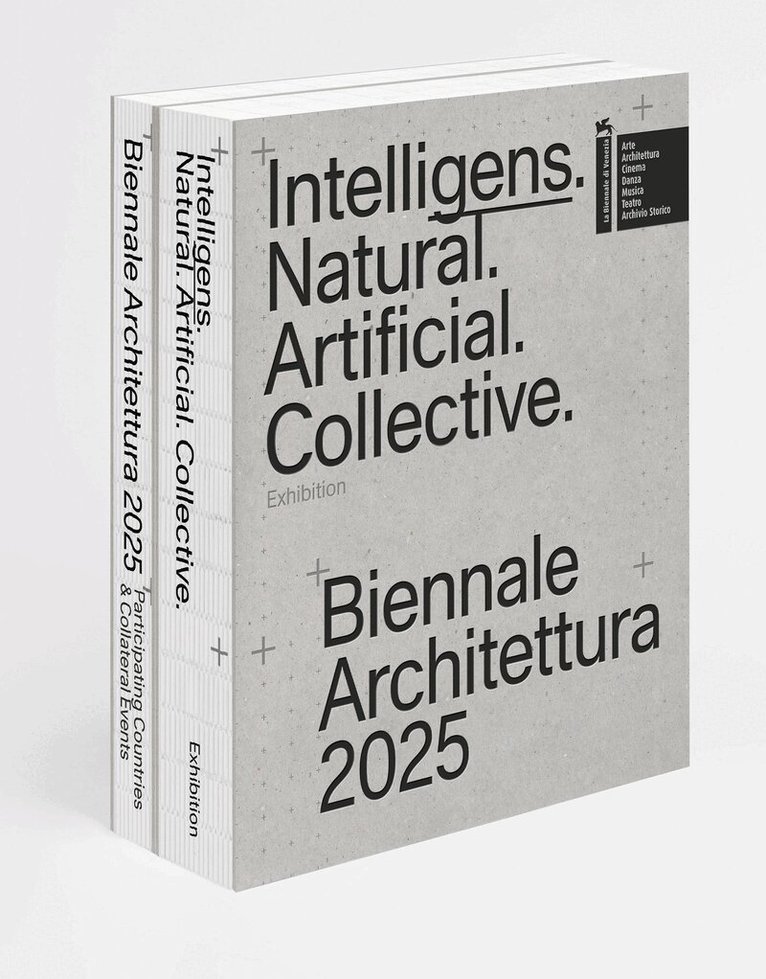
The 19th International Architecture Exhibition, curated by Carlo Ratti, to be held from 10 May to 23 November 2025 in Venice, is titled Intelligens. Natural. Artificial. Collective. The Exhibition, as the Curator himself explains, “will search for a path forward, proposing that intelligent solutions to pressing problems can take many forms” and “will present a collection of design proposals and many other experiments, exploring a definition of ‘intelligence’ as an ability to adapt to the environment with limited resources, knowledge, or power” (Carlo Ratti).The Catalogue is printed in two volumes and follows the Exhibition itinerary accompanying visitors and art lovers through the exhibition spaces of the Giardini and the Arsenale and presenting other projects on display in various locations around the city of Venice and Forte Marghera, in Mestre.Volume I of the Catalogue is dedicated to the International Exhibition, curated by Carlo Ratti. The first pages of the volume open with the statement by President Pietrangelo Buttafuoco and the presentation by the Artistic Director of the Architecture Department Carlo Ratti, and then presents the Circularity Manifesto. Volume I is then divided into two parts. Part one, titled Intelligens, is dedicated to presenting the sections of the International Exhibition, Natural Intelligence, Artificial Intelligence, Collective Intelligence, and Out. Each project on display in the Exhibition is accompanied by a critical text and a rich apparatus of photographs. Part two of the volume, titled Venice as a Living Lab, presents “a number of special projects that will leverage Venice and the outdoor areas of the Biennale Exhibition venues as a Living Lab, merging interacting forms of intelligence”. The volume is enriched with a series of critical essays and interesting “Impossible Conversations” that explore the themes of the Exhibition in depth. Volume I ends with the biographies of the participants and a detailed register of the projects on exhibit.The National Participations and the Collateral Events participating in the 19th International Architecture Exhibition are gathered in Volume II and presented with illustrated texts that explore the projects proposed by the National Pavilions and the Collateral Events at the Giardini, the Arsenale and in various spaces throughout Venice.