Carlo Trigilia – författare
Visar alla böcker från författaren Carlo Trigilia. Handla med fri frakt och snabb leverans.
5 produkter
5 produkter
1 141 kr
Skickas inom 3-6 vardagar
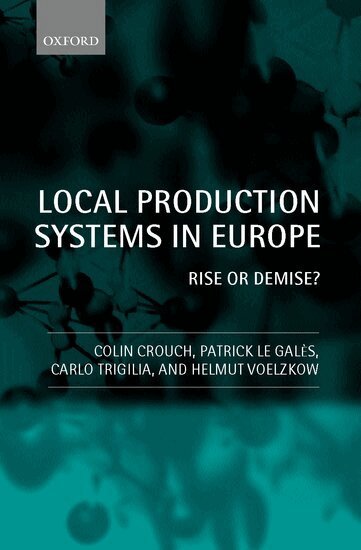
This is the first book to present a systematic analysis of specialized clusters of small manufacturing enterprises in the main European economies. Combining knowledge from case-study literature with original analyses of statistical data enables the authors to present full accounts of the role of these clusters in Britain, France, Germany, and Italy, showing the considerable diversity of forms they take.Local production systems (as these clusters are termed) are seen to exist where there are either particular competitive advantages for participation by clusters of small and medium-sized, as opposed to large, firms, or where such clusters at least stand as good a chance as large firms. Small firms may work through a diversity of forms of governance: certain forms of market; cooperation among themselves; through associations; with larger firms located in the same area; or by making use of local facilities provided by governmental or other external agencies - or a combination of all five.The introduction shows how previous literature has been divided into two strands. First came optimistic, mainly 1980s, writings, which assumed that the search for flexibility and quality, typical of post-Fordist models of economic organization, would enhance the role of SMEs. In the ensuing decade, a more pessimistic analysis was put forward. It was argued that the increasing globalization of the economy would bring about a demise of local production systems, under pressure from new global large firms. The authors discuss the possibility of more nuanced findings, and propose a combination of the literature on local production systems with theories of economic governance to assist this process.There follows a chapter which surveys overall economic development in the four countries, concentrating on local economies. Then four national surveys take up the theme of the governance of local production systems in Italy, Germany, France, and Britain. A concluding chapter identifies a diversity of forms of clusters of small firms, and on that basis develops a sociological critique of current neo-institutionalist theories of markets.Local production systems are found to be growing, not declining, in importance, as they facilitate the circulation of tacit knowledge - a precious resource in all sectors which depend on both constant innovation and the flexibility of small enterprises. However, the most rapidly growing form of these systems is that where groups of small suppliers depend on a major customer firm - a form that in the long run might undermine the autonomous capacities of local small-firm systems.
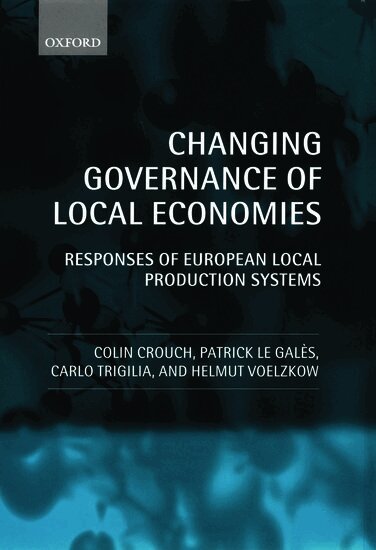
Changing Governance of Local Economies
Responses of European Local Production Systems
Inbunden, Engelska, 2004
1 386 kr
Skickas inom 3-6 vardagar
This book examines patterns of economic governance in three specific, contrasting, contexts: machinery-producing districts; declining steel cities; and clusters of high-technology activities. Building on the work of their previous book (Local Production Systems in Europe: Rise or Demise? OUP 2001), which charted the recent development of local clusters of specialized manufacturing among small and medium-sized enterprises (SMEs) in France, Germany, Italy, and the United Kingdom, the authors find patterns of economic governance far more complex and dynamic than usually described in a literature which insists on identifying simple national approaches.The machinery industries were often identified in the literature of the 1980s as prominent cases of industrial district formation, which were then considerably weakened by the crises of the mid-1990s. Did clustering help these industries and their associated districts to respond to challenge, or only weaken them further? The case studies focus on the Bologna and Modena area of Emilia-Romagna, Stuttgart in Baden-Württemberg, Birmingham and Coventry in the English west midlands, but generally in France where there are very few local concentrations. Even while some thought local production systems were in crisis, national governments and the European Commission continued to recommend their approach to areas experiencing economic decline. This was particularly the case for cities that had been dependent on a small number of large corporations in industries that would no longer be major employers. Political and business leaders in these areas were encouraged to diversify, in particular through SMEs. Could this be done in response to external pressure, given that successful local production systems depend on endogenous vitality? The authors ask these questions of former steel-producing cities St. Etienne, Duisburg, Piombino, and Sheffield.The idea that local production systems had had their day was challenged by clear evidence of clustering among SMEs in a number of flourishing high-tech industries in parts of the USA and western Europe. Why do scientists, other specialists and firms actively embedded in global networks, bother with geographical proximity? This question is addressed by examining the software firms at Grenoble, the mass media cluster in Cologne, the information technology sector around Pisa, and the Oxfordshire biotechnology region.
507 kr
Skickas inom 7-10 vardagar
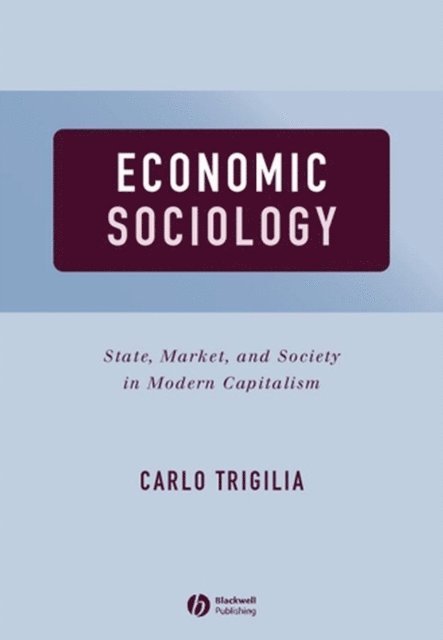
This book systematically reconstructs the origins and new advances in economic sociology. By presenting both classical and contemporary theory and research, the volume identifies and describes the continuity between past and present, and the move from economics to economic sociology. Most comprehensive and up-to-date overview available by an internationally renowned, award-winning economic sociologistSystematically reconstructs the origins and new advances in economic sociologyOrganizes the perspectives and methods of economic sociologists of the classical and contemporary eras, including coverage of modernization, globalization, and the welfare stateProvides insights into the social consequences of capitalism in the past and present for students of economic sociology.
1 966 kr
Skickas inom 10-15 vardagar
This book examines steadily-growing increases in inequality within Western capitalist democracies, examining with care the differences between these democracies rooted in their culture and institutions.It highlights the differences in growth and inequalities between different countries, pointing to the role of endogenous institutions that affect social inequalities as well as the relationship between redistribution and economic growth. The book presents extensive comparative research on institutional factors such as industrial relations, welfare systems, training and innovation policies.Paying attention to diverse types of democracies and to the main features of left-wing parties, the book highlights the importance of politics, and of different types of democracies, in shaping social inequalities and diverse development paths. It will appeal to students and scholars interested in economic and labour sociology, welfare studies, comparative political economy, comparative welfare, varieties of capitalism, and comparative politics.The Open Access version of this book, available at www.taylorfrancis.com, has been made available under a Creative Commons Attribution- Non Commercial-No Derivatives 4.0 license.
595 kr
Skickas inom 10-15 vardagar
This book examines steadily-growing increases in inequality within Western capitalist democracies, examining with care the differences between these democracies rooted in their culture and institutions.It highlights the differences in growth and inequalities between different countries, pointing to the role of endogenous institutions that affect social inequalities as well as the relationship between redistribution and economic growth. The book presents extensive comparative research on institutional factors such as industrial relations, welfare systems, training and innovation policies.Paying attention to diverse types of democracies and to the main features of left-wing parties, the book highlights the importance of politics, and of different types of democracies, in shaping social inequalities and diverse development paths. It will appeal to students and scholars interested in economic and labour sociology, welfare studies, comparative political economy, comparative welfare, varieties of capitalism, and comparative politics.The Open Access version of this book, available at www.taylorfrancis.com, has been made available under a Creative Commons Attribution- Non Commercial-No Derivatives 4.0 license.