• Fri frakt över 249 kr
  • •
  • Snabba leveranser
  • •
  • Billiga böcker
Kundservice

Du är på sajten för privatpersoner.

Företag, bibliotek eller offentlig verksamhet?

Du handlar på classic.bokus.com, där alla dina funktioner finns intakta.
Till classic.bokus.com
Bokus logotyp. Gå till startsidan.
  • Erbjudanden
  • Nyheter
  • Student
  • Topplistor
  • Barn & ungdom
  • Bokus Play
  • E-böcker
  • Pocketböcker
  • Spel & pussel

10% rabatt på allt med kod: NYSTART10 →

Sidfot

Mina sidor

    Hjälp

    • Kundservice
    • Vanliga frågor och svar
    • Frakt och leverans
    • Retur vid ångerrätt
    • Reklamera vara
    • Betalning
    • Köpvillkor
    • Allmänna villkor
    • Information om webbplatsens tillgänglighet

    Om Bokus

    • Om oss
    • Pressrum
    • För studenter
    • För företag
    • För bibliotek och offentlig verksamhet
    • För leverantörer
    • Hållbarhet

    Populärt

    • Aktuella erbjudanden
    • Presentkort
    • Studentlitteratur
    • Nya böcker
    • Topplistor
    • Signerade böcker
    • Engelska böcker

    Inspiration

    • Boktips
    • BookTok
    • Populära bokserier
    • Barnbokskaraktärer
    • Populära författare
    Logotyp för Bokus
    Följ oss på Facebook (extern länk)Följ oss på Instagram (extern länk)Följ oss på YouTube (extern länk)Följ oss på TikTok (extern länk)
    bokus @ CookiesAnpassa cookiesIntegritetspolicyKöpvillkor
    Till Citymail hemsida (extern länk)Till Budbee hemsida (extern länk)Till Postnord hemsida (extern länk)Till Schenker hemsida (extern länk)Till Early Bird hemsida (extern länk)Till Walleys hemsida (extern länk)
    1. Ekonomi och Ledarskap
    2. Nationalekonomi
    3. Ekonomiska system

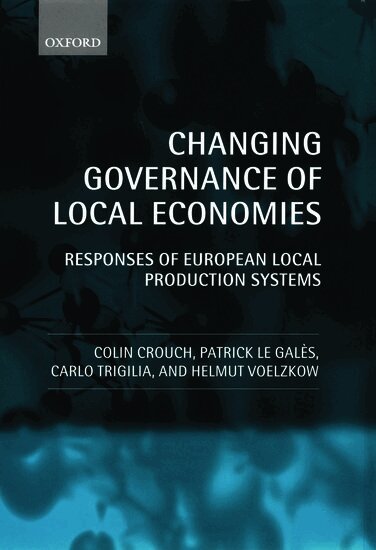
    Changing Governance of Local Economies

    Responses of European Local Production Systems

    AvColin Crouch,Patrick Le Galès

    Inbunden, Engelska, 2004

    1 346 kr

    Beställningsvara. Skickas inom 5-8 vardagar. Fri frakt över 249 kr.

    Beskrivning

    This book examines patterns of economic governance in three specific, contrasting, contexts: machinery-producing districts; declining steel cities; and clusters of high-technology activities. Building on the work of their previous book (Local Production Systems in Europe: Rise or Demise? OUP 2001), which charted the recent development of local clusters of specialized manufacturing among small and medium-sized enterprises (SMEs) in France, Germany, Italy, and the United Kingdom, the authors find patterns of economic governance far more complex and dynamic than usually described in a literature which insists on identifying simple national approaches.The machinery industries were often identified in the literature of the 1980s as prominent cases of industrial district formation, which were then considerably weakened by the crises of the mid-1990s. Did clustering help these industries and their associated districts to respond to challenge, or only weaken them further? The case studies focus on the Bologna and Modena area of Emilia-Romagna, Stuttgart in Baden-Württemberg, Birmingham and Coventry in the English west midlands, but generally in France where there are very few local concentrations. Even while some thought local production systems were in crisis, national governments and the European Commission continued to recommend their approach to areas experiencing economic decline. This was particularly the case for cities that had been dependent on a small number of large corporations in industries that would no longer be major employers. Political and business leaders in these areas were encouraged to diversify, in particular through SMEs. Could this be done in response to external pressure, given that successful local production systems depend on endogenous vitality? The authors ask these questions of former steel-producing cities St. Etienne, Duisburg, Piombino, and Sheffield.The idea that local production systems had had their day was challenged by clear evidence of clustering among SMEs in a number of flourishing high-tech industries in parts of the USA and western Europe. Why do scientists, other specialists and firms actively embedded in global networks, bother with geographical proximity? This question is addressed by examining the software firms at Grenoble, the mass media cluster in Cologne, the information technology sector around Pisa, and the Oxfordshire biotechnology region.

    Produktinformation

    • Utgivningsdatum:2004-02-26
    • Mått:162 x 242 x 25 mm
    • Vikt:692 g
    • Format:Inbunden
    • Språk:Engelska
    • Antal sidor:392
    • Förlag:OUP OXFORD
    • ISBN:9780199259403

    Utforska kategorier

    • Ekonomiska system inom Ekonomi och Ledarskap
    • Geografi inom Naturvetenskap och teknik
    • Statsskick och politiska processer inom Samhälle och politik

    Mer om författaren

    Colin Crouch is currently head of the department of social and political sciences and professor of sociology at the European University Institute, Florence. He is chairman, and former joint editor, of The Political Quarterly, and chairman-elect of the Society for the Advancement of Socio-Economics (SASE). He is also the External Scientific member of the Max-Planck-Institute for Social Research at Cologne. He has published within the fields of comparative European sociology and industrial relations, on economic sociology, and on contemporary issues in British and European politics. He is currently studying processes of institutional innovation in the economy and in public policy, in an approach critical of recent deterministic tendencies in neo-institutionalist theoriesPatrick Le Galès is a CNRS Research Professor in Sociology and Politics at CEVIPOF/Sciences Po, Paris, where he teaches. He has been a visitor at Nuffield College, Oxford, and the Maison Française, Oxford. He edits the International Journal of Urban and Regional Research. His recent work includes Les Économies Politiques du Capitalisme (with B. Palier, 2002) and European Cities: Social Conflicts and Governance (OUP 2002).Carlo Trigilia is Professor of Economic Sociology at the University of Florence. His recent works includes Economics Sociology: State, Market, and Society in Modern Capitalism (2002).Helmut Voelzkow is a wissenschaftlicher Mitarbeiter at the Max Planck Institute for Society Research at Cologne, where he works on economic sociology, economic structural change and policy, and technological development. He gained his Habilitation at the Ruhr-Universität Bochum, Faultät für Sozialwissenschaft. His publications include Mehr Technik in die Region (1990) and Private Regierungen in der Techniksteuerung (1996).

    Innehållsförteckning

    • PART I: ESTABLISHED LOCAL PRODUCTION SYSTEMS: THE MACHINERY INDUSTRIES; PART II: TRYING TO ESTABLISH LOCAL PRODUCTION SYSTEMS: THE EX-STEEL CITIES; PART III: NEW LOCAL PRODUCTION SYSTEMS: HIGH-TECH SECTORS