Carol Stoel-Gammon - Böcker
Visar alla böcker från författaren Carol Stoel-Gammon. Handla med fri frakt och snabb leverans.
3 produkter
3 produkter
792 kr
Skickas inom 7-10 vardagar
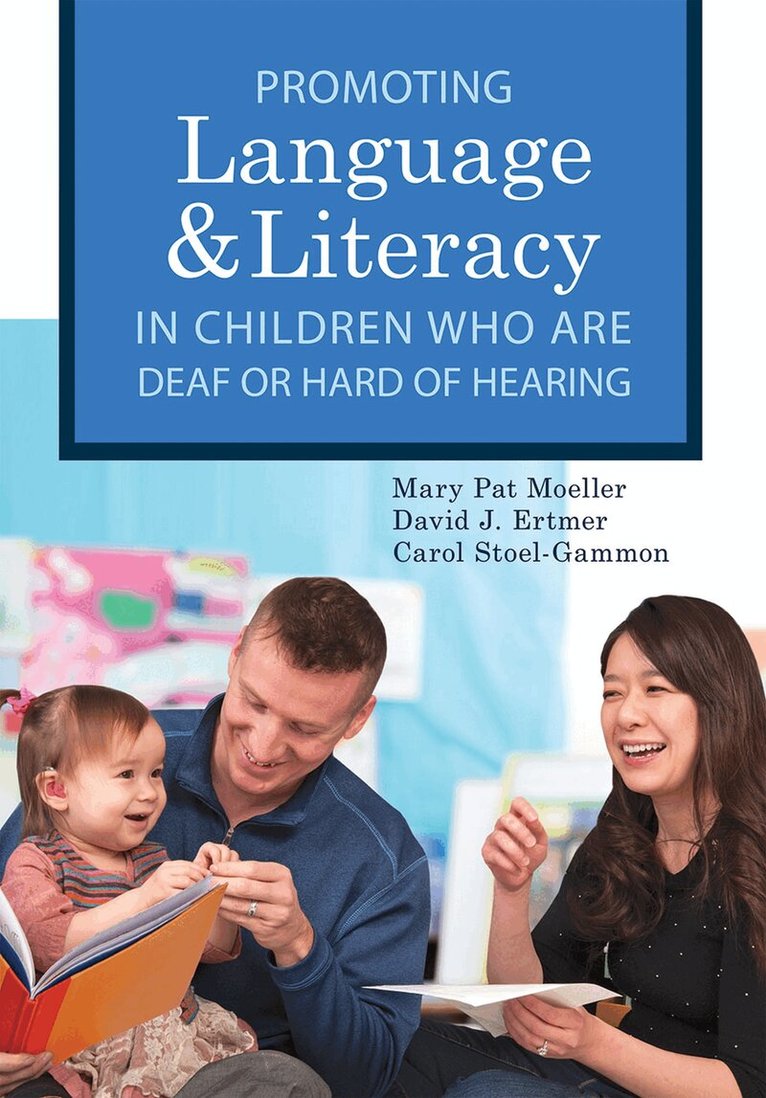
What are today’s best interventions for supporting language acquisition and literacy for children who are deaf or hard of hearing (D/HH)? This comprehensive textbook-and-DVD set brings the answers to life for tomorrow’s speech-language pathologists, audiologists, and educators. The newest addition to the respected Communication and Language Intervention (CLI) series, this important volume enlisted more than a dozen experts to present evidence-based intervention approaches, spanning the critical early years of language development through the complex reading and writing challenges of the school years. Chapters cover a continuum of available communication approaches—from auditory-focused to visually-focused to simultaneous use of speech and sign—while encouraging the use of individualized interventions to meet each child’s needs. To prepare professionals for decades of effective, evidence-based practice, the included video clips demonstrate how to implement assessments and interventions and work successfully with children and families. CUTTING-EDGE INFORMATION ON audiological assessments and technological interventions for childrenprinciples and practices for family-centered early interventionunderstanding, supporting, and coaching familiesassessments to identify intervention prioritiesTheory of Mindauditory-verbal therapy and phonological interventionssign language and sign systemsuse of the internet to deliver intervention serviceselements of supportive early education environmentsapproaches for optimizing reading and writing skillsstrategies for promoting social and academic success in integrated classrooms
549 kr
Skickas inom 7-10 vardagar
Phonological development is linked with a child’s later success with language and literacy, but tests of early phonological skills are often not sensitive enough for the youngest children. That’s why clinicians need PEEPS™, a comprehensive assessment of early phonological skills developed specifically for toddlers 18–36 months. Created by leading experts in early phonological development and speech sound disorders, PEEPS helps speech-language pathologists detect speech and language delays early, so children can receive the intervention and support they need to be effective communicators on track for academic achievement.Why PEEPS? Developmentally appropriate. Unlike similar tools, PEEPS is specially developed to screen young children and uses elicitation techniques and vocabulary words that are appropriate for this population.In-depth assessment of an overlooked skill set. Early phonological skills are often not assessed, even though they affect early lexical development. PEEPS is the tool clinicians need to analyze the key components of phonological development, including phonetic inventory, syllable structure, accuracy of consonant production, and error patterns.Accurately identifies delays. Because most phonological measures aren’t designed for the young age range, young children may be overidentified as struggling with phonological skills—or a wait-and-see approach is taken with these children, which can delay starting early intervention. PEEPS helps accurately evaluate children struggling with phonological skills, so they can receive support as early as possible.Quick, convenient, and flexible. PEEPS gives clinicians a comprehensive picture of early phonological skills in less than 20 minutes. The kit includes the full PEEPS assessment (60 words) and a shorter PEEPS screener (20 words) that helps determine if in-depth testing with the full PEEPS is warranted.How PEEPS WorksTo conduct either the full PEEPS or the screener, the clinician will:Present a stimulus to the child to elicit each word on the PEEPS word list. The clinician may point to a small toy, a body part or article of clothing, or an illustration in the included board book, A Book of Things.Transcribe the child’s speech production onto the test form.Complete the scoring and summary page to create a profile of the child’s phonological development.Use this profile to help determine if the child is developing within expected limits or displaying delays or red flags that warrant intervention.PEEPS is easy to administer. The Examiner’s Manual guides clinicians step by step through the process, and the kit includes access to a helpful video in which the authors clearly demonstrate how to deliver PEEPS.
441 kr
Skickas inom 7-10 vardagar
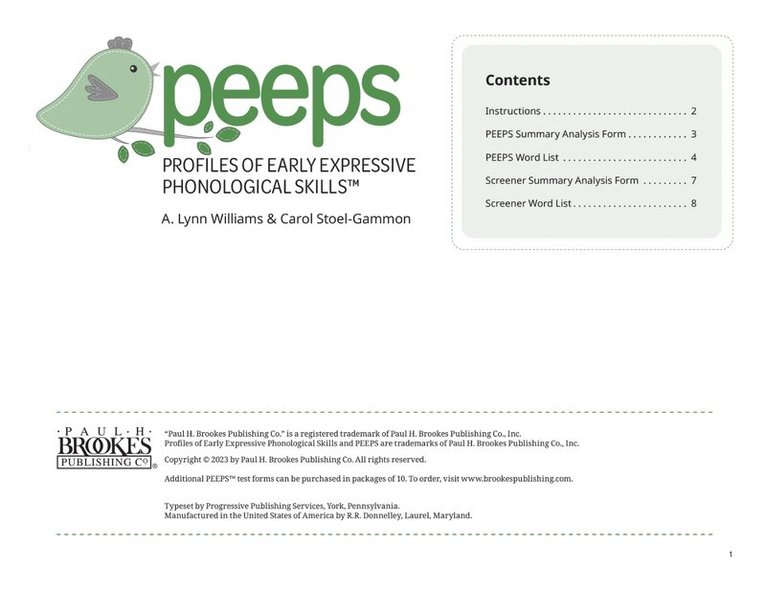
Phonological development is linked with a child’s later success with language and literacy, but tests of early phonological skills are often not sensitive enough for the youngest children. That’s why clinicians need PEEPS™, a comprehensive assessment of early phonological skills developed specifically for toddlers 18–36 months. Created by leading experts in early phonological development and speech sound disorders, PEEPS helps speech-language pathologists detect speech and language delays early, so children can receive the intervention and support they need to be effective communicators on track for academic achievement. This product is sold in a package of 10. Why PEEPS? Developmentally appropriate. Unlike similar tools, PEEPS is specially developed to screen young children and uses elicitation techniques and vocabulary words that are appropriate for this population. In-depth assessment of an overlooked skill set. Early phonological skills are often not assessed, even though they affect early lexical development. PEEPS is the tool clinicians need to analyze the key components of phonological development, including phonetic inventory, syllable structure, accuracy of consonant production, and error patterns. Accurately identifies delays. Because most phonological measures aren’t designed for the young age range, young children may be overidentified as struggling with phonological skills—or a wait-and-see approach is taken with these children, which can delay starting early intervention. PEEPS helps accurately evaluate children struggling with phonological skills, so they can receive support as early as possible. Quick, convenient, and flexible. PEEPS gives clinicians a comprehensive picture of early phonological skills in less than 20 minutes. The kit includes the full PEEPS assessment (60 words) and a shorter PEEPS screener (20 words) that helps determine if in-depth testing with the full PEEPS is warranted. How PEEPS WorksTo conduct either the full PEEPS or the screener, the clinician will: Present a stimulus to the child to elicit each word on the PEEPS word list. The clinician may point to a small toy, a body part or article of clothing, or an illustration in the included board book, A Book of Things.Transcribe the child’s speech production onto the test form. Complete the scoring and summary page to create a profile of the child’s phonological development. Use this profile to help determine if the child is developing within expected limits or displaying delays or red flags that warrant intervention. PEEPS is easy to administer. The Examiner’s Manual guides clinicians step by step through the process, and the kit includes access to a helpful video in which the authors clearly demonstrate how to deliver PEEPS.