Charles E. Wyman – författare
Visar alla böcker från författaren Charles E. Wyman. Handla med fri frakt och snabb leverans.
10 produkter
Aqueous Pretreatment of Plant Biomass for Biological and Chemical Conversion to Fuels and Chemicals
Av Charles E. Wyman, Charles E. Wyman
Inbunden, 2013
1939 kr
Lägg i varukorg
Plant biomass is attracting increasing attention as a sustainable resource for large-scale production of renewable fuels and chemicals. However, in order to successfully compete with petroleum, it is vital that biomass conversion processes are designed to minimize costs and maximize yields. …
Aqueous Pretreatment of Plant Biomass for Biological and Chemical Conversion to Fuels and Chemicals
E-bok, 2013
2265 kr
Lägg i varukorg
Plant biomass is attracting increasing attention as a sustainable resource for large-scale production of renewable fuels and chemicals. However, in order to successfully compete with petroleum, it is vital that biomass conversion processes are designed to minimize costs and maximize yields. …
Seventeenth Symposium on Biotechnology for Fuels and Chemicals
Proceedings as Volumes 57 and 58 of Applied Biochemistry and Biotechnology
Av Charles E. Wyman, Brian H. Davison
1996
1938 kr
Lägg i varukorg
In the Seventeenth Symposium on Biotechnology for Fuels and Chemicals, leading researchers from academia, industry, and government present state-of-the-art papers on how bioengineering can be used to produce fuels and chemicals competitively. This year's program covered topics in thermal, chemical, …
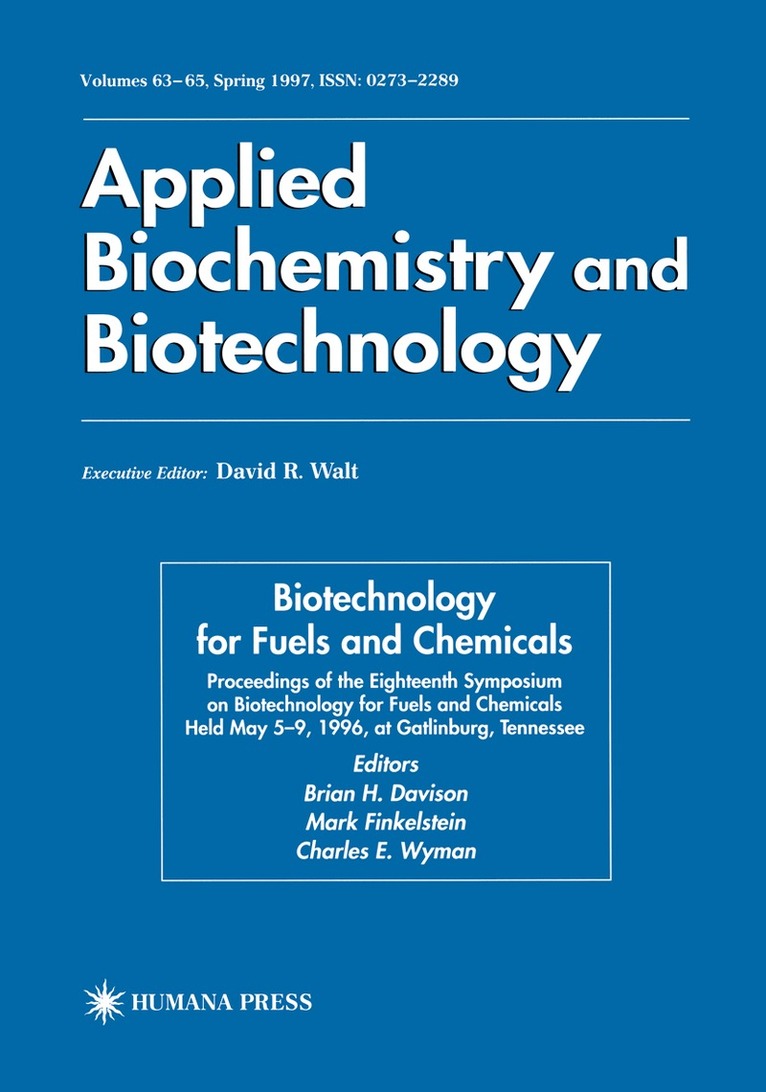
Biotechnology for Fuels and Chemicals
Proceedings of the Eighteenth Symposium on Biotechnology for Fuels and Chemicals Held May 5–9, 1996, at Gatlinburg, Tennessee
Av Brian H. Davison, Mark Finkelstein m. fl.
Inbunden, 1997
1643 kr
Lägg i varukorg
In Biotechnology for Fuels and Chemicals, based on the 18th Symposium, held in Gatlinburg, TN, May 5-9, 1996, leading researchers from academia, industry, and government present state-of-the-art research results and promising new concepts on the use of biotechnology to produce fuels and chemicals …
Aqueous Pretreatment of Plant Biomass for Biological and Chemical Conversion to Fuels and Chemicals
E-bok, 2013
2216 kr
Lägg i varukorg
Plant biomass is attracting increasing attention as a sustainable resource for large-scale production of renewable fuels and chemicals. However, in order to successfully compete with petroleum, it is vital that biomass conversion processes are designed to minimize costs and maximize yields. …
Seventeenth Symposium on Biotechnology for Fuels and Chemicals
Proceedings as Volumes 57 and 58 of Applied Biochemistry and Biotechnology
Av Brian H. Davison, Charles E. Wyman
E-bok, 2012
2111 kr
Lägg i varukorg
In the Seventeenth Symposium on Biotechnology for Fuels and Chemicals, leading researchers from academia, industry, and government present state-of-the-art papers on how bioengineering can be used to produce fuels and chemicals competitively. This year''s program covered topics in thermal, …
Biotechnology for Fuels and Chemicals
Proceedings of the Eighteenth Symposium on Biotechnology for Fuels and Chemicals Held May 5–9, 1996, at Gatlinburg, Tennessee
Av Charles E. Wyman, Mark Finkelstein m. fl.
E-bok, 2012
2049 kr
Lägg i varukorg
BRIAN H. DAVISON Oak Ridge National Laboratory MARK FINKELSTEIN National Renewable Energy Laboratory CHARLES E. WYMAN Oak Ridge National Laboratory The Eighteenth Symposium on Biotechnology for Fuels and Chemi cals continues to provide a forum for the presentation of research results and the …
Seventeenth Symposium on Biotechnology for Fuels and Chemicals
Proceedings as Volumes 57 and 58 of Applied Biochemistry and Biotechnology
Av Charles E. Wyman, Brian H. Davison
Häftad, 2012
1643 kr
Lägg i varukorg
In the Seventeenth Symposium on Biotechnology for Fuels and Chemicals, leading researchers from academia, industry, and government present state-of-the-art papers on how bioengineering can be used to produce fuels and chemicals competitively. This year's program covered topics in thermal, chemical, …
Biotechnology for Fuels and Chemicals
Proceedings of the Eighteenth Symposium on Biotechnology for Fuels and Chemicals Held May 5–9, 1996, at Gatlinburg, Tennessee
Av Brian H. Davison, Mark Finkelstein m. fl.
Häftad, 2011
1643 kr
Lägg i varukorg
BRIAN H. DAVISON Oak Ridge National Laboratory MARK FINKELSTEIN National Renewable Energy Laboratory CHARLES E. WYMAN Oak Ridge National Laboratory The Eighteenth Symposium on Biotechnology for Fuels and Chemi cals continues to provide a forum for the presentation of research results and the …
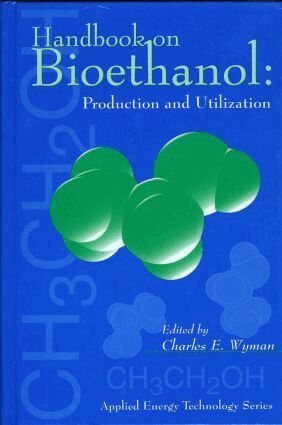
Handbook on Bioethanol
Production and Utilization
Av Charles Wyman, Charles E. Wyman m. fl.
Inbunden, 1996
7556 kr
Lägg i varukorg
Bioethanol is a versatile transportation fuel and fuel additive that offers excellent performance and reduced air pollution compared to conventional fuels. Its production and use adds little, if any, net release of carbon dioxide to the atmosphere, dramatically reducing the potential for global …