Charlotte Elisheva Fonrobert - Böcker
Visar alla böcker från författaren Charlotte Elisheva Fonrobert. Handla med fri frakt och snabb leverans.
6 produkter
6 produkter
410 kr
Skickas inom 7-10 vardagar
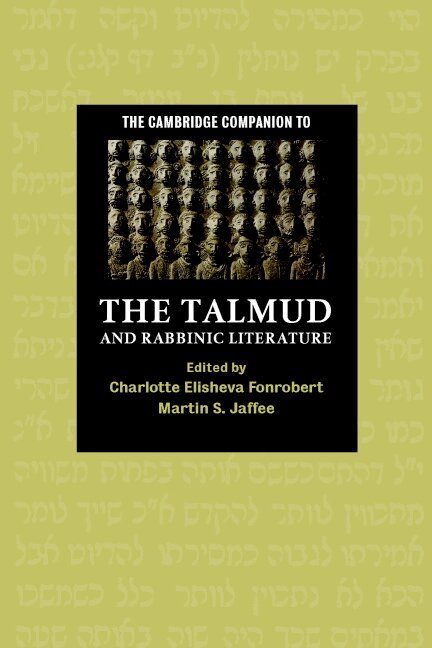
This volume introduces students of rabbinic literature to the range of historical and interpretative questions surrounding the rabbinic texts of late antiquity. The editors, themselves well-known interpreters of Rabbinic literature, have gathered an international collection of scholars to support students' initial steps in confronting the enormous and complex rabbinic corpus. Unlike other introductions to Rabbinic writings, the present volume includes approaches shaped by anthropology, gender studies, oral-traditional studies, classics, and folklore studies.
1 166 kr
Skickas inom 7-10 vardagar
This volume introduces students of rabbinic literature to the range of historical and interpretative questions surrounding the rabbinic texts of late antiquity. The editors, themselves well-known interpreters of Rabbinic literature, have gathered an international collection of scholars to support students' initial steps in confronting the enormous and complex rabbinic corpus. Unlike other introductions to Rabbinic writings, the present volume includes approaches shaped by anthropology, gender studies, oral-traditional studies, classics, and folklore studies.
1 386 kr
Skickas inom 10-15 vardagar
Perhaps more than any other aspect of rabbinic literature, the laws about and discussions of menstruation have polarized current discussions of gender relations in Jewish culture. Is the designated impurity of menstruation sexist? Or does ritual absence from sex during menstruation encourage a rhythmic reaffirmation of conjugal intimacy?This book offers a new perspective on the extensive rabbinic discussions of menstrual impurity, female physiology, and anatomy, and on the social and religious institutions those discussions engendered. It analyzes the functions of these discussions within the larger textual world of rabbinic literature and in the context of Jewish and Christian culture in late antiquity.How did gender work—how was it made to work—in rabbinic literature? How did that literature dictate the place of women in Jewish culture? In search of answers to these questions, the author analyzes the architectural metaphors deployed to describe female anatomy, arguing that this discursive construction operated culturally to associate women with the home and exclude them from rabbinic study halls. The author shows that rabbinic discourse is not completely controlled by rabbinic ideology, however. She analyzes talmudic discussions that allow alternative gender perspectives to emerge, indicating that women and their bodies were not completely objectified. This suggests that the Babylonian Talmud does not present a completely homogeneous gender structure, but contains a number of different, sometimes contradictory, possibilities.The book concludes with a study of early Christian texts that relate to the same biblical laws on menstrual impurity as rabbinic texts, focusing in particular on a Jewish-Christian text in which the anonymous author polemicizes against Jewish women converts who remain attached to the biblical laws. This text allows us to reconstruct women's perspectives on the inscription of religious meaning onto their bodies and physiological processes.
1 174 kr
Skickas inom 10-15 vardagar
After launching his career with the 1947 publication of his dissertation, Occidental Eschatology, Jacob Taubes spent the early years of his career as a fellow and then professor at various American institutions, including Harvard, Princeton, and Columbia. During his American years, he also gathered together a number of prominent thinkers at his weekly seminars on Jewish intellectual history. In the mid-60s, Taubes joined the faculty of the Free University in West Berlin, initially as the city's first Jewish Studies professor of the postwar period. But his work and interest expanded beyond the boundaries of the field of Jewish Studies to broader philosophical questions, particularly in the philosophy of religion. A charismatic speaker and a great polemicist, Taubes had a phenomenal ability to create interdisciplinary conversations in the humanities, engaging scholars from philosophy, literature, theology, and intellectual history. The essays presented here represent the fruit of conversations, conferences, and workshops that he organized over the course of his career.
283 kr
Skickas inom 7-10 vardagar
After launching his career with the 1947 publication of his dissertation, Occidental Eschatology, Jacob Taubes spent the early years of his career as a fellow and then professor at various American institutions, including Harvard, Princeton, and Columbia. During his American years, he also gathered together a number of prominent thinkers at his weekly seminars on Jewish intellectual history. In the mid-60s, Taubes joined the faculty of the Free University in West Berlin, initially as the city's first Jewish Studies professor of the postwar period. But his work and interest expanded beyond the boundaries of the field of Jewish Studies to broader philosophical questions, particularly in the philosophy of religion. A charismatic speaker and a great polemicist, Taubes had a phenomenal ability to create interdisciplinary conversations in the humanities, engaging scholars from philosophy, literature, theology, and intellectual history. The essays presented here represent the fruit of conversations, conferences, and workshops that he organized over the course of his career.
321 kr
Skickas inom 7-10 vardagar
Perhaps more than any other aspect of rabbinic literature, the laws about and discussions of menstruation have polarized current discussions of gender relations in Jewish culture. Is the designated impurity of menstruation sexist? Or does ritual absence from sex during menstruation encourage a rhythmic reaffirmation of conjugal intimacy?This book offers a new perspective on the extensive rabbinic discussions of menstrual impurity, female physiology, and anatomy, and on the social and religious institutions those discussions engendered. It analyzes the functions of these discussions within the larger textual world of rabbinic literature and in the context of Jewish and Christian culture in late antiquity.How did gender work—how was it made to work—in rabbinic literature? How did that literature dictate the place of women in Jewish culture? In search of answers to these questions, the author analyzes the architectural metaphors deployed to describe female anatomy, arguing that this discursive construction operated culturally to associate women with the home and exclude them from rabbinic study halls. The author shows that rabbinic discourse is not completely controlled by rabbinic ideology, however. She analyzes talmudic discussions that allow alternative gender perspectives to emerge, indicating that women and their bodies were not completely objectified. This suggests that the Babylonian Talmud does not present a completely homogeneous gender structure, but contains a number of different, sometimes contradictory, possibilities.The book concludes with a study of early Christian texts that relate to the same biblical laws on menstrual impurity as rabbinic texts, focusing in particular on a Jewish-Christian text in which the anonymous author polemicizes against Jewish women converts who remain attached to the biblical laws. This text allows us to reconstruct women's perspectives on the inscription of religious meaning onto their bodies and physiological processes.