Jacob Taubes - Böcker
Visar alla böcker från författaren Jacob Taubes. Handla med fri frakt och snabb leverans.
9 produkter
9 produkter
461 kr
Skickas inom 3-6 vardagar
A philosopher, rabbi, religious historian, and Gnostic, Jacob Taubes was for many years a correspondent and interlocutor of Carl Schmitt (1888-1985), a German jurist, philosopher, political theorist, law professor-and self-professed Nazi. Despite their unlikely association, Taubes and Schmitt shared an abiding interest in the fundamental problems of political theology, believing the great challenges of modern political theory were ancient in pedigree and, in many cases, anticipated the works of Judeo-Christian eschatologists. In this collection of Taubes's writings on Schmitt, the two intellectuals work through ideas of the apocalypse and other central concepts of political theology. Taubes acknowledges Schmitt's reservations about the weakness of liberal democracy yet distances himself from his prescription to rectify it, arguing the apocalyptic worldview requires less of a rigid hierarchical social ordering than a community committed to the importance of decision making.In these writings, a sharper and more nuanced portrait of Schmitt's thought emerges, as well as a more complicated understanding of Taubes, who has shaped the work of Giorgio Agamben, Peter Sloterdijk, and other major twentieth-century theorists.
1 021 kr
Skickas inom 10-15 vardagar
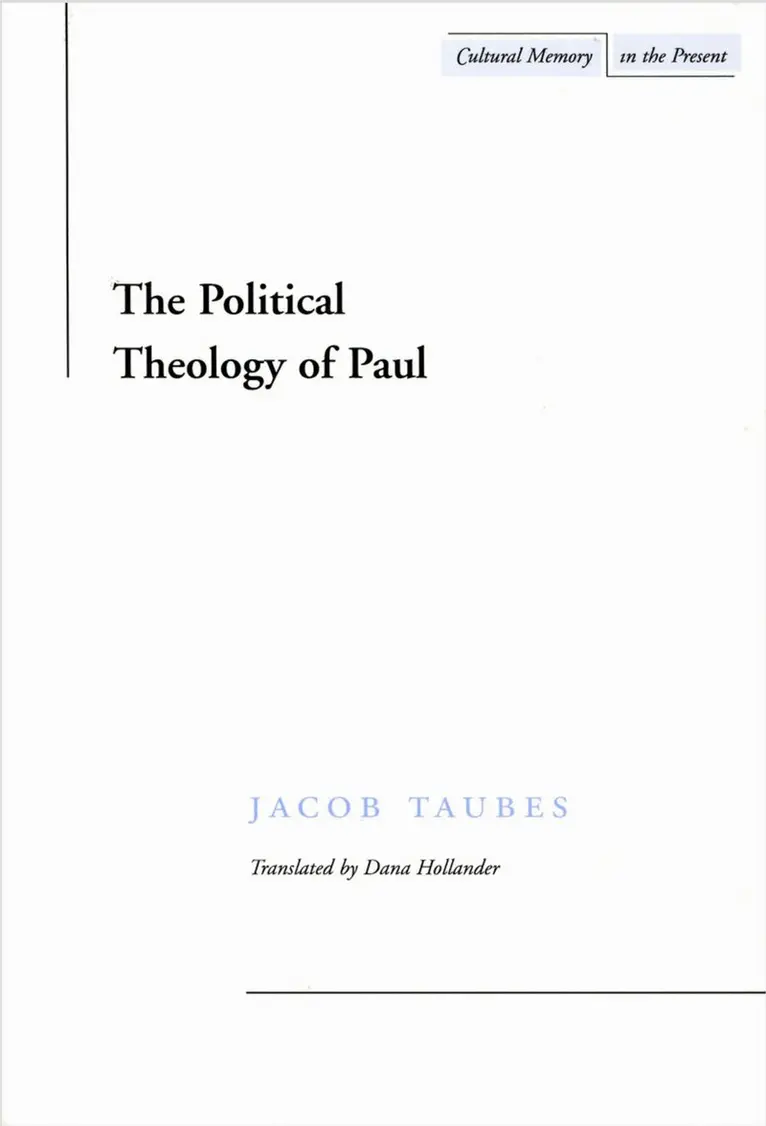
This highly original interpretation of Paul by the Jewish philosopher of religion Jacob Taubes was presented in a number of lectures held in Heidelberg toward the end of his life, and was regarded by him as his "spiritual testament." Taubes engages with classic Paul commentators, including Karl Barth, but also situates the Pauline text in the context of Freud, Nietzsche, Benjamin, Adorno, Scholem, and Rosenzweig. In his distinctive argument for the apocalyptic-revolutionary potential of Romans, Taubes also takes issue with the "political theology" advanced by the conservative Catholic jurist Carl Schmitt. Taubes's reading has been crucial for a number of interpretations of political theology and of Paul—including those of Jan Assmann and Giorgio Agamben—and it belongs to a wave of fresh considerations of Paul's legacy (Boyarin, Lyotard, Badiou, Zîzêk). Finally, Taubes's far-ranging lectures provide important insights into the singular experiences and views of this unconventional Jewish intellectual living in post-Holocaust Germany.
239 kr
Skickas inom 7-10 vardagar
This highly original interpretation of Paul by the Jewish philosopher of religion Jacob Taubes was presented in a number of lectures held in Heidelberg toward the end of his life, and was regarded by him as his "spiritual testament." Taubes engages with classic Paul commentators, including Karl Barth, but also situates the Pauline text in the context of Freud, Nietzsche, Benjamin, Adorno, Scholem, and Rosenzweig. In his distinctive argument for the apocalyptic-revolutionary potential of Romans, Taubes also takes issue with the "political theology" advanced by the conservative Catholic jurist Carl Schmitt. Taubes's reading has been crucial for a number of interpretations of political theology and of Paul—including those of Jan Assmann and Giorgio Agamben—and it belongs to a wave of fresh considerations of Paul's legacy (Boyarin, Lyotard, Badiou, Zîzêk). Finally, Taubes's far-ranging lectures provide important insights into the singular experiences and views of this unconventional Jewish intellectual living in post-Holocaust Germany.
1 181 kr
Skickas inom 10-15 vardagar
After launching his career with the 1947 publication of his dissertation, Occidental Eschatology, Jacob Taubes spent the early years of his career as a fellow and then professor at various American institutions, including Harvard, Princeton, and Columbia. During his American years, he also gathered together a number of prominent thinkers at his weekly seminars on Jewish intellectual history. In the mid-60s, Taubes joined the faculty of the Free University in West Berlin, initially as the city's first Jewish Studies professor of the postwar period. But his work and interest expanded beyond the boundaries of the field of Jewish Studies to broader philosophical questions, particularly in the philosophy of religion. A charismatic speaker and a great polemicist, Taubes had a phenomenal ability to create interdisciplinary conversations in the humanities, engaging scholars from philosophy, literature, theology, and intellectual history. The essays presented here represent the fruit of conversations, conferences, and workshops that he organized over the course of his career.
283 kr
Skickas inom 7-10 vardagar
After launching his career with the 1947 publication of his dissertation, Occidental Eschatology, Jacob Taubes spent the early years of his career as a fellow and then professor at various American institutions, including Harvard, Princeton, and Columbia. During his American years, he also gathered together a number of prominent thinkers at his weekly seminars on Jewish intellectual history. In the mid-60s, Taubes joined the faculty of the Free University in West Berlin, initially as the city's first Jewish Studies professor of the postwar period. But his work and interest expanded beyond the boundaries of the field of Jewish Studies to broader philosophical questions, particularly in the philosophy of religion. A charismatic speaker and a great polemicist, Taubes had a phenomenal ability to create interdisciplinary conversations in the humanities, engaging scholars from philosophy, literature, theology, and intellectual history. The essays presented here represent the fruit of conversations, conferences, and workshops that he organized over the course of his career.
1 394 kr
Skickas inom 10-15 vardagar
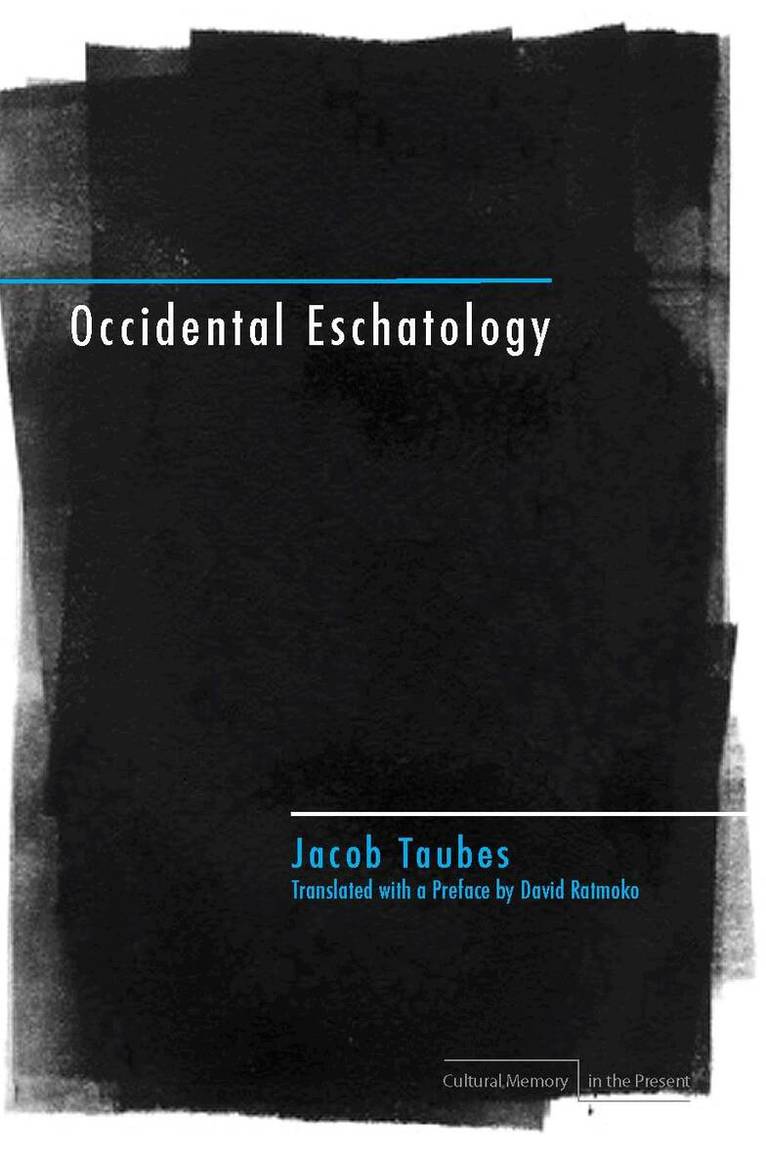
Occidental Eschatology, originally Jacob Taubes's doctoral thesis and the one book he published in his lifetime, seeks to renegotiate the historical synthesis and spiritual legacy of the West through the study of apocalypticism. Covering the origins of apocalypticism from Hebrew prophecy through antiquity and early Christianity to its medieval revival in Joachim of Fiore, Taubes reveals its later secularized forms in Kant, Hegel, Marx, and Kierkegaard. His aim is to show the lasting influence of revolutionary, messianic teleology on Western philosophy, history, and politics. Combining painstaking scholarship with an unmatched scope of reference, Taubes takes a comprehensive approach to the twin focuses of political theology and philosophy of history. He argues that acceptance of the idea that time will one day come to an end has profound implications for political thought. If natural time is experienced as an eternal cycle of events, "history" is the realm of time in which human actions can make decisions to alter the progression of events. This philosophy asks that individuals take responsibility for their own actions and resist authority that claims to act on their behalf. Whereas universal history is written by the victors, the messianic or apocalyptic event enters history and gives a voice to the oppressed.
270 kr
Skickas inom 7-10 vardagar
Occidental Eschatology, originally Jacob Taubes's doctoral thesis and the one book he published in his lifetime, seeks to renegotiate the historical synthesis and spiritual legacy of the West through the study of apocalypticism. Covering the origins of apocalypticism from Hebrew prophecy through antiquity and early Christianity to its medieval revival in Joachim of Fiore, Taubes reveals its later secularized forms in Kant, Hegel, Marx, and Kierkegaard. His aim is to show the lasting influence of revolutionary, messianic teleology on Western philosophy, history, and politics. Combining painstaking scholarship with an unmatched scope of reference, Taubes takes a comprehensive approach to the twin focuses of political theology and philosophy of history. He argues that acceptance of the idea that time will one day come to an end has profound implications for political thought. If natural time is experienced as an eternal cycle of events, "history" is the realm of time in which human actions can make decisions to alter the progression of events. This philosophy asks that individuals take responsibility for their own actions and resist authority that claims to act on their behalf. Whereas universal history is written by the victors, the messianic or apocalyptic event enters history and gives a voice to the oppressed.
704 kr
Skickas inom 3-6 vardagar
317 kr
Skickas inom 3-6 vardagar