Chris Argyris - Böcker
Visar alla böcker från författaren Chris Argyris. Handla med fri frakt och snabb leverans.
20 produkter
20 produkter
Flawed Advice and the Management Trap
How Managers Can Know When They're Getting Good Advice and When They're Not
Inbunden, Engelska, 1999
500 kr
Skickas inom 5-8 vardagar
Flawed Advice and the Management Trap: How Managers Can Know When They're Getting Good Advice and When They're Not is the first book to show how and why so much of today's business advice is flawed, and how managers and executives can better evaluate advice given to their firms Practitioners and scholars agree that businesses in the coming millennium will be managed differently than firms of the 20th century. And getting there from here, according to today's best advice, will require creative change. In this pioneering work, Argyris, one of the world's leading organizational thinkers, reviews a wide array of business advice from the best and brightest thinkers and consultants and concludes that as appealing as their ideas may be, most of them are simply not workable. They are too full of abstract claims, logical gaps, and inconsistencies, to be useful. And ironically, even when their recommendations are implemented correctly, the result is often failure. Why do these gaps in logic exist, and how can they be more effectively discovered? Applying a disciplined critique to numerous representative examples of advice about leadership, learning, change, and employee commitment, Argyris shows readers how to be more critical of the advice they are given, how to learn new approaches for appraising employee performance, and how to generate an internal commitment to values and better strategy. In our ever expanding global market, innovative business advice is at a premium, and giving this advice has become a lucrative industry in and of itself. This book provides the critical lens necessary to evaluate which advice is best for your organization.
1 200 kr
Skickas inom 5-8 vardagar
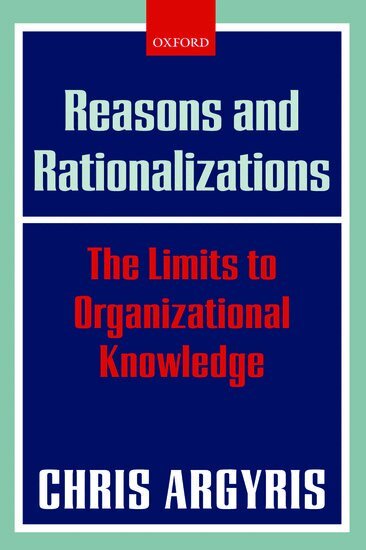
What is the purpose of social science and management research? Do scholars/researchers have a responsibility to generate insights and knowledge that are of practical (implementable) value and validity? We are told we live in turbulent and changing times, should this not provide an important opportunity for management researchers to provide understanding and guidance? Yet there is widespread concern about the efficacy of much research: These are some of the puzzles/pressing problems that Chris Argyris addresses in this short book.Argyris is one of the best known management scholars in the world - a leading light whose work has consistently addressed fundamental organizational questions, and who has provided some of the key concepts and building blocks of our understanding of organizational learning - single and double learning, theory in use, and espoused theory etc.In this book he questions many of the assumptions of organizational theory and research, and his investigation is not confined to academic analysis. He also scrutinizes that capacity for 'unproductive reasoning' (self-deception and rationalization) that is common amongst managers, consultants, and indeed more generally. As well as engaging with the work of leading organizational researchers (Sennett, Gabriel, Burgelman, Czarniawska, Grint, for example)he also ponders the work of the consultants, commentators, and accountants who endorsed Enron.Throughout his purpose is to affirm the goal and values of useful knowledge. His style/enquiry is direct but fair, challenging, if at times uncompromising. Drawing on his own wealth of experience of researching and working with organizations, this book will be a reference point for all concerned to develop useful knowledge and confront the defences and deceptions that are only too commonplace in the business and academic worlds.
668 kr
Skickas inom 5-8 vardagar
What is the purpose of social science and management research? Do scholars/researchers have a responsibility to generate insights and knowledge that are of practical (implementable) value and validity? We are told we live in turbulent and changing times, should this not provide an important opportunity for management researchers to provide understanding and guidance? Yet there is widespread concern about the efficacy of much research: These are some of the puzzles that Chris Argyris addresses in this short book. Argyris is one of the best known management scholars in the world - a leading light whose work has consistently addressed fundamental organizational questions, and who has provided some of the key concepts and building blocks of our understanding of organizational learning - single and double learning, theory in use, and espoused theory etc. In this book he questions many of the assumptions of organizational theory and research, and his investigation is not confined to academic analysis. He also scrutinizes that capacity for 'unproductive reasoning' (self-deception and rationalization) that is common amongst managers, consultants, and indeed more generally. As well as engaging with the work of leading organizational researchers (Sennett, Gabriel, Burgelman, Czarniawska, Grint, for example)he also ponders the work of the consultants, commentators, and accountants who endorsed Enron. Throughout his purpose is to affirm the goal and values of useful knowledge. His style is direct but fair, challenging, if at times uncompromising. Drawing on his own wealth of experience of researching and working with organizations, this book will be a reference point for all concerned to develop useful knowledge and confront the defences and deceptions that are only too commonplace in the business and academic worlds.
841 kr
Skickas inom 5-8 vardagar
Anyone who has spent time in an organization knows that dysfunctional behavior abounds. Conflict is frequently avoided or pushed underground rather than dealt with openly. At the same time, the same arguments often burst out again and again, almost verbatim. Turf battles continue for extended periods without resolution. People nod their heads in agreement in meetings, and then rush out of the room to voice complaints to sympathetic ears in private. Worst of all, when people are asked if things will ever change, they throw up their hands in despair. They feel like victims trapped in an asylum. And people often are trapped. But they are not trapped by some oppressive regime or organizational structure that has been imposed on them. They are not victims. In fact, people themselves are responsible for making the status quo so resistant to change. We are trapped by our own behavior. Researchers and practitioners have often reflected on these things, but there is a puzzle. On the one hand, there is substantial agreement that these traps are counterproductive to effective performance. On the other hand, there is almost no focus on how organizational traps can be prevented or reduced. This book argues that whatever theory is used to describe and understand such organizational traps should be used to design and implement interventions that reduce and prevent them. Argyris is one of the world's leading management scholars whose work has consistently shed light on orgainzational problems. This book is essential reading for MBAs, managers, and consultants.
351 kr
Skickas
Anyone who has spent time in an organization knows that dysfunctional behavior abounds. Conflict is frequently avoided or pushed underground rather than dealt with openly. At the same time, the same arguments often burst out again and again, almost verbatim. Turf battles continue for extended periods without resolution. People nod their heads in agreement in meetings, and then rush out of the room to voice complaints to sympathetic ears in private. Worst of all, when people are asked if things will ever change, they throw up their hands in despair. They feel like victims trapped in an asylum. And people often are trapped. But they are not trapped by some oppressive regime or organizational structure that has been imposed on them. They are not victims. In fact, people themselves are responsible for making the status quo so resistant to change. We are trapped by our own behavior. Researchers and practitioners have often reflected on these things, but there is a puzzle. On the one hand, there is substantial agreement that these traps are counterproductive to effective performance. On the other hand, there is almost no focus on how organizational traps can be prevented or reduced. This book argues that whatever theory is used to describe and understand such organizational traps should be used to design and implement interventions that reduce and prevent them. Argyris is one of the world's leading management scholars whose work has consistently shed light on organizational problems. This book is essential reading for MBAs, managers, and consultants.
925 kr
Skickas inom 7-10 vardagar
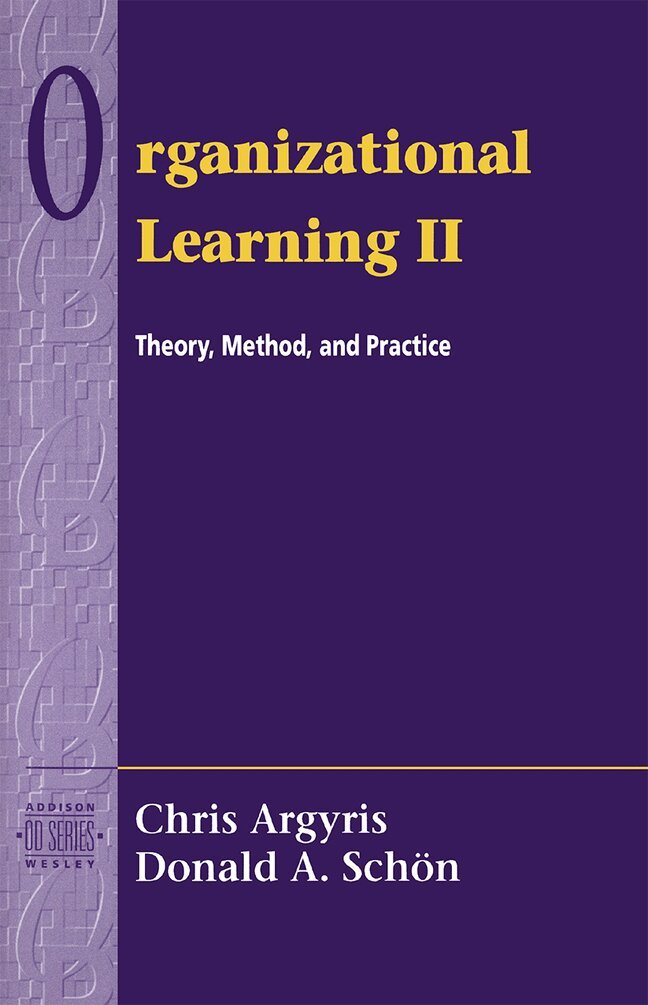
A member of the PH OD Series! Organizational Learning II expands and updates the ideas and concepts of the authors��� ground- breaking first book. With new examples and the most up-to-date information on the technical aspects of organizational and management theory, Argyris and Schon demonstrate how the research and practice of organizational learning can be incorporated in today���s business environment.
428 kr
Skickas inom 7-10 vardagar
First published in 1972, this is a searching critique of work by both sociologists and psychologists on organisational structure and behaviour. Professor Argyris - although examining many different viewpoints - focuses in depth on five major writers on the subject: John Goldthrope, Peter Blau, James Thompson, Charles Perrow and David Lockwood, and analyses the practical, policy-making implications they draw or which would logically follow from their theoretical position. Asserting that research work on complex organizations has failed to integrate the sociological and psychological level of analysis - ignoring the importance of individual personality, group dynamics and interpersonal relationships - the author argues that this is self-defeating for sociological research; that it questions many of the findings of sociologists; and leads to their work in fact unintentionally maintaining the status quo as conceived by scientific management. A challenging and stimulating contribution to the debate on sociological theory.
576 kr
Skickas inom 7-10 vardagar
For the student of business and management, the Concise Encyclopaedia will be an essential vade mecum for their studies; for the specialist, it offers insights from leading researchers; for the working manager it will be a one stop guide to today's management theory.
468 kr
Skickas inom 7-10 vardagar
This book is essential for anyone who needs to understand how organizations work, evolve, and learn. In this new edition, Argyris discusses vital topics of current management research, such as tacit knowledge and management, so reflecting the evolving field of organizational learning. Brings together the thinking of one of the world's leading management thinkers: especially in the area of action learning.
18 627 kr
Tillfälligt slut
The second edition of this flagship business and management reference work is divided into 12 individual subject volumes and an index and includes a brand new volume on Entrepreneurship: Comprises over 6500 specially commissioned and carefully edited entries Written and edited by international teams of over 1500 of the world's best scholars and teachers Features extended bibliographies of relevant, wider, international literature and the foremost global scholarship in each field Flexible, multi-level use, maintained and further extended by sophisticated cross-referencing both among individual encyclopedia entries and between volumes and external sources Available online, for the first time, via the EBSCO database and linked to wider literature and to an associated Blackwell Library Online, consisting of a selection of Blackwell Handbooks and Journals in the field. Register with us to receive updates on this landmark project at www.managementencyclopedia.com where you will find further details, a special pre-publication offer and, coming soon, contributor browsing features.
691 kr
Skickas inom 10-15 vardagar
The emphasis on organizational change in the corporate life of recent years-including job redesign, autonomous groups, high performance work systems, and the redesign of control systems-owes a great deal to the pioneering work of Chris Argyris.This book examines how individuals in organizations can become more effective, in turn making organizations more effective. It explores the conventional pyramidal structure of organizations, in which there is top-down control by managers over workers, and examines their negative consequences. These include organizational injustice and eventually irrational decision-making. Argyris also discusses the characteristic learning system of the modern organization, which he describes as "single-loop" in character. This system, he argues, is only adequeate enough to permit the organization to implement existing policies. It does not permit the more difficult and comprehensive task of questioning underlying goals and assumptions, which he terms "doubt loop" learning. In this kind of learning, the organization is able to confront the more difficult problems that affect organizations in a time of transition.In his new introduction, Argyris reviews the strengths and limitations of the argument advanced in Integrating the Individual and the Organization. He describes why the pyramidal structure endures, and why creating a self-learning organization is an even more challenging task than he has imagined. The book will be of interest to professionals with a long-standing interest in organizational development as well as those just entering the field, managers confronting the challenge of organization change, and researchers in organizational behavior and theory.
391 kr
Skickas inom 5-8 vardagar
266 kr
Skickas inom 5-8 vardagar
2 150 kr
Skickas inom 10-15 vardagar
The emphasis on organizational change in the corporate life of recent years-including job redesign, autonomous groups, high performance work systems, and the redesign of control systems-owes a great deal to the pioneering work of Chris Argyris.This book examines how individuals in organizations can become more effective, in turn making organizations more effective. It explores the conventional pyramidal structure of organizations, in which there is top-down control by managers over workers, and examines their negative consequences. These include organizational injustice and eventually irrational decision-making. Argyris also discusses the characteristic learning system of the modern organization, which he describes as "single-loop" in character. This system, he argues, is only adequeate enough to permit the organization to implement existing policies. It does not permit the more difficult and comprehensive task of questioning underlying goals and assumptions, which he terms "doubt loop" learning. In this kind of learning, the organization is able to confront the more difficult problems that affect organizations in a time of transition.In his new introduction, Argyris reviews the strengths and limitations of the argument advanced in Integrating the Individual and the Organization. He describes why the pyramidal structure endures, and why creating a self-learning organization is an even more challenging task than he has imagined. The book will be of interest to professionals with a long-standing interest in organizational development as well as those just entering the field, managers confronting the challenge of organization change, and researchers in organizational behavior and theory.
120 kr
Skickas
Why are your smartest and most successful employees often the worst learners? Likely, they haven't had the opportunities for introspection that failure affords. So when they do fail, instead of critically examining their own behavior, they cast blame outward--on anyone or anything they can. In Teaching Smart People How to Learn, Chris Argyris sheds light on the forces that prevent highly skilled employees for learning from mistakes and offers suggestions for helping talented employees develop more productive responses. Since 1922, Harvard Business Review has been a leading source of breakthrough ideas in management practice-many of which still speak to and influence us today. The HBR Classics series now offers you the opportunity to make these seminal pieces a part of your permanent management library. Each volume contains a groundbreaking idea that has shaped best practices and inspired countless managers around the world-and will change how you think about the business world today.
Del 2 - Occasional Paper
Some Causes of Organizational Ineffectiveness Within the Department of State
Häftad, Engelska, 2017
150 kr
Skickas inom 5-8 vardagar
467 kr
Skickas inom 7-10 vardagar
"This book is a landmark in two fields. It is a practical guide tothe reform of professional education. It is also a beacon totheoretical thinking about human organizations, about theirinterdepAndence with the social structure of the professions, andabout theory in practice."-- Journal of Higher Education
709 kr
Skickas inom 7-10 vardagar
Must reading for academics and executives alike. Leading business scholar Chris Argyris helps readers understand why individuals and organizations are unable to learn from their action, then presents the steps that must be taken to change.
258 kr
Skickas inom 3-6 vardagar
436 kr
Skickas inom 3-6 vardagar