Christian Czarnecki - Böcker
Visar alla böcker från författaren Christian Czarnecki. Handla med fri frakt och snabb leverans.
5 produkter
5 produkter
585 kr
Skickas inom 7-10 vardagar
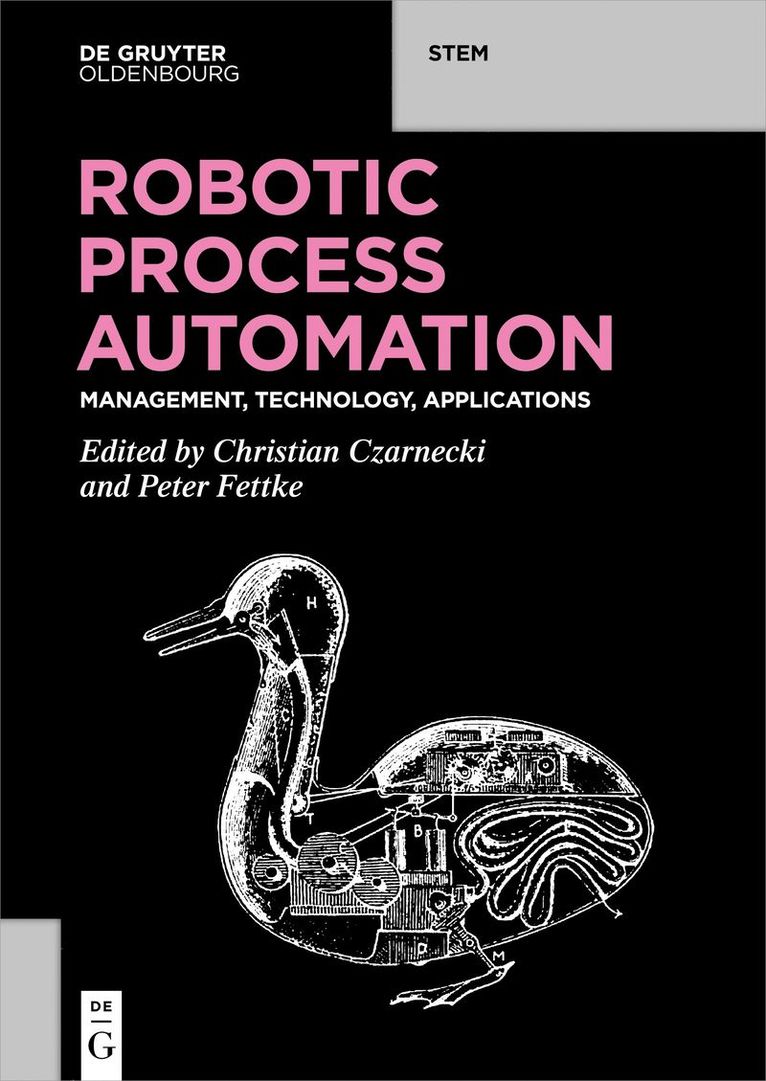
This book brings together experts from research and practice. It includes the design of innovative Robot Process Automation (RPA) concepts, the discussion of related research fields (e.g., Artificial Intelligence, AI), the evaluation of existing software products, and findings from real-life implementation projects. Similar to the substitution of physical work in manufacturing (blue collar automation), Robotic Process Automation tries to substitute intellectual work in office and administration processes with software robots (white-collar automation). The starting point for the development of RPA was the observation that – despite the use of process-oriented enterprise systems (such as ERP, CRM and BPM systems) – additional manual activities are still indispensable today. In the RPA approach, these manual activities are learned and automated by software robots, either by defining rules or by observing manual activities. RPA is related to business process management, machine learning, and artificial intelligence. Tools for RPA originated from dedicated stand-alone software. Today, RPA functionalities are also integrated into elaborated process management suites. From a conceptual perspective, RPA can be structured into input components (sensors in the wide sense), an intelligence center, and output components (actuators in the wide sense). From a strategic perspective, the impact of RPA can be related to the support of existing tasks, the complete substitution of human activities, and the innovation of processes as well as business models. At present, high expectations are related to the use of RPA in the improvement of software-supported business processes. Manual activities are learned and automated by software robots that interact with existing applications via the presentation layer. In combination with artificial intelligence (AI) as well as innovative interfaces (e. g., voice recognition) RPA creates a novel level of automation for office and administration processes. Its benefit potential reaches a return on investment (ROI) up-to 800% that is documented in various case studies.
Reference Architecture for the Telecommunications Industry
Transformation of Strategy, Organization, Processes, Data, and Applications
Inbunden, Engelska, 2017
958 kr
Skickas inom 10-15 vardagar
The book describes how these reference solutions can be used in a practical context: it presents the latest insights into their development, highlights lessons learned from numerous international projects and combines them with well-founded research results in enterprise architecture management and reference modeling.
Reference Architecture for the Telecommunications Industry
Transformation of Strategy, Organization, Processes, Data, and Applications
Häftad, Engelska, 2018
694 kr
Skickas inom 10-15 vardagar
The book describes how these reference solutions can be used in a practical context: it presents the latest insights into their development, highlights lessons learned from numerous international projects and combines them with well-founded research results in enterprise architecture management and reference modeling.
Anwendungsorientierte Wirtschaftsinformatik
Strategische Planung, Entwicklung und Nutzung von Informationssystemen
Häftad, Tyska, 2023
516 kr
Skickas inom 10-15 vardagar
Ein Lehrbuch für die anwendungsorientierte Seite der WirtschaftsinformatikDieses Lehrbuch der Wirtschaftsinformatik ist vor allem eines: anwendungsorientiert. Nutzen Sie die zahlreichen Fallbeispiele, um die Kerninhalte des Fachgebiets zu erlernen und einen Einblick in die umfassenden Einsatzmöglichkeiten der Informationstechnologien zu gewinnen, die in Zeiten der Digitalisierung für Wirtschaft und Gesellschaft unverzichtbar sind.Von den Grundbegriffen der Informations- und Kommunikationstechnologie bis zur strategischen Planung, Nutzung und Entwicklung von Informationssystemen – dieses Buch bietet Ihnen alle Werkzeuge zur Integration neuer Konzepte in bestehende Softwarearchitekturen.Grundwissen und Handlungsempfehlungen für die PraxisDie Autoren führen Sie mit diesem Lehrbuch unter anderem in die folgenden anwendungsorientierten Aspekte der Wirtschaftsinformatik ein:· Bedeutung und Arten betrieblicher Informationssysteme sowie Klärung grundlegender Begriffe· Digitale Transformation: Social Media, das Internet der Dinge, Industrie 4.0 und Mobile Business· Enterprise-Resource-Planning-Systeme (ERP)· Electronic Business mit Customer Relationship Management (CRM) und Supply Chain Management (SCM)· Data Warehouse, Business Intelligence, Big Data und Blockchain Durch den hohen Praxisbezug des Lehrbuchs lernen Sie nicht nur die Grundzüge des Informationsmanagements kennen, sondern erhalten auch einen Einblick in die Beziehung zwischen Nutzer und Infrastruktur im jeweiligen betrieblichen Anwendungssystem.Auf diese Weise kombinieren die Autoren geschickt die multidimensionalen Gestaltungsansätze des Business Engineerings mit der betrieblichen Anwendung der vorgestellten Werkzeuge.Das Werk richtet sich an ein breites PublikumMit dem ausgeprägten Fokus auf die Anwendbarkeit der Informationstechnologien ist dieses Lehrbuch der Wirtschaftsinformatik eine Empfehlung für:· Studierende, Dozenten und Wissenschaftler aus verschiedenen Bereichen der Wirtschaftsinformatik· Praktiker wie Ingenieure aus Fach- und IT-Abteilungen
314 kr
Kommande
Generative KI eröffnet neue Möglichkeiten – doch viele Unternehmen fragen sich: Wie findet man die richtige Idee und setzt sie erfolgreich um?Dieses Buch zeigt eine praxisbewährte Methode, mit der aus Herausforderungen konkrete GenAI-Lösungen entstehen. Die GenAI-Matrix macht den Weg von bestehenden Erfolgsbeispielen zu eigenen Anwendungen nachvollziehbar.Schritt für Schritt führt das Werk von der Ideengenerierung über Bewertung bis zur Umsetzung – klar strukturiert, praxisnah und direkt übertragbar auf den Unternehmensalltag.