Christian Knudsen – författare
Visar alla böcker från författaren Christian Knudsen. Handla med fri frakt och snabb leverans.
9 produkter
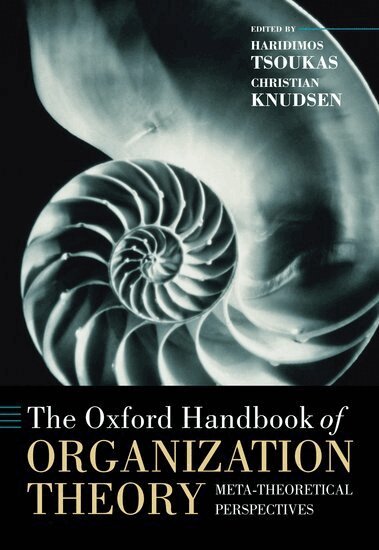
The Oxford Handbook of Organization Theory
Inbunden, 2003
4027 kr
Lägg i varukorg
This book provides a forum for leading scholars in As globalization explodes, so does international businession scholarship. This handbook synthesizes all the relevante literature of the last forty years in twenty-eight original. chapters by the world's most distinguished scholars. Thetus coverage …
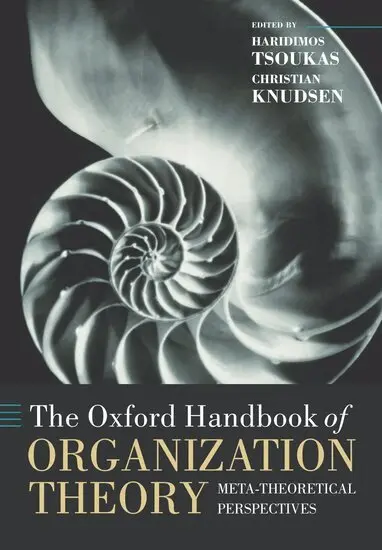
The Oxford Handbook of Organization Theory
Av Haridimos Tsoukas, Christian Knudsen
Häftad, 2005
981 kr
Lägg i varukorg
This book provides a forum for leading scholars in organization theory to engage in meta-theoretical reflection on the historical development, present state, and future prospects of organization theory as a scientific discipline. The central question explored is the epistemological status of …
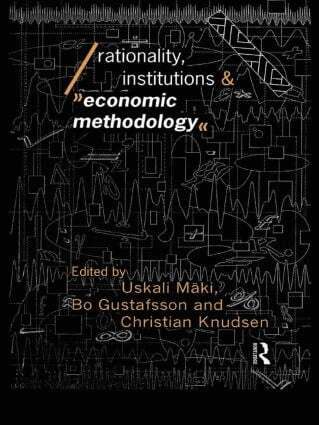
Rationality, Institutions and Economic Methodology
Av Bo Gustafsson, Christian Knudsen m. fl.
Inbunden, 1993
3156 kr
Lägg i varukorg
Looks at ways to increase the scope and power of institutional economics. Different approaches to economic methodology are considered and the broader notions of rationality offered by institutional economics are discussed.
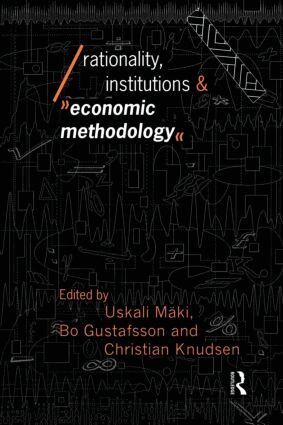
Rationality, Institutions and Economic Methodology
Av Bo Gustafsson, Christian Knudsen m. fl.
Häftad, 1993
1042 kr
Lägg i varukorg
Looks at ways to increase the scope and power of institutional economics. Different approaches to economic methodology are considered and the broader notions of rationality offered by institutional economics are discussed.
Towards a Competence Theory of the Firm
Av Nicolai J. Foss, Christian Knudsen
Inbunden, 1996
1882 kr
Lägg i varukorg
This book explores a new theory of the firm produced through an exchange between management theory and economics. In the process economics is seen to provide a foundational element for strategy research whilst developing a more realistic theory of the firm with a greater emphasis on its internal …
Towards a Competence Theory of the Firm
Av Nicolai J. Foss, Christian Knudsen
Häftad, 2006
517 kr
Lägg i varukorg
This book explores a new theory of the firm produced through an exchange between management theory and economics. In the process economics is seen to provide a foundational element for strategy research whilst developing a more realistic theory of the firm with a greater emphasis on its internal …
Rationality, Institutions and Economic Methodology
Av Uskali Maki, Christian Knudsen m. fl.
E-bok, 1993
1074 kr
Lägg i varukorg
Looks at ways to increase the scope and power of institutional economics. Different approaches to economic methodology are considered and the broader notions of rationality offered by institutional economics are discussed.
Towards a Competence Theory of the Firm
Av Christian Knudsen, Nicolai J. Foss
E-bok, 2013
607 kr
Lägg i varukorg
This book explores a new theory of the firm produced through an exchange between management theory and economics. In the process economics is seen to provide a foundational element for strategy research whilst developing a more realistic theory of the firm with a greater emphasis on its internal …
Towards a Competence Theory of the Firm
Av Christian Knudsen, Nicolai J. Foss
E-bok, 2013
607 kr
Lägg i varukorg
This book explores a new theory of the firm produced through an exchange between management theory and economics. In the process economics is seen to provide a foundational element for strategy research whilst developing a more realistic theory of the firm with a greater emphasis on its internal …