• Fri frakt över 249 kr
  • •
  • Snabba leveranser
  • •
  • Billiga böcker
Kundservice

Du är på sajten för privatpersoner.

Företag, bibliotek eller offentlig verksamhet?

Du handlar på classic.bokus.com, där alla dina funktioner finns intakta.
Till classic.bokus.com
Bokus logotyp. Gå till startsidan.
  • Erbjudanden
  • Nyheter
  • Student
  • Topplistor
  • Barn & ungdom
  • Bokus Play
  • E-böcker
  • Pocketböcker
  • Spel & pussel

Må bättre, för mindre! Upp till 50% rabatt på hälsoböcker

Sidfot

Mina sidor

    Hjälp

    • Kundservice
    • Vanliga frågor och svar
    • Frakt och leverans
    • Retur vid ångerrätt
    • Reklamera vara
    • Betalning
    • Köpvillkor
    • Allmänna villkor
    • Information om webbplatsens tillgänglighet

    Om Bokus

    • Om oss
    • Pressrum
    • För studenter
    • För företag
    • För bibliotek och offentlig verksamhet
    • För leverantörer
    • Hållbarhet

    Populärt

    • Aktuella erbjudanden
    • Presentkort
    • Studentlitteratur
    • Nya böcker
    • Topplistor
    • Signerade böcker
    • Engelska böcker

    Inspiration

    • Boktips
    • BookTok
    • Populära bokserier
    • Barnbokskaraktärer
    • Populära författare
    Logotyp för Bokus
    Följ oss på Facebook (extern länk)Följ oss på Instagram (extern länk)Följ oss på YouTube (extern länk)Följ oss på TikTok (extern länk)
    bokus @ CookiesAnpassa cookiesIntegritetspolicyKöpvillkor
    Till Citymail hemsida (extern länk)Till Budbee hemsida (extern länk)Till Postnord hemsida (extern länk)Till Schenker hemsida (extern länk)Till Early Bird hemsida (extern länk)Till Walleys hemsida (extern länk)
    1. Ekonomi och Ledarskap
    2. Företagsekonomi
    3. Organisationsteori

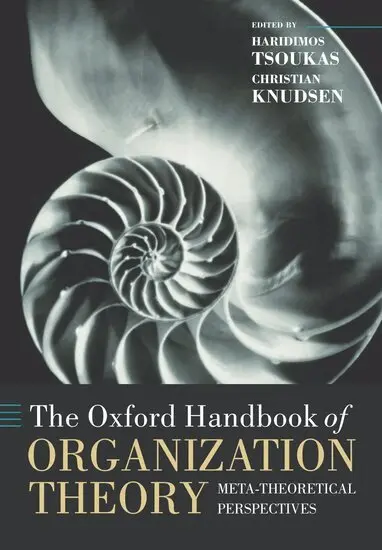
    The Oxford Handbook of Organization Theory

    AvHaridimos Tsoukas,Christian Knudsen

    Häftad, Engelska, 2005

    Del i serien Oxford Handbooks

    950 kr

    Beställningsvara. Skickas inom 7-10 vardagar. Fri frakt över 249 kr.

    Beskrivning

    This book provides a forum for leading scholars in organization theory to engage in meta-theoretical reflection on the historical development, present state, and future prospects of organization theory as a scientific discipline. The central question explored is the epistemological status of organization theory as a policy science. This is a meta-theoretical question; the object of analysis and debate in this volume is not a set of organizational phenomena, but organization theory itself. By drawing attention to organization theory as a practical social activity, this handbook reviews and evaluates important epistemological developments in the discipline. More specifically, the focus is on issues related to the nature of knowledge claims put forward in organization theory and the controversies surrounding the generation, validation, and utilization of such knowledge.Five sets of questions are raised in the handbook, each one of which is dealt with in a separate section: 1) What does a science of organizations consist of? What counts as valid knowledge in organization theory and why? How do different paradigms view organization theory as a science? 2) How has organization theory developed over time, and what structure has the field taken? What assumptions does knowledge produced in organization theory incorporate, and what forms do its knowledge claims take as they are put forward for public adoption? 3) How have certain well-known controversies in organization theory, such as for example, the structure/agency dilemma, the study of organizational culture, the different modes of explanation, the micro/macro controversy, and the differnet explanations produced by organizational economists and sociologists, been dealt with? 4) How, and in what ways, is knowledge generated in organization theory related to action? What features must organization theory knowledge have in order to be actionable, and of relevance to the world 'out there'? How have ethical concerns been taken into account in organization theory?5) What is the future of organization theory? What direction should the field take? What must change in the way research is conducted and key theoretical terms are conceptualized so that organization theory enhances its capacity to generate valid and relevant knowledge?

    Produktinformation

    • Utgivningsdatum:2005-03-10
    • Mått:171 x 246 x 33 mm
    • Vikt:1 170 g
    • Format:Häftad
    • Språk:Engelska
    • Serie:Oxford Handbooks
    • Antal sidor:672
    • Förlag:OUP OXFORD
    • ISBN:9780199275250

    Utforska kategorier

    • Organisationsteori inom Ekonomi och Ledarskap
    • Affärsstrategi inom Ekonomi och Ledarskap

    Mer om författaren

    Haridimos Tsoukas is the George D. Mavros Research Professor of Organization and Management at ALBA in Greece, and Professor of Organization Theory and Behaviour at the University of Strathclyde Graduate School of Business, UK. Previous positions held include Lecturer at Warwick Business School (1990-5), and Associate Professor at the University of Cyprus.Christian Knudsen is a Research Fellow at Copenhagen University and Århus Business School, Associate Professor at Copenhagen Business School, Visiting Professor at the Swedish Collegium for Advanced Studies in the Social Sciences, and Visiting Fellow at the London School of Economics and Stanford University.

    Recensioner i media

    ...brings together an extraordinary and erudite range of conributions to which I expect to refer for many years to come. There is not a single chapter from which I did not learn something, and from many I learnt a great deal.

    Innehållsförteckning

    • PART I: ORGANIZATION THEORY AS SCIENCE; PART II: THE CONSTRUCTION OF ORGANIZATION THEORY; PART III: META-THEORETICAL CONTROVERSIES IN ORGANIZATION THEORY; PART IV: ORGANIZATION THEORY AS A POLICY SCIENCE; PART V: THE FUTURE OF ORGANIZATION THEORY