Christoph Börgers – författare
Visar alla böcker från författaren Christoph Börgers. Handla med fri frakt och snabb leverans.
4 produkter
4 produkter
Häftad, Engelska, 2009
559 kr
Skickas inom 5-8 vardagar
How do you select a winner from a field of candidates? How do you rank a field of candidates? How do you share a divisible resource like a cake, or an indivisible one like a pet or a house? These are the questions addressed in this fun and accessible book that takes an entertaining look at the choices made by groups of people with different preferences, needs, and interests.Divided into three parts, the text first examines voting methods for selecting or ranking candidates. A brief second part addresses compensation problems wherein an indivisible item must be assigned to one of several people who are equally entitled to ownership of the item, with monetary compensation paid to the others. The third part discusses the problem of sharing a divisible resource among several people.Mathematics of Social Choice can be used by mathematics majors as well as students whose only mathematical background is elementary algebra. Material geared toward more sophisticated readers can be skipped without any loss of continuity. The book includes many elementary and usually simple, but rigorous mathematical proofs appropriate for beginning mathematics majors. Students will also find appendices with background material on set notation, logic, and mathematical induction and solutions to many of the homework exercises.
Del 110 - IMA Volumes in Mathematics and its Applications
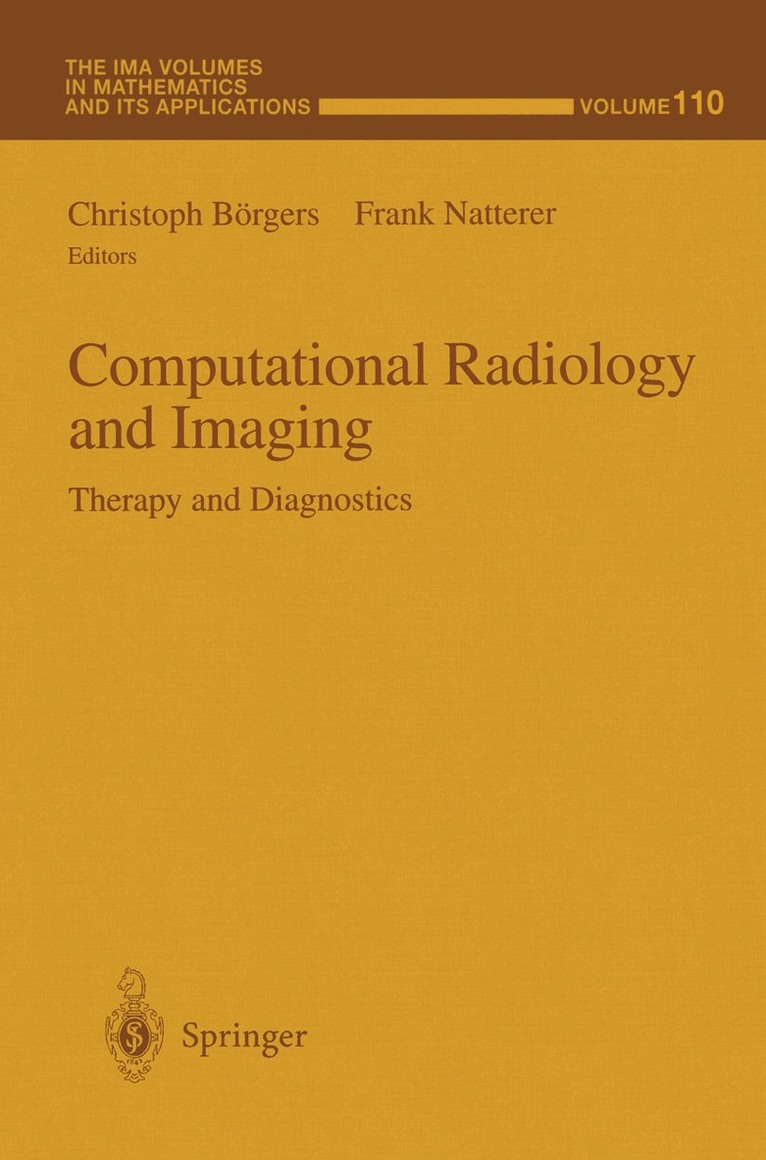
Computational Radiology and Imaging
Therapy and Diagnostics
Häftad, Engelska, 2012
564 kr
Skickas inom 10-15 vardagar
The articles collected in this volume are based on lectures given at the IMA Workshop, "Computational Radiology and Imaging: Therapy and Diagnostics", March 17-21, 1997. Introductory articles by the editors have been added. The focus is on inverse problems involving electromagnetic radiation and particle beams, with applications to X-ray tomography, nuclear medicine, near-infrared imaging, microwave imaging, electron microscopy, and radiation therapy planning. Mathematical and computational tools and models which play important roles in this volume include the X-ray transform and other integral transforms, the linear Boltzmann equation and, for near-infrared imaging, its diffusion approximation, iterative methods for large linear and non-linear least-squares problems, iterative methods for linear feasibility problems, and optimization methods. The volume is intended not only for mathematical scientists and engineers working on these and related problems, but also for non-specialists. It contains much introductory expository material, and a large number of references. Many unsolved computational and mathematical problems of substantial practical importance are pointed out.
Inbunden, Engelska, 2017
818 kr
Skickas inom 10-15 vardagar
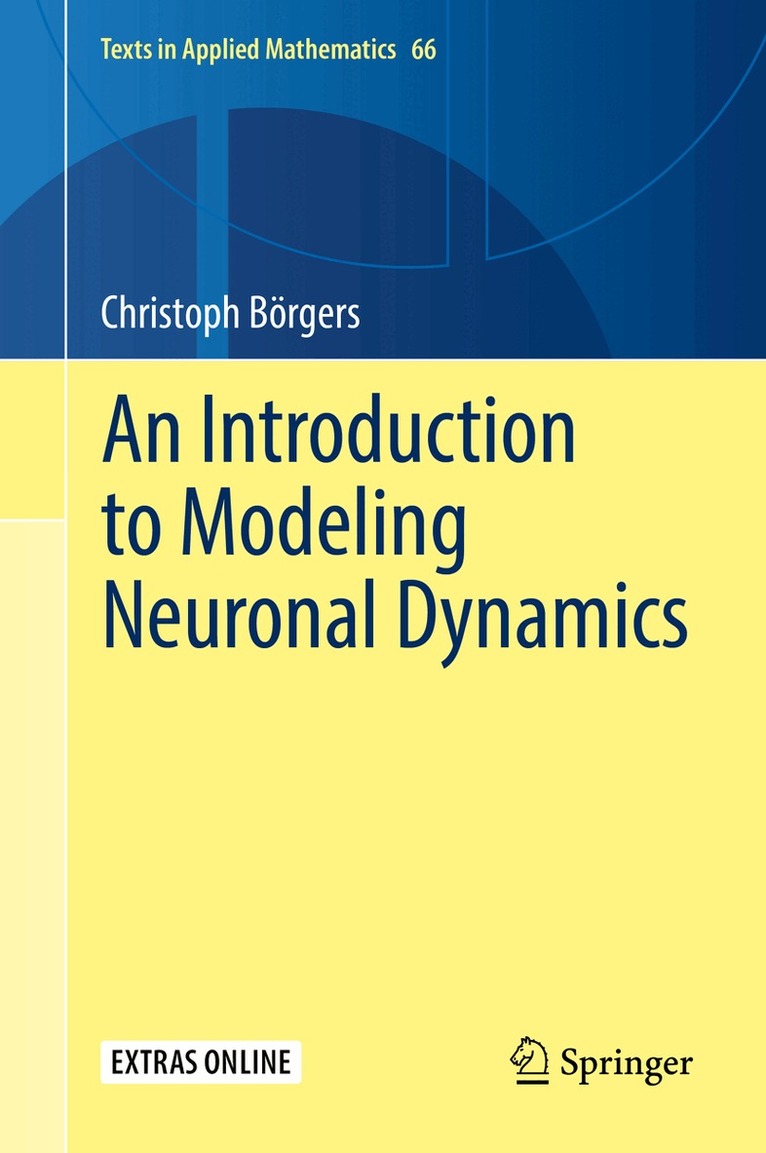
This book is intended as a text for a one-semester course on Mathematical and Computational Neuroscience for upper-level undergraduate and beginning graduate students of mathematics, the natural sciences, engineering, or computer science. An undergraduate introduction to differential equations is more than enough mathematical background. Only a slim, high school-level background in physics is assumed, and none in biology.Topics include models of individual nerve cells and their dynamics, models of networks of neurons coupled by synapses and gap junctions, origins and functions of population rhythms in neuronal networks, and models of synaptic plasticity.An extensive online collection of Matlab programs generating the figures accompanies the book.
Del 66 - Texts in Applied Mathematics
Introduction to Modeling Neuronal Dynamics
Häftad, Engelska, 2018
548 kr
Skickas inom 10-15 vardagar
This book is intended as a text for a one-semester course on Mathematical and Computational Neuroscience for upper-level undergraduate and beginning graduate students of mathematics, the natural sciences, engineering, or computer science. An undergraduate introduction to differential equations is more than enough mathematical background. Only a slim, high school-level background in physics is assumed, and none in biology.Topics include models of individual nerve cells and their dynamics, models of networks of neurons coupled by synapses and gap junctions, origins and functions of population rhythms in neuronal networks, and models of synaptic plasticity.An extensive online collection of Matlab programs generating the figures accompanies the book.