• Fri frakt över 249 kr
  • •
  • Snabba leveranser
  • •
  • Billiga böcker
Kundservice

Du är på sajten för privatpersoner.

Företag, bibliotek eller offentlig verksamhet?

Du handlar på classic.bokus.com, där alla dina funktioner finns intakta.
Till classic.bokus.com
Bokus logotyp. Gå till startsidan.
  • Erbjudanden
  • Nyheter
  • Student
  • Topplistor
  • Barn & ungdom
  • Bokus Play
  • E-böcker
  • Pocketböcker
  • Spel & pussel

10% rabatt på allt med kod NYSTART10 →

Sidfot

Mina sidor

    Hjälp

    • Kundservice
    • Vanliga frågor och svar
    • Frakt och leverans
    • Retur vid ångerrätt
    • Reklamera vara
    • Betalning
    • Köpvillkor
    • Allmänna villkor
    • Information om webbplatsens tillgänglighet

    Om Bokus

    • Om oss
    • Pressrum
    • För studenter
    • För företag
    • För bibliotek och offentlig verksamhet
    • För leverantörer
    • Hållbarhet

    Populärt

    • Aktuella erbjudanden
    • Presentkort
    • Studentlitteratur
    • Nya böcker
    • Topplistor
    • Signerade böcker
    • Engelska böcker

    Inspiration

    • Boktips
    • BookTok
    • Populära bokserier
    • Barnbokskaraktärer
    • Populära författare
    Logotyp för Bokus
    Följ oss på Facebook (extern länk)Följ oss på Instagram (extern länk)Följ oss på YouTube (extern länk)Följ oss på TikTok (extern länk)
    bokus @ CookiesAnpassa cookiesIntegritetspolicyKöpvillkor
    Till Citymail hemsida (extern länk)Till Budbee hemsida (extern länk)Till Postnord hemsida (extern länk)Till Schenker hemsida (extern länk)Till Early Bird hemsida (extern länk)Till Walleys hemsida (extern länk)
    1. Naturvetenskap och teknik
    2. Matematik och naturvetenskap
    3. Matematik
    4. Tillämpad matematik

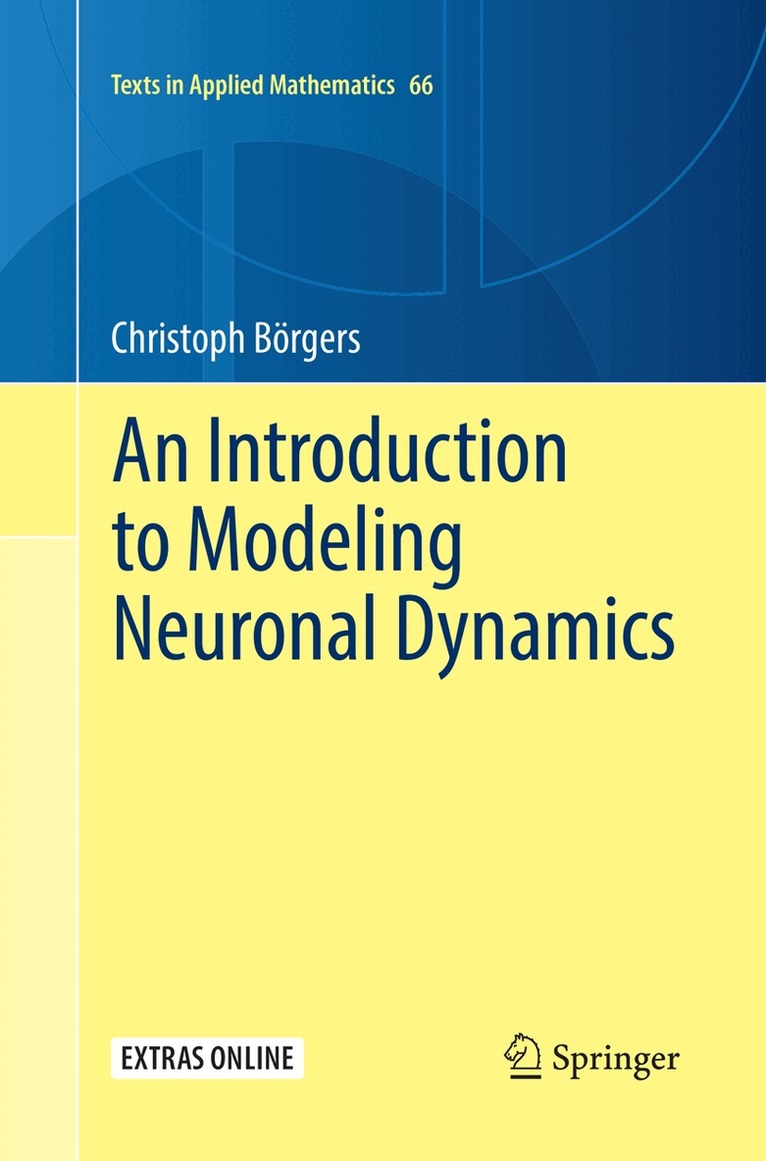
    Introduction to Modeling Neuronal Dynamics

    AvChristoph Börgers

    Häftad, Engelska, 2018

    Del 66 i serien Texts in Applied Mathematics

    546 kr

    Beställningsvara. Skickas inom 10-15 vardagar. Fri frakt över 249 kr.

    Fler format och utgåvor

    Inbunden

    815 kr

    Beskrivning

    This book is intended as a text for a one-semester course on Mathematical and Computational Neuroscience for upper-level undergraduate and beginning graduate students of mathematics, the natural sciences, engineering, or computer science. An undergraduate introduction to differential equations is more than enough mathematical background. Only a slim, high school-level background in physics is assumed, and none in biology.Topics include models of individual nerve cells and their dynamics, models of networks of neurons coupled by synapses and gap junctions, origins and functions of population rhythms in neuronal networks, and models of synaptic plasticity.An extensive online collection of Matlab programs generating the figures accompanies the book.

    Produktinformation

    • Utgivningsdatum:2018-07-18
    • Mått:155 x 235 x 26 mm
    • Vikt:709 g
    • Format:Häftad
    • Språk:Engelska
    • Serie:Texts in Applied Mathematics
    • Antal sidor:457
    • Förlag:Springer International Publishing AG
    • ISBN:9783319845852

    Utforska kategorier

    • Tillämpad matematik inom Naturvetenskap och teknik
    • Biovetenskap inom Naturvetenskap och teknik
    • Matematisk fysik inom Naturvetenskap och teknik

    Mer om författaren

    Christoph Börgers is Professor of Mathematics at Tufts University, USA.  His expertise is in mathematical neuroscience, applied dynamical systems, numerical analysis, and scientific computing.

    Recensioner i media

    “I would be happy to recommend this textbook to instructors seeking a textbook for an introductory course in mathematical neuroscience, and for students with quantitative backgrounds interested in taking such a course. … For those students beginning their climb from the established foundations of mathematical neuroscience towards these newer branches, An Introduction to Modeling Neuronal Dynamics offers a fine place to start.” (Braden A. W. Brinkman, SIAM Review, Vol. 61 (2), 2019)“The book is supplemented with a helpful library of Matlab scripts that generate many of the plots and numerical results presented in it. The exercises encourage the readers to modify the scripts to create new plots ... the book takes the reader on a fascinating journey of neuronal dynamics via introduction, analysis and numerical simulation of relevant dynamical systems. It is written with clarity and rigor.” (Oksana Bihun, zbMATH 1382.92001, 2018)

    Innehållsförteckning

    • Vocabulary and Notation.- Modeling a Single Neuron.- The Nernst Equilibrium.- The Classical Hodgkin-Huxley ODEs.- Numerical Solution of the Hodgkin-Huxley ODEs.- Three Simple Models of Neurons in Rodent Brains.- The Classical Hodgkin-Huxley PDEs.- Linear Integrate-and-fire (LIF) Neurons.- Quadratic Integrate-and-fire (QIF) and Theta Neurons.- Spike Frequency Adaptation.- Dynamics of Single Neuron Models.- The Slow-fast Phase Plane.- Saddle-node Collisions.- Model Neurons of Bifurcation Type 1.- Hopf Bifurcations.- Model Neurons of Bifurcation Type 2.- Canard Explosions.- Model Neurons of Bifurcation Type 3.- Frequency-current Curves.- Bistability Resulting from Rebound Firing.- Bursting.- Modeling Nuronal Communication.- Chemical Synapses.- Gap Junctions.- A Wilson-Cowan Model of an Oscillatory E-I Network.- Entertainment, Synchronization, and Oscillations.- Entertainment by Excitatory Input Pulses.- Synchronization by Fast Recurrent Excitation.- Phase Response Curves (PRCs).- Synchronization of Two Pulse-coupled Oscillators.- Oscillators Coupled by Delayed Pulses.- Weakly Coupled Oscillators.- Approximate Synchronization by a Single Inhibitory Pulse.- The PING Model of Gamma Rhythms.- ING Rhythms.- Weak PING Rhythms.- Beta Rhythms.- Nested Gamma-theta Rhythms.- Functional Significance of Synchrony and Oscillations.- Rhythmic vs. Tonic Inhibition.- Rhythmic vs. Tonic Excitation.- Gamma Rhythms and Cell Assemblies.- Gamma Rhythms and Communication.- Synaptic Plasticity.- Short-term Depression and Facilitation.- Spike Timing-dependent Plasticity (STDP).- Appendices.- A. The Bisection Method.- Fixed Point Iteration.- Elementary Probability Theory.- Smooth Approximations of Non-smooth Functions.- Solutions to Selected Homework Problems.