Christophe Prieur - Böcker
Visar alla böcker från författaren Christophe Prieur. Handla med fri frakt och snabb leverans.
4 produkter
4 produkter
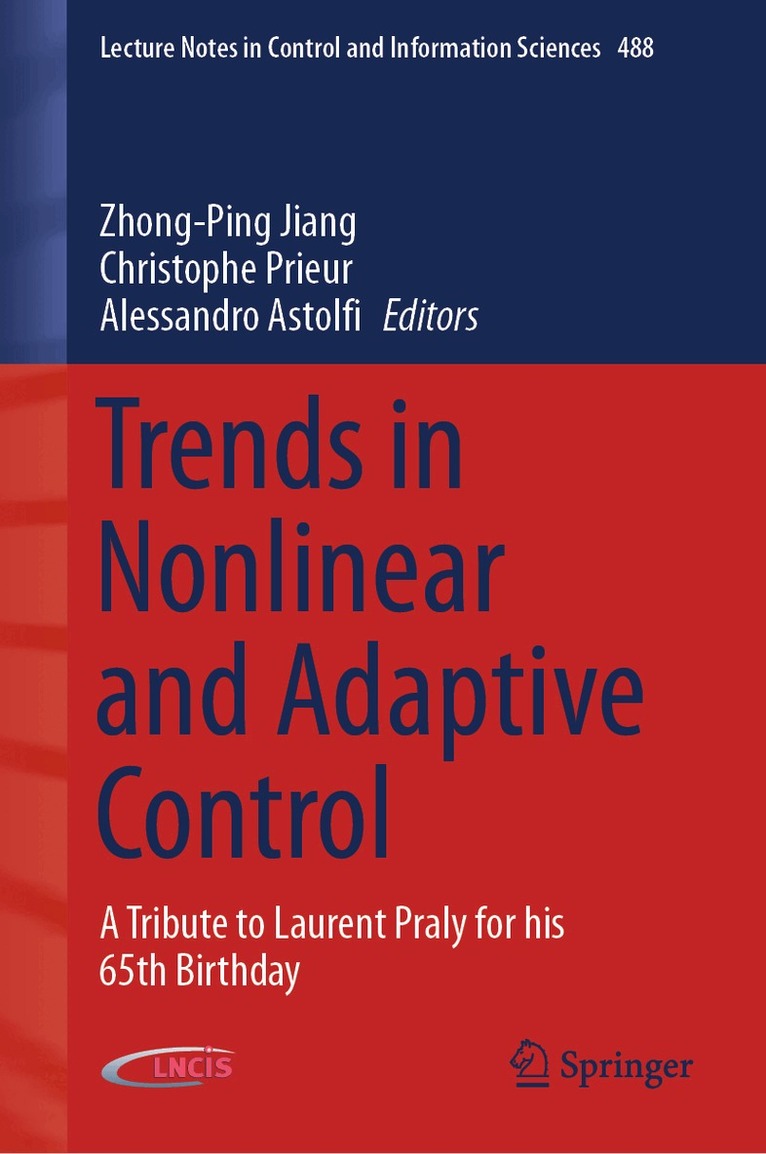
Trends in Nonlinear and Adaptive Control
A Tribute to Laurent Praly for his 65th Birthday
Inbunden, Engelska, 2021
1 786 kr
Skickas inom 10-15 vardagar
This book, published in honor of Professor Laurent Praly on the occasion of his 65th birthday, explores the responses of some leading international authorities to new challenges in nonlinear and adaptive control.
Trends in Nonlinear and Adaptive Control
A Tribute to Laurent Praly for his 65th Birthday
Häftad, Engelska, 2022
1 786 kr
Skickas inom 10-15 vardagar
This book, published in honor of Professor Laurent Praly on the occasion of his 65th birthday, explores the responses of some leading international authorities to new challenges in nonlinear and adaptive control.
2 712 kr
Kommande
This book celebrates Doctor Sophie Tarbouriech’s achievements in systems, control and related topics. The contributions in this book summarize the content of invited lectures given at the workshop “Methods and Algorithms for the Control of Complex Systems” held in Banyuls, France in late August 2024 in honor of Doctor Tarbouriech’s sixtieth birthday. These contributions are the work of forty-four distinguished researchers from nine countries and are related to Doctor Tarbouriech’s areas of research, being organized in parts dealing with:static nonlinearities;robustness analysis;networked and hybrid systems;partial-differential-equation systems; anddata-driven control.This Festschrift volume remains as a permanent scientific record of this event and is of interest to academic researchers working in any of the listed topics.Control of Complex Systems presents recent control methods and algorithms for analysing the stability or guaranteeing the performance of complex dynamical systems. Several classes of systems are covered, including nonlinear, hybrid and infinite-dimensional systems. Various control strategies are addressed, including reset control, anti-windup, event-based control, impulsive control, boundary control for PDEs and data-driven control. Analysis and design objectives include, among others, synchronization, robustness of linear and nonlinear systems, anti-windup loops and convex optimization for stability. Applications include aeronautics and space, control of physical systems with isolated nonlinearities and epidemiological models.
540 kr
Skickas inom 10-15 vardagar
Control of the Safety Factor Profile in a Tokamak uses Lyapunov techniques to address a challenging problem for which even the simplest physically relevant models are represented by nonlinear, time-dependent, partial differential equations (PDEs). This is because of the spatiotemporal dynamics of transport phenomena (magnetic flux, heat, densities, etc.) in the anisotropic plasma medium.Robustness considerations are ubiquitous in the analysis and control design since direct measurements on the magnetic flux are impossible (its estimation relies on virtual sensors) and large uncertainties remain in the coupling between the plasma particles and the radio-frequency waves (distributed inputs).The Brief begins with a presentation of the reference dynamical model and continues by developing a Lyapunov function for the discretized system (in a polytopic linear-parameter-varying formulation). The limitations of this finite-dimensional approach motivate new developments in the infinite-dimensional framework. The text then tackles the construction of an input-to-state-stability Lyapunov function for the infinite-dimensional system that handles the medium anisotropy and provides a common basis for analytical robustness results. This function is used as a control-Lyapunov function and allows the amplitude and nonlinear shape constraints in the control action to be dealt with.Finally, the Brief addresses important application- and implementation-specific concerns. In particular, the coupling of the PDE and the finite-dimensional subsystem representing the evolution of the boundary condition (magnetic coils) and the introduction of profile-reconstruction delays in the control loop (induced by solving a 2-D inverse problem for computing the magnetic flux) is analyzed. Simulation results are presented for various operation scenarios on Tore Supra (simulated with METIS) and on TCV (simulated with RAPTOR).Control of the Safety FactorProfile in a Tokamak will be of interest to both academic and industrially-based researchers interested in nuclear energy and plasma-containment control systems, and graduate students in nuclear and control engineering.