Christopher Kruger - Böcker
Visar alla böcker från författaren Christopher Kruger. Handla med fri frakt och snabb leverans.
2 produkter
2 produkter
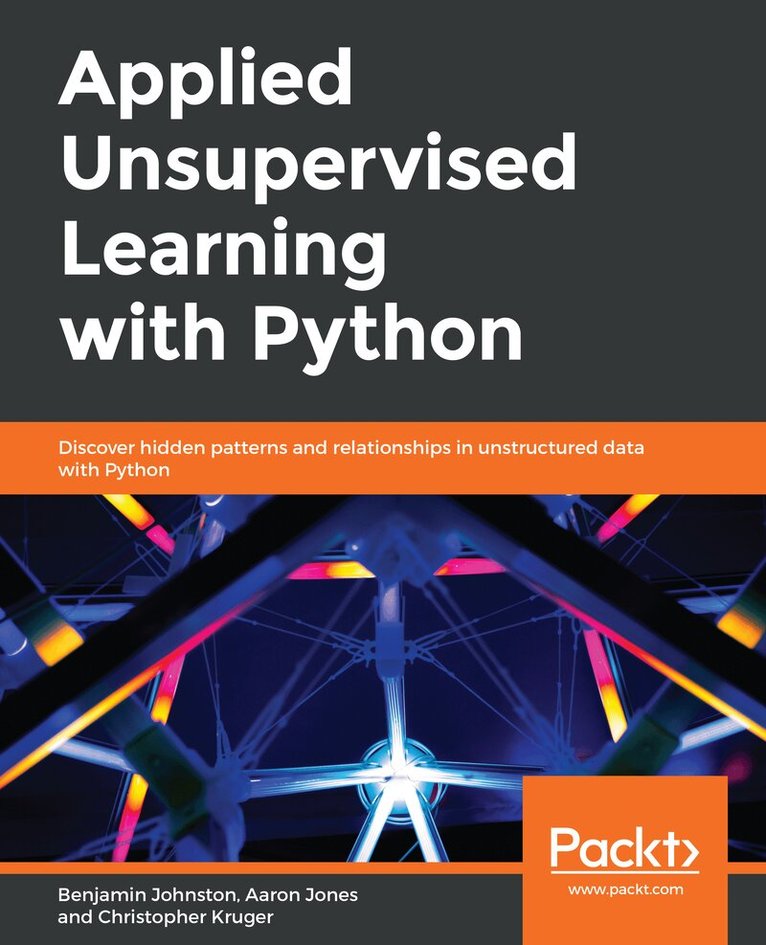
Applied Unsupervised Learning with Python
Discover hidden patterns and relationships in unstructured data with Python
Häftad, Engelska, 2019
589 kr
Skickas inom 5-8 vardagar
Design clever algorithms that can uncover interesting structures and hidden relationships in unstructured and unlabeled dataKey FeaturesLearn how to select the most suitable Python library to solve your problemCompare k-Nearest Neighbor (k-NN) and non-parametric methods and decide when to use themExplore the applications of neural networks using real-world datasetsBook DescriptionUnsupervised learning is a useful and practical solution in situations where labeled data is not available.Applied Unsupervised Learning with Python guides you in learning the best practices for using unsupervised learning techniques in tandem with Python libraries and extracting meaningful information from unstructured data. The book begins by explaining how basic clustering works to find similar data points in a set. Once you are well-versed with the k-means algorithm and how it operates, you’ll learn what dimensionality reduction is and where to apply it. As you progress, you’ll learn various neural network techniques and how they can improve your model. While studying the applications of unsupervised learning, you will also understand how to mine topics that are trending on Twitter and Facebook and build a news recommendation engine for users. Finally, you will be able to put your knowledge to work through interesting activities such as performing a Market Basket Analysis and identifying relationships between different products.By the end of this book, you will have the skills you need to confidently build your own models using Python.What you will learnUnderstand the basics and importance of clusteringBuild k-means, hierarchical, and DBSCAN clustering algorithms from scratch with built-in packagesExplore dimensionality reduction and its applicationsUse scikit-learn (sklearn) to implement and analyze principal component analysis (PCA) on the Iris datasetEmploy Keras to build autoencoder models for the CIFAR-10 datasetApply the Apriori algorithm with machine learning extensions (Mlxtend) to study transaction dataWho this book is forThis course is designed for developers, data scientists, and machine learning enthusiasts who are interested in unsupervised learning. Some familiarity with Python programming along with basic knowledge of mathematical concepts including exponents, square roots, means, and medians will be beneficial.
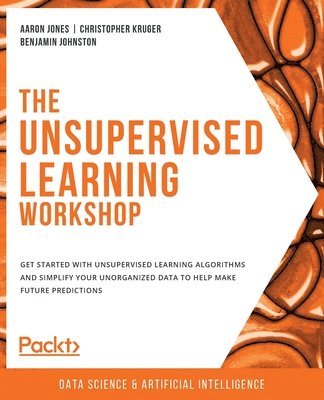
Unsupervised Learning Workshop
Get started with unsupervised learning algorithms and simplify your unorganized data to help make future predictions
Häftad, Engelska, 2020
510 kr
Skickas inom 5-8 vardagar
Learning how to apply unsupervised algorithms on unlabeled datasets from scratch can be easier than you thought with this beginner's workshop, featuring interesting examples and activitiesKey FeaturesGet familiar with the ecosystem of unsupervised algorithmsLearn interesting methods to simplify large amounts of unorganized dataTackle real-world challenges, such as estimating the population density of a geographical areaBook DescriptionDo you find it difficult to understand how popular companies like WhatsApp and Amazon find valuable insights from large amounts of unorganized data? The Unsupervised Learning Workshop will give you the confidence to deal with cluttered and unlabeled datasets, using unsupervised algorithms in an easy and interactive manner.The book starts by introducing the most popular clustering algorithms of unsupervised learning. You'll find out how hierarchical clustering differs from k-means, along with understanding how to apply DBSCAN to highly complex and noisy data. Moving ahead, you'll use autoencoders for efficient data encoding.As you progress, you’ll use t-SNE models to extract high-dimensional information into a lower dimension for better visualization, in addition to working with topic modeling for implementing natural language processing (NLP). In later chapters, you’ll find key relationships between customers and businesses using Market Basket Analysis, before going on to use Hotspot Analysis for estimating the population density of an area.By the end of this book, you’ll be equipped with the skills you need to apply unsupervised algorithms on cluttered datasets to find useful patterns and insights.What you will learnDistinguish between hierarchical clustering and the k-means algorithmUnderstand the process of finding clusters in dataGrasp interesting techniques to reduce the size of dataUse autoencoders to decode dataExtract text from a large collection of documents using topic modelingCreate a bag-of-words model using the CountVectorizerWho this book is forIf you are a data scientist who is just getting started and want to learn how to implement machine learning algorithms to build predictive models, then this book is for you. To expedite the learning process, a solid understanding of the Python programming language is recommended, as you’ll be editing classes and functions instead of creating them from scratch.