Christopher M Kelty – författare
Visar alla böcker från författaren Christopher M Kelty. Handla med fri frakt och snabb leverans.
5 produkter
5 produkter
986 kr
Tillfälligt slut
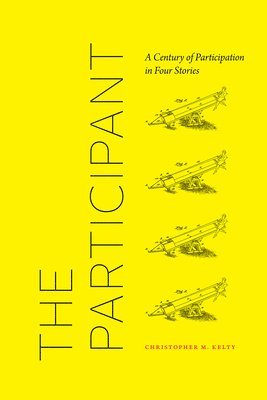
Participation is everywhere today. It has been formalized, measured, standardized, scaled up, network-enabled, and sent around the world. Platforms, algorithms, and software offer to make participation easier, but new technologies have had the opposite effect. We find ourselves suspicious of how participation extracts our data or monetizes our emotions, and the more procedural participation becomes, the more it seems to recede from our grasp. In this book, Christopher M. Kelty traces four stories of participation across the twentieth century, showing how they are part of a much longer-term problem in relation to the individual and collective experience of representative democracy. Kelty argues that in the last century or so, the power of participation has dwindled; over time, it has been formatted in ways that cramp and dwarf it, even as drive to participate has spread to nearly every kind of human endeavor, all around the world. The Participant is a historical ethnography of the concept of participation, investigating how the concept has evolved into the form it takes today. It is a book that asks, "why do we participate?" And sometimes, "why do we refuse?"
320 kr
Skickas inom 5-8 vardagar
Participation is everywhere today. It has been formalized, measured, standardized, scaled up, network-enabled, and sent around the world. Platforms, algorithms, and software offer to make participation easier, but new technologies have had the opposite effect. We find ourselves suspicious of how participation extracts our data or monetizes our emotions, and the more procedural participation becomes, the more it seems to recede from our grasp. In this book, Christopher M. Kelty traces four stories of participation across the twentieth century, showing how they are part of a much longer-term problem in relation to the individual and collective experience of representative democracy. Kelty argues that in the last century or so, the power of participation has dwindled; over time, it has been formatted in ways that cramp and dwarf it, even as drive to participate has spread to nearly every kind of human endeavor, all around the world. The Participant is a historical ethnography of the concept of participation, investigating how the concept has evolved into the form it takes today. It is a book that asks, "why do we participate?" And sometimes, "why do we refuse?"
1 329 kr
Skickas inom 5-8 vardagar
In Two Bits, Christopher M. Kelty investigates the history and cultural significance of Free Software, revealing the people and practices that have transformed not only software but also music, film, science, and education. Free Software is a set of practices devoted to the collaborative creation of software source code that is made openly and freely available through an unconventional use of copyright law. Kelty explains how these specific practices have reoriented the relations of power around the creation, dissemination, and authorization of all kinds of knowledge. He also makes an important contribution to discussions of public spheres and social imaginaries by demonstrating how Free Software is a “recursive public”-a public organized around the ability to build, modify, and maintain the very infrastructure that gives it life in the first place. Drawing on ethnographic research that took him from an Internet healthcare start-up company in Boston to media labs in Berlin to young entrepreneurs in Bangalore, Kelty describes the technologies and the moral vision that bind together hackers, geeks, lawyers, and other Free Software advocates. In each case, he shows how their practices and way of life include not only the sharing of software source code but also ways of conceptualizing openness, writing copyright licenses, coordinating collaboration, and proselytizing. By exploring in detail how these practices came together as the Free Software movement from the 1970s to the 1990s, Kelty also considers how it is possible to understand the new movements emerging from Free Software: projects such as Creative Commons, a nonprofit organization that creates copyright licenses, and Connexions, a project to create an online scholarly textbook commons.
417 kr
Skickas inom 5-8 vardagar
In Two Bits, Christopher M. Kelty investigates the history and cultural significance of Free Software, revealing the people and practices that have transformed not only software but also music, film, science, and education. Free Software is a set of practices devoted to the collaborative creation of software source code that is made openly and freely available through an unconventional use of copyright law. Kelty explains how these specific practices have reoriented the relations of power around the creation, dissemination, and authorization of all kinds of knowledge. He also makes an important contribution to discussions of public spheres and social imaginaries by demonstrating how Free Software is a “recursive public”-a public organized around the ability to build, modify, and maintain the very infrastructure that gives it life in the first place. Drawing on ethnographic research that took him from an Internet healthcare start-up company in Boston to media labs in Berlin to young entrepreneurs in Bangalore, Kelty describes the technologies and the moral vision that bind together hackers, geeks, lawyers, and other Free Software advocates. In each case, he shows how their practices and way of life include not only the sharing of software source code but also ways of conceptualizing openness, writing copyright licenses, coordinating collaboration, and proselytizing. By exploring in detail how these practices came together as the Free Software movement from the 1970s to the 1990s, Kelty also considers how it is possible to understand the new movements emerging from Free Software: projects such as Creative Commons, a nonprofit organization that creates copyright licenses, and Connexions, a project to create an online scholarly textbook commons.
207 kr
Kommande
What happened to the internet we could have had? Can we remember a future that did not come to pass? The Internet We Could Have Had takes up the challenge, revisiting the days of "end-to-end" networks, of net neutrality, of free and open source software, the days of Geocities and the lulz of Anonymous. Not as nostalgia, but as a reckoning with the internet we do have.The internet we could have had was a promise; it could have been a global brain, an end to monopoly capitalism, a liberation of free speech. How did we get from there to here: to surveillance capitalism and data colonialism, facing an extractive AI industry and a fragmented social media landscape powered by misinformation and advertising? Where did it all go wrong? What happened to the promise of the internet and how did it become the disaster we know today?Part political inquest, part theoretical autopsy, Kelty documents how aspirations of liberation, openness, and participatory democracy opened a door — and through that door walked the Facebook Like Button, Amazon Web Services, Google’s Chrome browser and much more. A work of concerted remembering, The Internet We Could Have Had is an attempt to fathom how this past was immensely generative of a future we didn't ask for.