• Fri frakt över 249 kr
  • •
  • Snabba leveranser
  • •
  • Billiga böcker
Kundservice

Du är på sajten för privatpersoner.

Företag, bibliotek eller offentlig verksamhet?

Du handlar på classic.bokus.com, där alla dina funktioner finns intakta.

Till classic.bokus.com
Bokus logotyp. Gå till startsidan.
  • Erbjudanden
  • Student
  • Topplistor
  • Barn & ungdom
  • Bokus Play
  • E-böcker
  • Ljudböcker
  • Pocketböcker
  • Spel & pussel

10% rabatt på allt med kod NYSTART10 →

Sidfot

Mina sidor

    Hjälp

    • Kundservice
    • Vanliga frågor och svar
    • Frakt och leverans
    • Retur vid ångerrätt
    • Reklamera vara
    • Betalning
    • Köpvillkor
    • Allmänna villkor
    • Information om webbplatsens tillgänglighet

    Om Bokus

    • Om oss
    • Pressrum
    • För studenter
    • För företag
    • För bibliotek och offentlig verksamhet
    • För leverantörer
    • Hållbarhet

    Populärt

    • Aktuella erbjudanden
    • Presentkort
    • Studentlitteratur
    • Nya böcker
    • Topplistor
    • Signerade böcker
    • Engelska böcker

    Inspiration

    • Boktips
    • BookTok
    • Populära bokserier
    • Barnbokskaraktärer
    • Populära författare
    Logotyp för Bokus
    Följ oss på Facebook (extern länk)Följ oss på Instagram (extern länk)Följ oss på YouTube (extern länk)Följ oss på TikTok (extern länk)
    bokus @ CookiesAnpassa cookiesIntegritetspolicyKöpvillkor
    Till Citymail hemsida (extern länk)Till Budbee hemsida (extern länk)Till Postnord hemsida (extern länk)Till Schenker hemsida (extern länk)Till Early Bird hemsida (extern länk)Till Walleys hemsida (extern länk)
    1. Samhälle och politik
    2. Samhälle och kultur
    3. Kultur och medier
    4. Kulturvetenskap

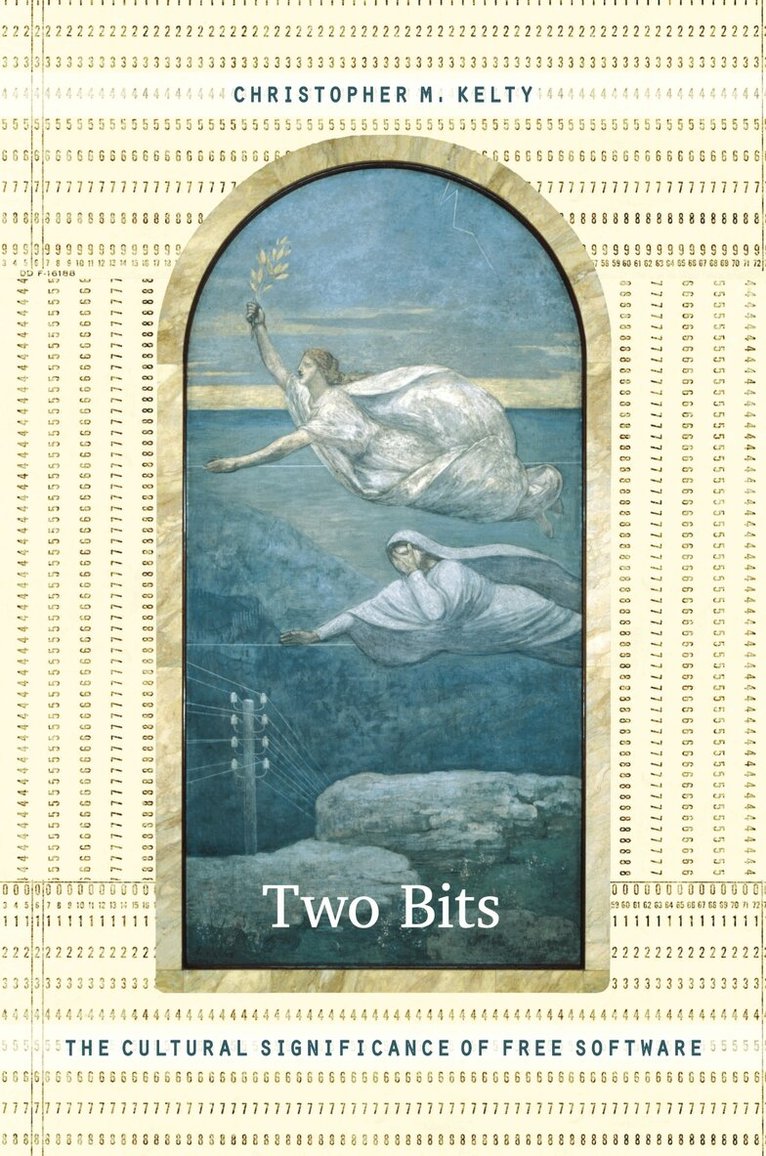
    Two Bits

    The Cultural Significance of Free Software

    AvChristopher M. Kelty

    Häftad, Engelska, 2008

    Del i serien Experimental Futures

    431 kr

    Beställningsvara. Skickas inom 5-8 vardagar. Fri frakt över 249 kr.

    Fler format och utgåvor

    Inbunden

    1 374 kr

    E-bok

    631 kr

    Beskrivning

    In Two Bits, Christopher M. Kelty investigates the history and cultural significance of Free Software, revealing the people and practices that have transformed not only software but also music, film, science, and education. Free Software is a set of practices devoted to the collaborative creation of software source code that is made openly and freely available through an unconventional use of copyright law. Kelty explains how these specific practices have reoriented the relations of power around the creation, dissemination, and authorization of all kinds of knowledge. He also makes an important contribution to discussions of public spheres and social imaginaries by demonstrating how Free Software is a “recursive public”-a public organized around the ability to build, modify, and maintain the very infrastructure that gives it life in the first place. Drawing on ethnographic research that took him from an Internet healthcare start-up company in Boston to media labs in Berlin to young entrepreneurs in Bangalore, Kelty describes the technologies and the moral vision that bind together hackers, geeks, lawyers, and other Free Software advocates. In each case, he shows how their practices and way of life include not only the sharing of software source code but also ways of conceptualizing openness, writing copyright licenses, coordinating collaboration, and proselytizing. By exploring in detail how these practices came together as the Free Software movement from the 1970s to the 1990s, Kelty also considers how it is possible to understand the new movements emerging from Free Software: projects such as Creative Commons, a nonprofit organization that creates copyright licenses, and Connexions, a project to create an online scholarly textbook commons.

    Produktinformation

    • Utgivningsdatum:2008-06-09
    • Mått:156 x 235 x 31 mm
    • Vikt:662 g
    • Format:Häftad
    • Språk:Engelska
    • Serie:Experimental Futures
    • Antal sidor:400
    • Förlag:Duke University Press
    • ISBN:9780822342649

    Utforska kategorier

    • Kulturvetenskap inom Samhälle och politik
    • Medievetenskap inom Samhälle och politik

    Mer om författaren

    Christopher M. Kelty is Assistant Professor of Anthropology at Rice University.

    Recensioner i media

    “[R]ich with empirical insight and exceptionally well written, Two Bits is delightful to read. I recommend the book to readers interested in open source, technology, and social change. . . .” - Zack Kertcher, American Journal of Sociology “It would be a great pity indeed if anthropologists, assuming they have no interest in software development, were to ignore the subtitle of this book. Because ‘the cultural significance of free software’ takes to heart matters of concern to all anthropologists. . . . They would miss a book that has as much to contribute to the anthropology of law as to the anthropology of religion, both much enhanced by the unusual perspective that emerges from software development. They would also miss a good read.” - Daniel Miller, American Anthropologist “I think Kelty’s book deserves a wide readership - especially among nerds trying to make sense of the past decade, let alone to prepare for the next one.” - Scott McLemee, Inside Higher Ed “Considering the scope of the subject matter, the book is not especially steeped in technical jargon, and is therefore highly readable for a wide and varied audience. Contrary to first impression this book is not specifically directed towards geeks, software code authors, or other computer nerds, although these individuals will find the book informative and inspiring. It also should be read by all those who have positions of influence such as teachers, cultural studies academics, government decision/policy makers and of course members of the legal profession.” - Rob Harle, Leonardo “[A] closely argued, well-defended, painstakingly referenced treatise covering one of the most complex, and possibly least understood, cultural movements of recent decades. . . . [D]eeply engaging.” - John Gilbey, Times Higher Education “In this study of the Free Software/Open Source movement, Christopher Kelty provides a fascinating look into a world that may initially seem arcane to those outside the field, but which illuminates many connections between ‘geek’ culture and the wider world as well. . . . In a moment marked by Wikipedia and Facebook, new connections and forms are emerging every day. Two Bits reaches beyond the technicalities of the Free Software movement to help provide productive ways to think about these non-traditional communities as they are only beginning to imagine themselves.” - Erica A. Farmer, Anthropological Quarterly “Two Bits describes the way those who work and play with Free Software themselves change in the process-engendering what Kelty calls ‘recursive publics’-social configurations that realize the Internet’s non-hierarchical, ever-evolving, and thus historically attuned logic, creatively updating the types of public spheres previously theorized by Habermas and Michael Warner, among others. Two Bits does something similar, pulling readers into an experimental (ethnographic) mode that draws out how Open Source movements have garnered the momentum and significance they have today. The book-on paper and online-quite literally shows how it is done, itself embodying the standards that make Free Software work. Two Bits is critical reading, in all senses.”-Kim Fortun, Rensselaer Polytechnic Institute “I know of no other book that mixes so beautifully a deep theoretical understanding of social theory with a rich historical and contemporary ethnography of the Free Software and free culture movements. Christopher M. Kelty’s book speaks to many audiences; his message should be understood by many more.”-Lawrence Lessig, Stanford Law School “[A] closely argued, well-defended, painstakingly referenced treatise covering one of the most complex, and possibly least understood, cultural movements of recent decades. . . . [D]eeply engaging.” - John Gilbey (Times Higher Education) “[R]ich with empirical insight and exceptionally well written, Two Bits is delightful to read. I recommend the book to readers interested in open source, technology, and social change. . . .” - Zack Kertcher (American Journal of Sociology) “Considering the scope of the subject matter, the book is not especially steeped in technical jargon, and is therefore highly readable for a wide and varied audience. Contrary to first impression this book is not specifically directed towards geeks, software code authors, or other computer nerds, although these individuals will find the book informative and inspiring. It also should be read by all those who have positions of influence such as teachers, cultural studies academics, government decision/policy makers and of course members of the legal profession.” - Rob Harle (Leonardo Reviews) “I think Kelty’s book deserves a wide readership - especially among nerds trying to make sense of the past decade, let alone to prepare for the next one.” - Scott McLemee (Inside Higher Ed) “In this study of the Free Software/Open Source movement, Christopher Kelty provides a fascinating look into a world that may initially seem arcane to those outside the field, but which illuminates many connections between ‘geek’ culture and the wider world as well. . . . In a moment marked by Wikipedia and Facebook, new connections and forms are emerging every day. Two Bits reaches beyond the technicalities of the Free Software movement to help provide productive ways to think about these non-traditional communities as they are only beginning to imagine themselves.” - Erica A. Farmer (Anthropological Quarterly) “It would be a great pity indeed if anthropologists, assuming they have no interest in software development, were to ignore the subtitle of this book. Because ‘the cultural significance of free software’ takes to heart matters of concern to all anthropologists. . . . They would miss a book that has as much to contribute to the anthropology of law as to the anthropology of religion, both much enhanced by the unusual perspective that emerges from software development. They would also miss a good read.” - Daniel Miller (American Anthropologist)

    Innehållsförteckning

    • Preface ixAcknowledgments xiiiIntroduction 1Part I. The Internet 1. Geeks and Recursive Publics 272. Protestant Reformers, Polymaths, Transhumanists 64Part II. Free Software 3. The Movement 974. Sharing Source Code 1185. Conceiving Open Systems 1436. Writing Copyright Licenses 1797. Coordinating Collaborations 210Part III. Modulations 8. "If We Succeed, We Will Disappear" 2439. Reuse, Modification, and the Nonexistence of Norms 269Conclusion: The Cultural Consequences of Free Software 301Notes 311Bibliography 349Index 367