Chrystopher L. Nehaniv – författare
Visar alla böcker från författaren Chrystopher L. Nehaniv. Handla med fri frakt och snabb leverans.
14 produkter
14 produkter
Häftad, Engelska, 2002
893 kr
Skickas inom 5-8 vardagar
Häftad, Engelska, 2009
752 kr
Skickas inom 7-10 vardagar
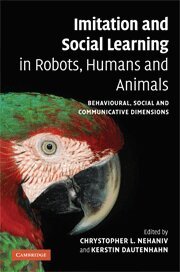
Mechanisms of imitation and social matching play a fundamental role in development, communication, interaction, learning and culture. Their investigation in different agents (animals, humans and robots) has significantly influenced our understanding of the nature and origins of social intelligence. Whilst such issues have traditionally been studied in areas such as psychology, biology and ethnology, it has become increasingly recognised that a 'constructive approach' towards imitation and social learning via the synthesis of artificial agents can provide important insights into mechanisms and create artefacts that can be instructed and taught by imitation, demonstration, and social interaction rather than by explicit programming. This book studies increasingly sophisticated models and mechanisms of social matching behaviour and marks an important step towards the development of an interdisciplinary research field, consolidating and providing a valuable reference for the increasing number of researchers in the field of imitation and social learning in robots, humans and animals.
Inbunden, Engelska, 2004
1 705 kr
Skickas inom 5-8 vardagar
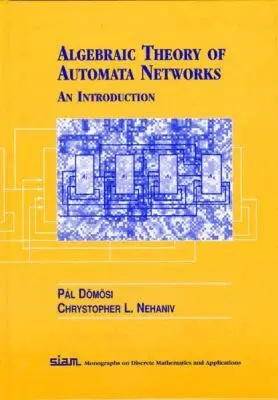
Algebraic Theory of Automata Networks investigates automata networks as algebraic structures and develops their theory in line with other algebraic theories, such as those of semigroups, groups, rings, and fields. The authors also investigate automata networks as products of automata, that is, as compositions of automata obtained by cascading without feedback or with feedback of various restricted types or, most generally, with the feedback dependencies controlled by an arbitrary directed graph. This self-contained book surveys and extends the fundamental results in regard to automata networks, including the main decomposition theorems of Letichevsky, of Krohn and Rhodes, and of others.It summarizes the most important results of the past four decades regarding automata networks and presents many new results discovered since the last book on this subject was published. It contains several new methods and special techniques not discussed in other books, including characterization of homomorphically complete classes of automata under the cascade product; products of automata with semi-Letichevsky criterion and without any Letichevsky criteria; automata with control words; primitive products and temporal products; network completeness for digraphs having all loop edges; complete finite automata network graphs with minimal number of edges; and emulation of automata networks by corresponding asynchronous ones.
Inbunden, Engelska, 2007
1 668 kr
Skickas inom 10-15 vardagar
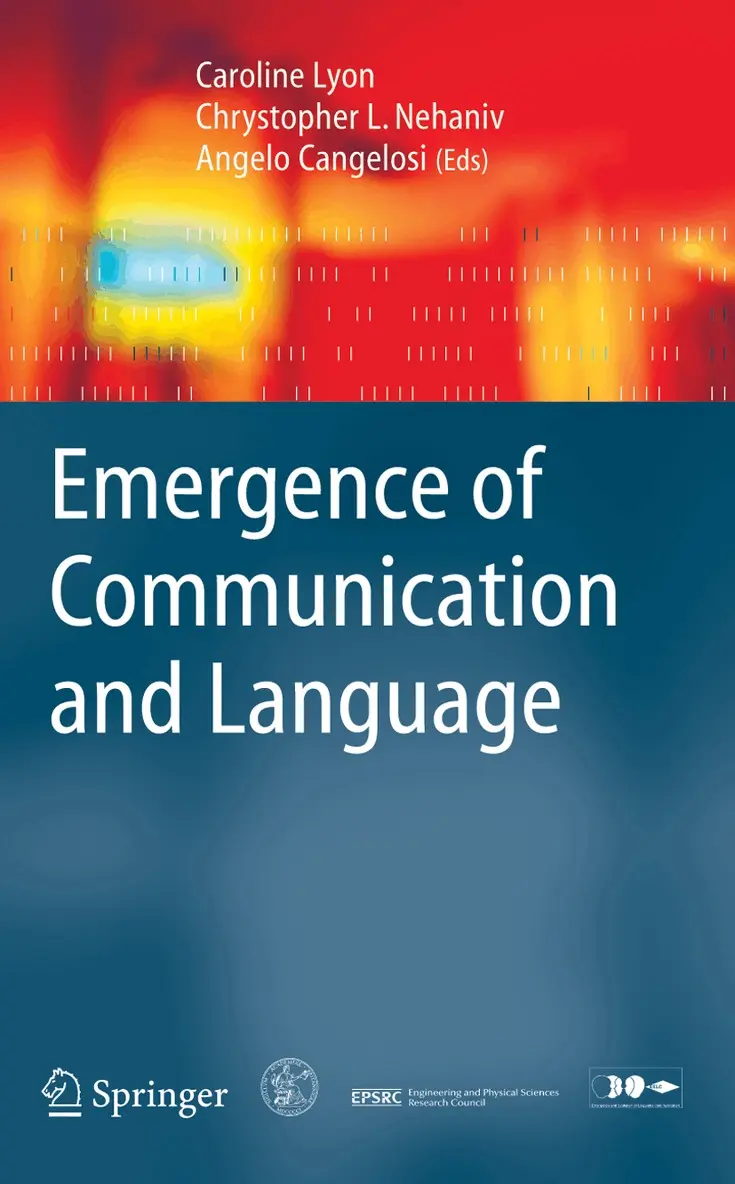
Current Work and Open Problems: A Road-Map for Research into the Emergence of Communication and Language Chrystopher L. Nehaniv, Caroline Lyon, and Angelo Cangelosi 1.1. Introduction This book brings together work on the emergence of communication and language from researchers working in a broad array of scientific paradigms in North America, Europe, Japan and Africa. We hope that its multi-disciplinary approach will encourage cross-fertilization and promote further advances in this active research field. The volume draws on diverse disciplines, including linguistics, psychology, neuroscience, ethology, anthropology, robotics, and computer science. Computational simulations of the emergence of phenomena associated with communication and language play a key role in illuminating some of the most significant issues, and the renewed scientific interest in language emergence has benefited greatly from research in Artificial Intelligence and Cognitive Science. The book starts with this road map chapter by the editors, pointing to the ways in which disparate disciplines can inform and stimulate each other. It examines the role of simulations as a novel way to express theories in science, and their contribution to the development of a new approach to the study of the emergence of communication and language. We will also discuss and collect the most promising directions and grand challenge problems for future research. The present volume, is organized into three parts: I. Empirical Investi- tions on Human Language, II. Synthesis and Simulation of Communication and Language in Artificial Systems, and III. Insights from Animal Communication.
E-bok
PDF, Engelska, 20101 995 kr
Läs direkt efter köp
Current Work and Open Problems: A Road-Map for Research into the Emergence of Communication and Language Chrystopher L. Nehaniv, Caroline Lyon, and Angelo Cangelosi 1.1. Introduction This book brings together work on the emergence of communication and language from researchers working in a broad array of scientific paradigms in North America, Europe, Japan and Africa. We hope that its multi-disciplinary approach will encourage cross-fertilization and promote further advances in this active research field. The volume draws on diverse disciplines, including linguistics, psychology, neuroscience, ethology, anthropology, robotics, and computer science. Computational simulations of the emergence of phenomena associated with communication and language play a key role in illuminating some of the most significant issues, and the renewed scientific interest in language emergence has benefited greatly from research in Artificial Intelligence and Cognitive Science. The book starts with this road map chapter by the editors, pointing to the ways in which disparate disciplines can inform and stimulate each other. It examines the role of simulations as a novel way to express theories in science, and their contribution to the development of a new approach to the study of the emergence of communication and language. We will also discuss and collect the most promising directions and grand challenge problems for future research. The present volume, is organized into three parts: I. Empirical Investi- tions on Human Language, II. Synthesis and Simulation of Communication and Language in Artificial Systems, and III. Insights from Animal Communication.
Häftad, Engelska, 2010
1 620 kr
Skickas inom 10-15 vardagar
Current Work and Open Problems: A Road-Map for Research into the Emergence of Communication and Language Chrystopher L. Nehaniv, Caroline Lyon, and Angelo Cangelosi 1.1. Introduction This book brings together work on the emergence of communication and language from researchers working in a broad array of scientific paradigms in North America, Europe, Japan and Africa. We hope that its multi-disciplinary approach will encourage cross-fertilization and promote further advances in this active research field. The volume draws on diverse disciplines, including linguistics, psychology, neuroscience, ethology, anthropology, robotics, and computer science. Computational simulations of the emergence of phenomena associated with communication and language play a key role in illuminating some of the most significant issues, and the renewed scientific interest in language emergence has benefited greatly from research in Artificial Intelligence and Cognitive Science. The book starts with this road map chapter by the editors, pointing to the ways in which disparate disciplines can inform and stimulate each other. It examines the role of simulations as a novel way to express theories in science, and their contribution to the development of a new approach to the study of the emergence of communication and language. We will also discuss and collect the most promising directions and grand challenge problems for future research. The present volume, is organized into three parts: I. Empirical Investi- tions on Human Language, II. Synthesis and Simulation of Communication and Language in Artificial Systems, and III. Insights from Animal Communication.
Häftad, Engelska, 2001
1 115 kr
Skickas inom 10-15 vardagar
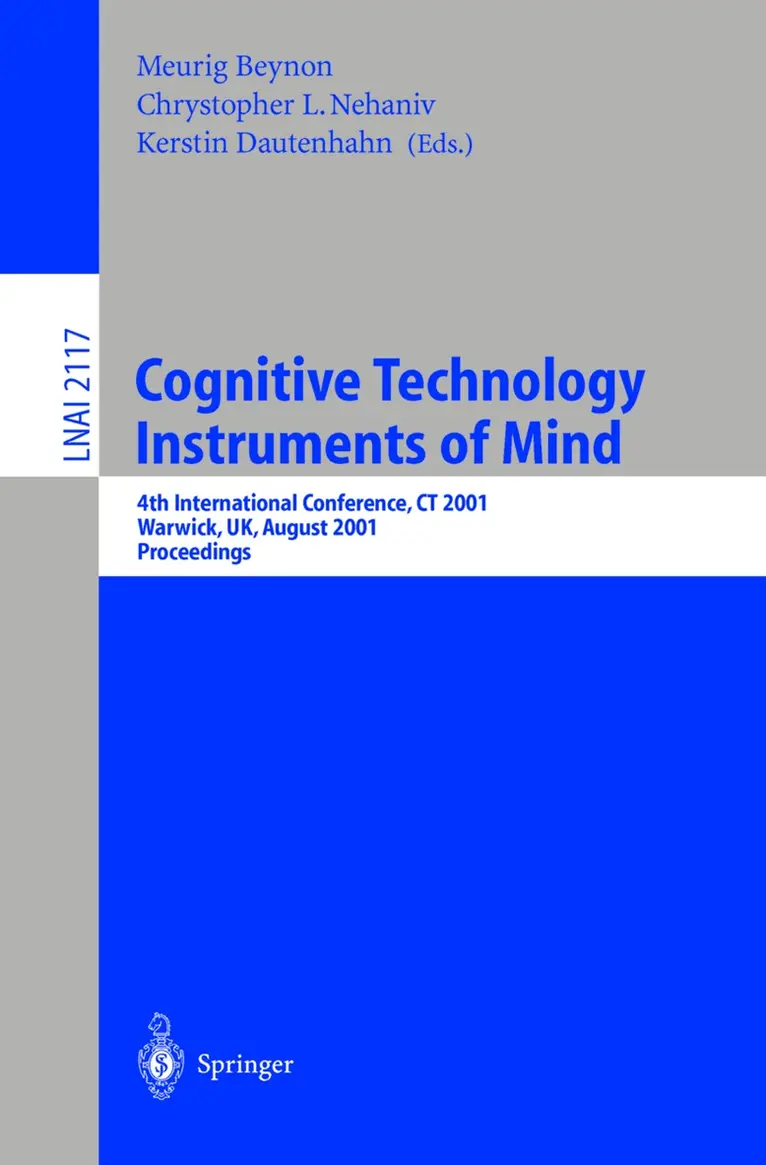
Cognitive Technology: Instruments of Mind Cognitive Technology is the study of the impact of technology on human cog- tion, the externalization of technology from the human mind, and the pragmatics of tools. It promotes the view that human beings should develop methods to p- dict, analyse, and optimize aspects of human-tool relationship in a manner that respects human wholeness. In particular the development of new tools such as virtual environments, new computer devices, and software tools has been too little concerned with the impacts these technologies will have on human cog- tive and social capacities. Our tools change what we are and how we relate to the world around us. They need to be developed in a manner that both extends human capabilities while ensuring an appropriate cognitive t between organism and instrument. The principal theme of the CT 2001 conference and volume is declared in its title: Instruments of Mind. Cognitive Technology is concerned with the interaction between two worlds: that of the mind and that of the machine. In science and engineering, this - teraction is often explored by posing the question: how can technology be best tailored to human cognition? But as the history of technological developments has consistently shown, cognition is also fashioned by technology. Technologies as diverse as writing, electricity generation, and the silicon chip all illustrate the profound and dynamic impact of technology upon ourselves and our conceptions of the world.
E-bok
PDF, Engelska, 20031 377 kr
Läs direkt efter köp
Cognitive Technology: Instruments of Mind Cognitive Technology is the study of the impact of technology on human cog- tion, the externalization of technology from the human mind, and the pragmatics of tools. It promotes the view that human beings should develop methods to p- dict, analyse, and optimize aspects of human-tool relationship in a manner that respects human wholeness. In particular the development of new tools such as virtual environments, new computer devices, and software tools has been too little concerned with the impacts these technologies will have on human cog- tive and social capacities. Our tools change what we are and how we relate to the world around us. They need to be developed in a manner that both extends human capabilities while ensuring an appropriate cognitive t between organism and instrument. The principal theme of the CT 2001 conference and volume is declared in its title: Instruments of Mind. Cognitive Technology is concerned with the interaction between two worlds: that of the mind and that of the machine. In science and engineering, this - teraction is often explored by posing the question: how can technology be best tailored to human cognition? But as the history of technological developments has consistently shown, cognition is also fashioned by technology. Technologies as diverse as writing, electricity generation, and the silicon chip all illustrate the profound and dynamic impact of technology upon ourselves and our conceptions of the world.
E-bok
PDF, Engelska, 2003734 kr
Läs direkt efter köp
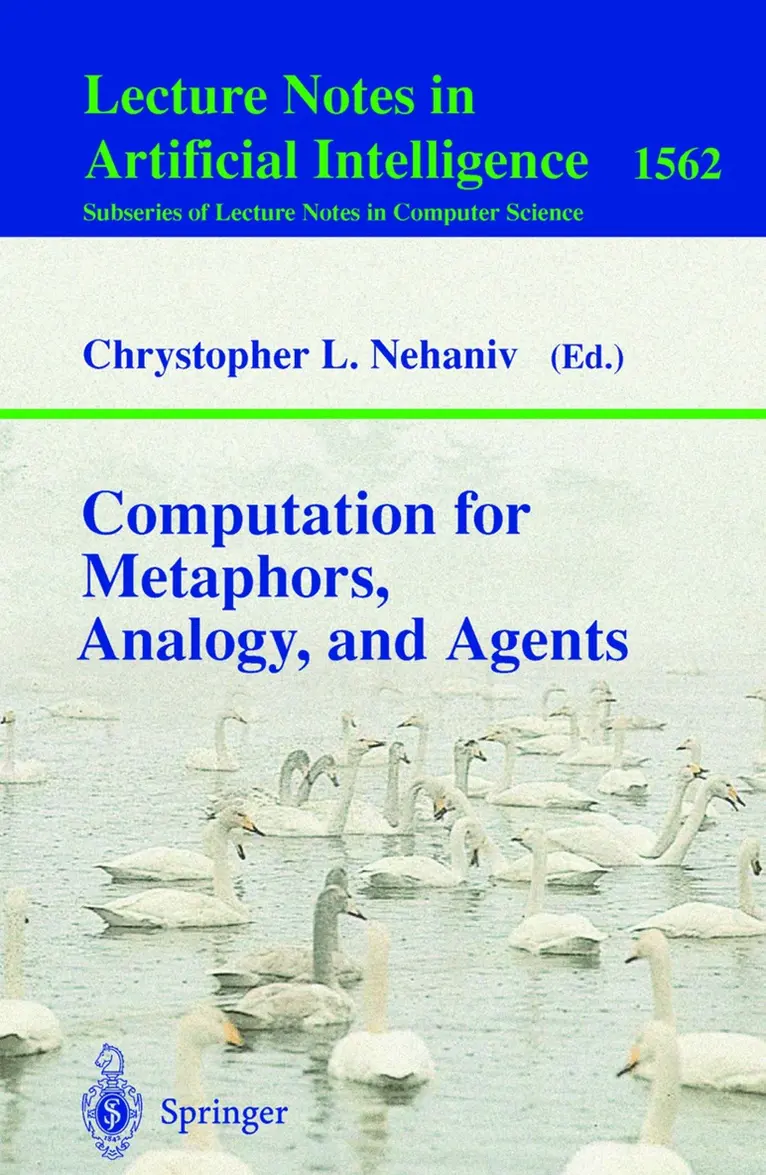
This volume brings together the work of researchers from various disciplines where aspects of descriptive, mathematical, computational or design knowledge concerning metaphor and analogy, especially in the context of agents, have emerged. The book originates from an international workshop on Computation for Metaphors, Analogy, and Agents (CMAA), held in Aizu, Japan in April 1998.The 19 carefully reviewed and revised papers presented together with an introduction by the volume editor are organized into sections on Metaphor and Blending, Embodiment, Interaction, Imitation, Situated Mapping in Space and Time, Algebraic Engineering: Respecting Structure, and a Sea-Change in Viewpoints.
Häftad, Engelska, 1999
561 kr
Skickas inom 10-15 vardagar
This volume brings together the work of researchers from various disciplines where aspects of descriptive, mathematical, computational or design knowledge concerning metaphor and analogy, especially in the context of agents, have emerged. The book originates from an international workshop on Computation for Metaphors, Analogy, and Agents (CMAA), held in Aizu, Japan in April 1998.The 19 carefully reviewed and revised papers presented together with an introduction by the volume editor are organized into sections on Metaphor and Blending, Embodiment, Interaction, Imitation, Situated Mapping in Space and Time, Algebraic Engineering: Respecting Structure, and a Sea-Change in Viewpoints.
Inbunden, Engelska, 2009
1 001 kr
Skickas inom 5-8 vardagar
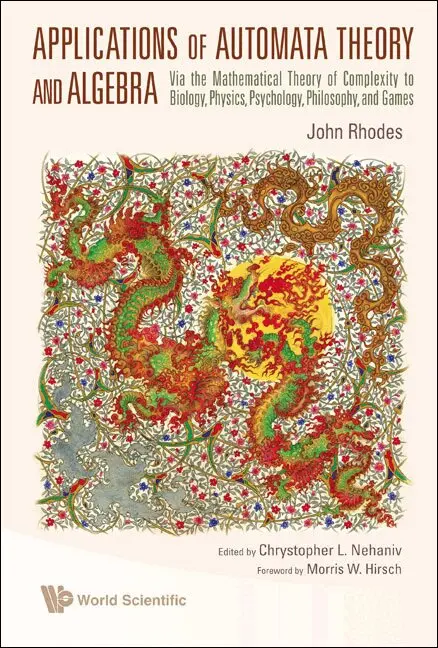
This book was originally written in 1969 by Berkeley mathematician John Rhodes. It is the founding work in what is now called algebraic engineering, an emerging field created by using the unifying scheme of finite state machine models and their complexity to tie together many fields: finite group theory, semigroup theory, automata and sequential machine theory, finite phase space physics, metabolic and evolutionary biology, epistemology, mathematical theory of psychoanalysis, philosophy, and game theory. The author thus introduced a completely original algebraic approach to complexity and the understanding of finite systems. The unpublished manuscript, often referred to as “The Wild Book”, became an underground classic, continually requested in manuscript form, and read by many leading researchers in mathematics, complex systems, artificial intelligence, and systems biology. Yet it has never been available in print until now.This first published edition has been edited and updated by Chrystopher Nehaniv for the 21st century. Its novel and rigorous development of the mathematical theory of complexity via algebraic automata theory reveals deep and unexpected connections between algebra (semigroups) and areas of science and engineering. Co-founded by John Rhodes and Kenneth Krohn in 1962, algebraic automata theory has grown into a vibrant area of research, including the complexity of automata, and semigroups and machines from an algebraic viewpoint, and which also touches on infinite groups, and other areas of algebra. This book sets the stage for the application of algebraic automata theory to areas outside mathematics.The material and references have been brought up to date by the editor as much as possible, yet the book retains its distinct character and the bold yet rigorous style of the author. Included are treatments of topics such as models of time as algebra via semigroup theory; evolution-complexity relations applicable to both ontogeny and evolution; an approach to classification of biological reactions and pathways; the relationships among coordinate systems, symmetry, and conservation principles in physics; discussion of “punctuated equilibrium” (prior to Stephen Jay Gould); games; and applications to psychology, psychoanalysis, epistemology, and the purpose of life.The approach and contents will be of interest to a variety of researchers and students in algebra as well as to the diverse, growing areas of applications of algebra in science and engineering. Moreover, many parts of the book will be intelligible to non-mathematicians, including students and experts from diverse backgrounds. remove
Häftad, Engelska, 2009
632 kr
Skickas inom 5-8 vardagar
This book was originally written in 1969 by Berkeley mathematician John Rhodes. It is the founding work in what is now called algebraic engineering, an emerging field created by using the unifying scheme of finite state machine models and their complexity to tie together many fields: finite group theory, semigroup theory, automata and sequential machine theory, finite phase space physics, metabolic and evolutionary biology, epistemology, mathematical theory of psychoanalysis, philosophy, and game theory. The author thus introduced a completely original algebraic approach to complexity and the understanding of finite systems. The unpublished manuscript, often referred to as “The Wild Book”, became an underground classic, continually requested in manuscript form, and read by many leading researchers in mathematics, complex systems, artificial intelligence, and systems biology. Yet it has never been available in print until now.This first published edition has been edited and updated by Chrystopher Nehaniv for the 21st century. Its novel and rigorous development of the mathematical theory of complexity via algebraic automata theory reveals deep and unexpected connections between algebra (semigroups) and areas of science and engineering. Co-founded by John Rhodes and Kenneth Krohn in 1962, algebraic automata theory has grown into a vibrant area of research, including the complexity of automata, and semigroups and machines from an algebraic viewpoint, and which also touches on infinite groups, and other areas of algebra. This book sets the stage for the application of algebraic automata theory to areas outside mathematics.The material and references have been brought up to date by the editor as much as possible, yet the book retains its distinct character and the bold yet rigorous style of the author. Included are treatments of topics such as models of time as algebra via semigroup theory; evolution-complexity relations applicable to both ontogeny and evolution; an approach to classification of biological reactions and pathways; the relationships among coordinate systems, symmetry, and conservation principles in physics; discussion of “punctuated equilibrium” (prior to Stephen Jay Gould); games; and applications to psychology, psychoanalysis, epistemology, and the purpose of life.The approach and contents will be of interest to a variety of researchers and students in algebra as well as to the diverse, growing areas of applications of algebra in science and engineering. Moreover, many parts of the book will be intelligible to non-mathematicians, including students and experts from diverse backgrounds. remove
Inbunden, Engelska, 2007
1 180 kr
Tillfälligt slut
Mechanisms of imitation and social matching play a fundamental role in development, communication, interaction, learning and culture. Their investigation in different agents (animals, humans and robots) has significantly influenced our understanding of the nature and origins of social intelligence. Whilst such issues have traditionally been studied in areas such as psychology, biology and ethnology, it has become increasingly recognised that a 'constructive approach' towards imitation and social learning via the synthesis of artificial agents can provide important insights into mechanisms and create artefacts that can be instructed and taught by imitation, demonstration, and social interaction rather than by explicit programming. This book studies increasingly sophisticated models and mechanisms of social matching behaviour and marks an important step towards the development of an interdisciplinary research field, consolidating and providing a valuable reference for the increasing number of researchers in the field of imitation and social learning in robots, humans and animals.
Inbunden, Engelska, 1999
3 377 kr
Tillfälligt slut
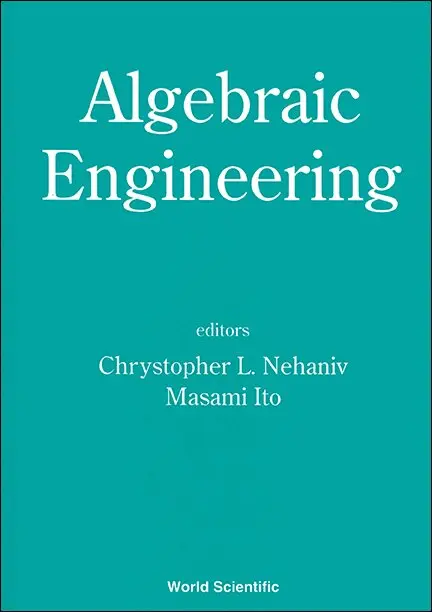
There is algebraic structure in time, computation and biological systems. Algebraic engineering exploits this structure to achieve better understanding and design. In this book, pure and applied results in semigroups, language theory and algebra are applied to areas ranging from circuit design to software engineering to biological evolution.