Claude E. Barfield – författare
Visar alla böcker från författaren Claude E. Barfield. Handla med fri frakt och snabb leverans.
8 produkter
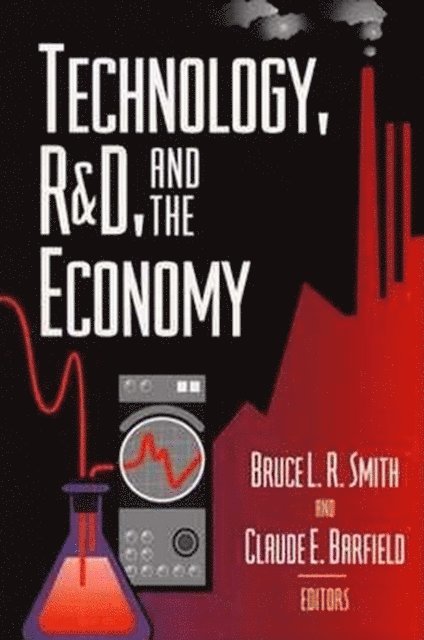
Technology, R&D, and the Economy
Av Bruce Smith, Claude E. Barfield
E-bok, 2010
321 kr
Lägg i varukorg
""How and how much should we seek R&D knowledge to pursue 21st century human and economic goals? The valid options are clearly presented here with incomparable diversity and depth of thought.""Robert W. Galvin, Motorola, Inc. What are the links between technology and the economy? How much does …
Technology, R&D, and the Economy
Av Bruce Smith, Claude E. Barfield
Häftad, 1996
290 kr
Lägg i varukorg
""How and how much should we seek R&D knowledge to pursue 21st century human and economic goals? The valid options are clearly presented here with incomparable diversity and depth of thought.""Robert W. Galvin, Motorola, Inc.What are the links between technology and the economy? How much does …
Tiger by the Tail
Av Claude E. Barfield, Mark A. Groombridge
Häftad, 1999
193 kr
Lägg i varukorg
In this work, the authors examine the problems that are likely to delay China's accession to the World Trade Organization. They propose guidelines for how the WTO should address the accession of not only China, but of other non-market economies as well.
High-tech Protectionism
The Irrationality of Antidumping Laws
Häftad, 2003
193 kr
Lägg i varukorg
In this study, Claude Barfield explores the negative consequences of attempts to protect key U.S. manufacturing industries through the use of antidumping laws. These laws are one of the most contentious areas of international trade policy. Barfield believes antidumping laws are fundamentally at …
Internet, Economic Growth and Globalization
Perspectives on the New Economy in Europe, Japan and the USA
Av Claude E. Barfield, Günter S. Heiduk m. fl.
Inbunden, 2003
1095 kr
Lägg i varukorg
The dynamics of the digital economy in the US, Europe and Japan are rather different. Some EU countries come close to the USA as the leading OECD country in the new economy, but Japan faces particular problems in catching-up digitally. Information and communication technology will affect …
Internet, Economic Growth and Globalization
Perspectives on the New Economy in Europe, Japan and the USA
Av Paul J.J. Welfens, Gunter S. Heiduk m. fl.
E-bok, 2012
1459 kr
Lägg i varukorg
The dynamics of the digital economy in the US, Europe and Japan are rather different. Some EU countries come close to the USA as the leading OECD country in the new economy, but Japan faces particular problems in catching-up digitally. Information and communication technology will affect …
Internet, Economic Growth and Globalization
Perspectives on the New Economy in Europe, Japan and the USA
Av Claude E. Barfield, Günter S. Heiduk m. fl.
Häftad, 2010
1128 kr
Lägg i varukorg
The dynamics of the digital economy in the US, Europe and Japan are rather different. Some EU countries come close to the USA as the leading OECD country in the new economy, but Japan faces particular problems in catching-up digitally. Information and communication technology will affect …