Claudia Leacock – författare
Visar alla böcker från författaren Claudia Leacock. Handla med fri frakt och snabb leverans.
5 produkter
5 produkter
Inbunden, Engelska, 2000
2 491 kr
Skickas inom 5-8 vardagar
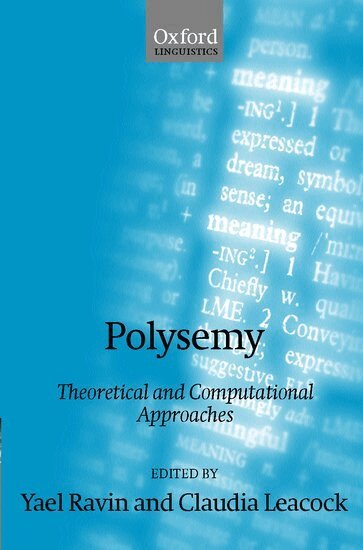
This volume of newly commissioned essays examines current theoretical and computational work on polysemy, the term used in semantic analysis to describe words with more than one meaning or function, sometimes perhaps related (as in plain) and sometimes perhaps not (as in bank). Such words present few difficulties in everyday language, but pose central problems for linguists and lexicographers, especially for those involved in lexical semantics and in computational modelling. The contributors to this book–leading researchers in theoretical and computational linguistics–consider the implications of these problems for grammatical theory and how they may be addressed by computational means. The theoretical essays in the book examine polysemy as an aspect of a broader theory of word meaning. Three theoretical approaches are presented: the Classical (or Aristotelian), the Prototypical, and the Relational. Their authors describe the nature of polysemy, the criteria for detecting it, and its manifestations across languages. They examine the issues arising from the regularity of polysemy and the theoretical principles proposed to account for the interaction of lexical meaning with the semantics and syntax of the context in which it occurs. Finally they consider the formal representations of meaning in the lexicon, and their implications for dictionary construction. The computational essays are concerned with the challenge of polysemy to automatic sense disambiguation–how intended meaning for a word occurrence can be identified. The approaches presented include the exploitation of lexical information in machine-readable dictionaries, machine learning based on patterns of word co-occurrence, and hybrid approaches that combine the two. As a whole, the volume shows how on the one hand theoretical work provides the motivation and may suggest the basis for computational algorithms, while on the other computational results may validate, or reveal problems in, the principles set forth by theories.
Häftad, Engelska, 2001
950 kr
Skickas inom 5-8 vardagar
This volume of newly commissioned essays examines current theoretical and computational work on polysemy, the term used in semantic analysis to describe words with more than one meaning. Such words present few difficulties in everyday language, but pose central problems for linguists and lexicographers, especially for those involved in lexical semantics and in computational modelling. The contributors to this book -- leading researchers in theoretical and computational linguistics -- consider the implications of these problems for linguistic theory and how they may be addressed by computational means. The theoretical essays in the book examine polysemy as an aspect of a broader theory of word meaning. Three theoretical approaches are presented: the Classical (or Aristotelian), the Prototypical, and the Relational. Their authors describe the nature of polysemy, the criteria for detecting it, and its manifestations across languages. They examine the issues arising from the regularity of polysemy and the theoretical principles proposed to account for the interaction of lexical meaning with the semantics and syntax of the context in which it occurs. Finally they consider the formal representations of meaning in the lexicon, and their implications for dictionary construction. The computational essays are concerned with the challenge of polysemy to automatic sense disambiguation -- how the intended meaning for a word occurrence can be identified. The approaches presented include the exploitation of lexical information in machine-readable dictionaries, machine learning based on patterns of word co-occurrence, and hybrid approaches that combine the two.As a whole the volume shows how on the one hand theoretical work provides the motivation and may suggest the basis for computational algorithms, while on the other computational results may validate, or reveal problems in, the principles set forth by theories.
Häftad, Engelska, 2014
398 kr
Skickas inom 10-15 vardagar
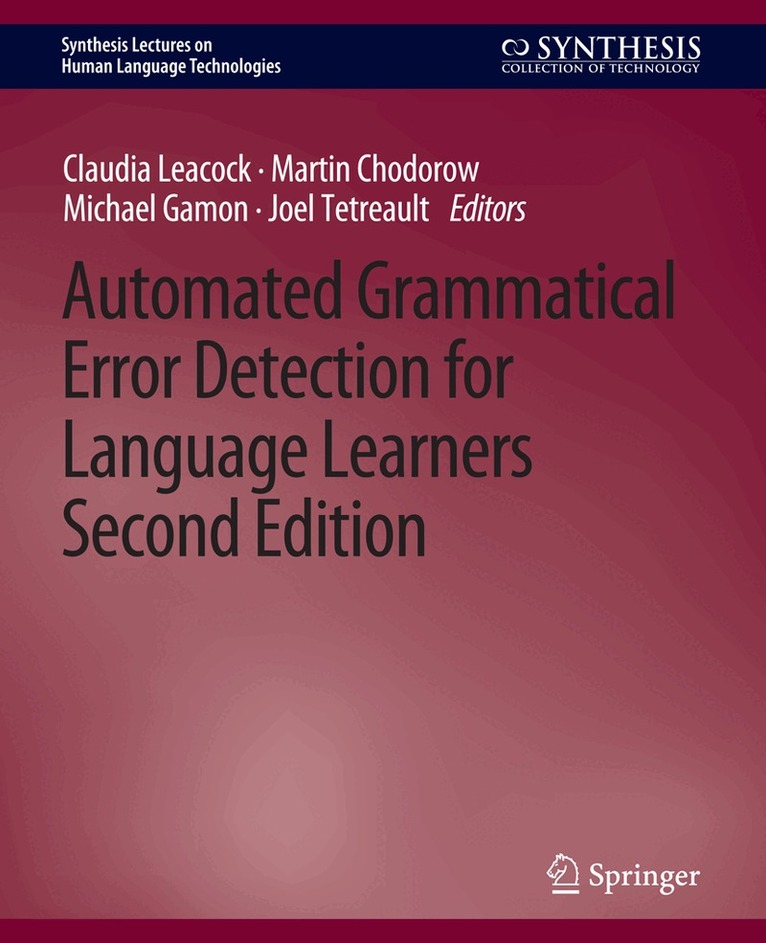
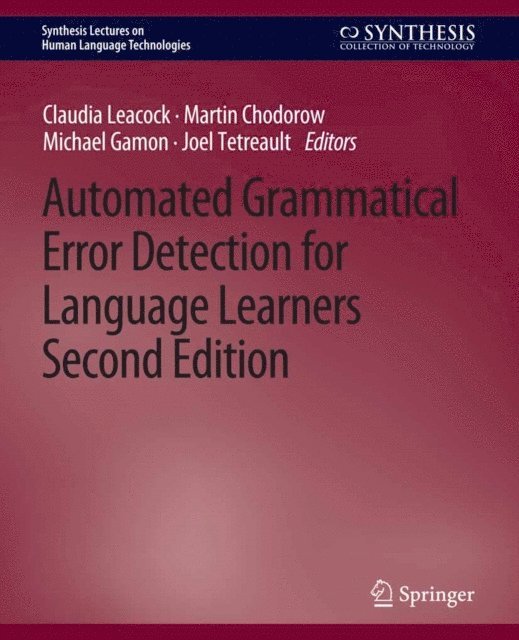
It has been estimated that over a billion people are using or learning English as a second or foreign language, and the numbers are growing not only for English but for other languages as well. These language learners provide a burgeoning market for tools that help identify and correct learners' writing errors. Unfortunately, the errors targeted by typical commercial proofreading tools do not include those aspects of a second language that are hardest to learn. This volume describes the types of constructions English language learners find most difficult: constructions containing prepositions, articles, and collocations. It provides an overview of the automated approaches that have been developed to identify and correct these and other classes of learner errors in a number of languages. Error annotation and system evaluation are particularly important topics in grammatical error detection because there are no commonly accepted standards. Chapters in the book describe the options available to researchers, recommend best practices for reporting results, and present annotation and evaluation schemes. The final chapters explore recent innovative work that opens new directions for research. It is the authors' hope that this volume will continue to contribute to the growing interest in grammatical error detection by encouraging researchers to take a closer look at the field and its many challenging problems.
E-bok
PDF, Engelska, 20221 258 kr
Läs direkt efter köp
It has been estimated that over a billion people are using or learning English as a second or foreign language, and the numbers are growing not only for English but for other languages as well. These language learners provide a burgeoning market for tools that help identify and correct learners'' writing errors. Unfortunately, the errors targeted by typical commercial proofreading tools do not include those aspects of a second language that are hardest to learn. This volume describes the types of constructions English language learners find most difficult -- constructions containing prepositions, articles, and collocations. It provides an overview of the automated approaches that have been developed to identify and correct these and other classes of learner errors in a number of languages. Error annotation and system evaluation are particularly important topics in grammatical error detection because there are no commonly accepted standards. Chapters in the book describe the options available to researchers, recommend best practices for reporting results, and present annotation and evaluation schemes. The final chapters explore recent innovative work that opens new directions for research. It is the authors'' hope that this volume will contribute to the growing interest in grammatical error detection by encouraging researchers to take a closer look at the field and its many challenging problems. Table of Contents: Introduction / History of Automated Grammatical Error Detection / Special Problems of Language Learners / Language Learner Data / Evaluating Error Detection Systems / Article and Preposition Errors / Collocation Errors / Different Approaches for Different Errors / Annotating Learner Errors / New Directions / Conclusion
E-bok
PDF, Engelska, 2022472 kr
Läs direkt efter köp
It has been estimated that over a billion people are using or learning English as a second or foreign language, and the numbers are growing not only for English but for other languages as well. These language learners provide a burgeoning market for tools that help identify and correct learners'' writing errors. Unfortunately, the errors targeted by typical commercial proofreading tools do not include those aspects of a second language that are hardest to learn. This volume describes the types of constructions English language learners find most difficult: constructions containing prepositions, articles, and collocations. It provides an overview of the automated approaches that have been developed to identify and correct these and other classes of learner errors in a number of languages. Error annotation and system evaluation are particularly important topics in grammatical error detection because there are no commonly accepted standards. Chapters in the book describe the options available to researchers, recommend best practices for reporting results, and present annotation and evaluation schemes. The final chapters explore recent innovative work that opens new directions for research. It is the authors'' hope that this volume will continue to contribute to the growing interest in grammatical error detection by encouraging researchers to take a closer look at the field and its many challenging problems.