Yael Ravin - Böcker
Visar alla böcker från författaren Yael Ravin. Handla med fri frakt och snabb leverans.
3 produkter
3 produkter
2 528 kr
Skickas inom 5-8 vardagar
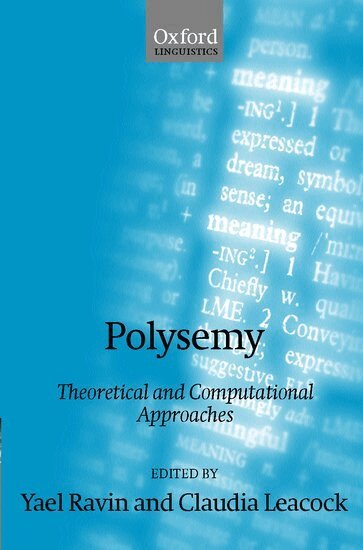
This volume of newly commissioned essays examines current theoretical and computational work on polysemy, the term used in semantic analysis to describe words with more than one meaning or function, sometimes perhaps related (as in plain) and sometimes perhaps not (as in bank). Such words present few difficulties in everyday language, but pose central problems for linguists and lexicographers, especially for those involved in lexical semantics and in computational modelling. The contributors to this book–leading researchers in theoretical and computational linguistics–consider the implications of these problems for grammatical theory and how they may be addressed by computational means. The theoretical essays in the book examine polysemy as an aspect of a broader theory of word meaning. Three theoretical approaches are presented: the Classical (or Aristotelian), the Prototypical, and the Relational. Their authors describe the nature of polysemy, the criteria for detecting it, and its manifestations across languages. They examine the issues arising from the regularity of polysemy and the theoretical principles proposed to account for the interaction of lexical meaning with the semantics and syntax of the context in which it occurs. Finally they consider the formal representations of meaning in the lexicon, and their implications for dictionary construction. The computational essays are concerned with the challenge of polysemy to automatic sense disambiguation–how intended meaning for a word occurrence can be identified. The approaches presented include the exploitation of lexical information in machine-readable dictionaries, machine learning based on patterns of word co-occurrence, and hybrid approaches that combine the two. As a whole, the volume shows how on the one hand theoretical work provides the motivation and may suggest the basis for computational algorithms, while on the other computational results may validate, or reveal problems in, the principles set forth by theories.
370 kr
Skickas inom 7-10 vardagar
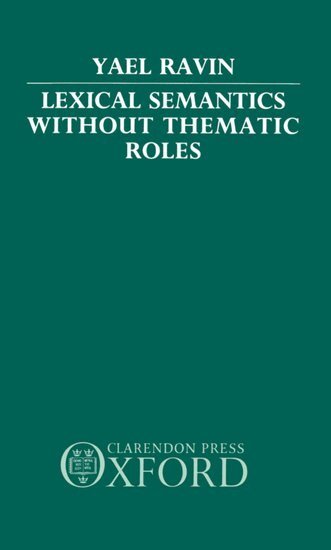
One of the central issues in modern linguistics has been the relationship between syntax and semantics. Within the framework of generative grammar, established by Chomsky in the early 1960s, it has been assumed that syntax is distinct from, and independent of, semantics. This premise has been challenged recently by Chomsky himself; he now proposes semantics, and in particular thematic roles, as the basis for generating syntactic structures.Yael Ravin argues that thematic roles are not valid semantic entities, and that syntax and semantics are indeed autonomous and independent of one another. She advocates a Decompositional approach to lexical semantics, in the spirit of Katz's semantic theory. In the course of her argument she discusses theoretical issues such as indeterminacy and ambiguity, lexical configuration rules, and lexical projection, and analyses the semantic content of event concepts such as causation, action, and change.
930 kr
Skickas inom 5-8 vardagar
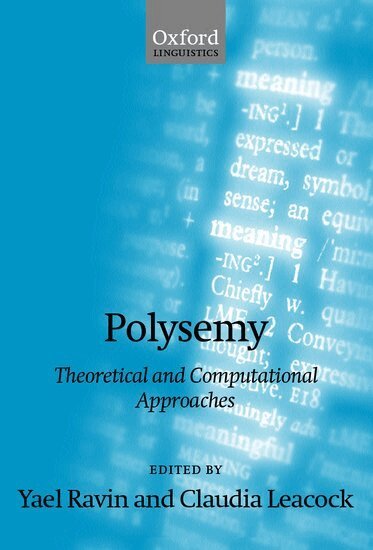
This volume of newly commissioned essays examines current theoretical and computational work on polysemy, the term used in semantic analysis to describe words with more than one meaning. Such words present few difficulties in everyday language, but pose central problems for linguists and lexicographers, especially for those involved in lexical semantics and in computational modelling. The contributors to this book -- leading researchers in theoretical and computational linguistics -- consider the implications of these problems for linguistic theory and how they may be addressed by computational means. The theoretical essays in the book examine polysemy as an aspect of a broader theory of word meaning. Three theoretical approaches are presented: the Classical (or Aristotelian), the Prototypical, and the Relational. Their authors describe the nature of polysemy, the criteria for detecting it, and its manifestations across languages. They examine the issues arising from the regularity of polysemy and the theoretical principles proposed to account for the interaction of lexical meaning with the semantics and syntax of the context in which it occurs. Finally they consider the formal representations of meaning in the lexicon, and their implications for dictionary construction. The computational essays are concerned with the challenge of polysemy to automatic sense disambiguation -- how the intended meaning for a word occurrence can be identified. The approaches presented include the exploitation of lexical information in machine-readable dictionaries, machine learning based on patterns of word co-occurrence, and hybrid approaches that combine the two.As a whole the volume shows how on the one hand theoretical work provides the motivation and may suggest the basis for computational algorithms, while on the other computational results may validate, or reveal problems in, the principles set forth by theories.