Colin M. Coates - Böcker
Visar alla böcker från författaren Colin M. Coates. Handla med fri frakt och snabb leverans.
6 produkter
6 produkter
Del 8 - McGill-Queen's French Atlantic Worlds Series
Political Culture in Louis XIV’s Canada
Majesty, Ritual, and Rhetoric
Inbunden, Engelska, 2024
1 199 kr
Skickas inom 7-10 vardagar
In Louis XIV’s New France, colonial authorities attempted to reproduce French regal authority in novel ways, often by performing typical metropolitan political rituals. When these practices were transposed into the St Lawrence Valley settlements, where a small French population lived alongside a substantial Indigenous presence, they took on new meanings.The colony of Canada replicated many features of the developing French absolutist state. Yet while the king likely knew more about his colony than he did about most parts of metropolitan France, this transatlantic setting imposed new constraints on absolutist authority, from the challenges of distance to an Indigenous population that largely lived outside European norms. Political Culture in Louis XIV’s Canada examines royal power as it was represented in ritual (ceremonial entrances, Te Deums, processions), in rhetoric (political disputes over cabals and factions), and in objects (portraits, royal busts, currency, buildings, maps, and censuses). Colin Coates describes the successes and failures the French authorities experienced in exporting their political practices. He reveals how those authorities’ understandings of Indigenous political culture shaped ideas of the proper relation between rulers and the ruled.This book traces the establishment of a colonial political culture that continued to shape the lives of the French in Canada long after the Sun King’s death in 1715.
Del 8 - McGill-Queen's French Atlantic Worlds Series
Political Culture in Louis XIV’s Canada
Majesty, Ritual, and Rhetoric
Häftad, Engelska, 2024
409 kr
Skickas inom 11-20 vardagar
In Louis XIV’s New France, colonial authorities attempted to reproduce French regal authority in novel ways, often by performing typical metropolitan political rituals. When these practices were transposed into the St Lawrence Valley settlements, where a small French population lived alongside a substantial Indigenous presence, they took on new meanings.The colony of Canada replicated many features of the developing French absolutist state. Yet while the king likely knew more about his colony than he did about most parts of metropolitan France, this transatlantic setting imposed new constraints on absolutist authority, from the challenges of distance to an Indigenous population that largely lived outside European norms. Political Culture in Louis XIV’s Canada examines royal power as it was represented in ritual (ceremonial entrances, Te Deums, processions), in rhetoric (political disputes over cabals and factions), and in objects (portraits, royal busts, currency, buildings, maps, and censuses). Colin Coates describes the successes and failures the French authorities experienced in exporting their political practices. He reveals how those authorities’ understandings of Indigenous political culture shaped ideas of the proper relation between rulers and the ruled.This book traces the establishment of a colonial political culture that continued to shape the lives of the French in Canada long after the Sun King’s death in 1715.
319 kr
Skickas inom 7-10 vardagar
Intended to delight and provoke, these short, beautifully crafted essays, enlivened with photos and illustrations, explore how humans have engaged with the Canadian environment and what those interactions say about the nature of Canada. Tracing a path from the Ice Age to the Anthropocene, some of the foremost stars in the field of environmental history reflect on how we, as a nation, have idolized and found inspiration in nature even as fishers, fur traders, farmers, foresters, miners, and city planners have commodified it or tried to tame it. They also travel lesser-known routes, revealing how Indigenous people listened to glaciers and what they have to tell us; and how even the nature we can't see – the smallest of pathogens – has served the interests of some while threatening the very existence of others.The Nature of Canada will make you think differently not only about Canada and its past but quite possibly about Canada and its future. Its insights are just what we need as Canada attempts to reconcile the opposing goals of prosperity and preservation.
Heroines and History
Representations of Madeleine De Verchères and Laura Secord
Häftad, Engelska, 2002
545 kr
Skickas inom 10-15 vardagar
Heroines and History is a comparative study of the images of Laura Secord and Madeleine de Verchères, symbols respectively of the nationalism of English-Canadian and French-Canadian loyalism and national identity. The authors explore the relations of gender, race/ethnicity, and imperialism in defining national identity and shaping the past by looking at such things as the role of local historical societies, the formation of narratives of Loyalism and the War of 1812 in school texts, the use of historical figures in the services of twentieth-century consumer capitalism (e.g. the Secord chocolate company), and the development of tourism.This is a fascinating comparison of the histories of Ontario and Quebec as seen through the handling of their best-known heroines. The story of Laura Secord and her cow bravely crossing the American lines to warn the British during the War of 1812 is well known in Ontario; most of us also grew up with the legend of Madeleine de Verchères defending Montreal against the Iroquois in 1692. Although both tales are dubious, the authors show how the images of these heroines were used for nationalistic purposes in both provinces, and how their images changed down through the ages.Heroines and History is a unique work, one which makes a significant contribution to the growing body of literature on commemoration, as well as to the literatures of gender, cultural, and aboriginal studies. It is accessible both to an audience of specialist academic readers and to a wider readership of those interested in Canadian history and society.Winner of the Prix Lionel-Groulx -- Fondation Yves-Saint-Germain 2003, awarded by l'Institute d'histoire de l'Amérique franâaise
378 kr
Skickas inom 10-15 vardagar
Studies of the radical environmental politics of the 1960s have tended to downplay the extent to which much of that countercultural intellectual and social ferment continued into the 1970s and 1980s. Canadian Countercultures and the Environment adds to our knowledge of this understudied period. This collection contributes a sustained analysis of the beginning of major environmental debates in this era and examines a range of issues related to broad environmental concerns, topics which emerged as key concerns in the context of Cold War military investments and experiments, the oil crisis of the 1970s, debates over gendered roles, and the increasing attention to urban pollution and pesticide use.No other publication dealing with this period covers the wide range of environmental topics (among others, activism, midwifery, organic farming, recycling, urban cycling, and communal living) or geographic locales, from Yukon to Atlantic Canada. Together, they demonstrate how this period influenced and informed environmental action and issues in ways that have had a long-term impact on Canadian society.
378 kr
Skickas inom 10-15 vardagar
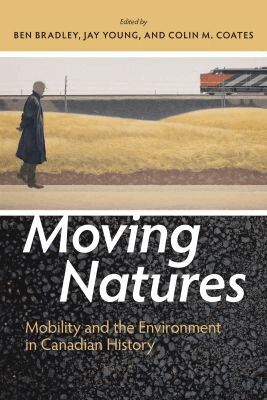
Mobility - the movements of people, things, and ideas, as well as their associated cultural meanings - has been a key factor in shaping Canadians' perceptions of and interactions with their country. Approaching the burgeoning field of environmental history in Canada through the lens of mobility reveals some of the distinctive ways in which Canadians have come to terms with the country's climate and landscape.Spanning Canada's diverse regions, throughout its history, from the closing of the age of sail to the contemporary era of just-on-time delivery, Moving Natures examines a wide range of topics, from the impact of seasonal climactic conditions on different transportation modes, to the environmental consequences of building mobility corridors and pathways, to the relationship between changing forms of mobility with tourism and other recreational activities. Contributors make use of traditional archival sources, as well as historical geographic information systems (HGIS), qualitative and quantitative analysis, and critical theory.This thought-provoking collection divides the intersection of environmental and mobility history into two approaches. The chapters in the first section deal primarily with the construction and productive use of mobility technologies and infrastructure, as well as their environmental constraints and consequences. The chapters in the second section focus on consumers' uses of those vehicles and pathways: on pleasure travel, tourism, and recreational mobility. Together, they highlight three quintessentially Canadian themes: seasonality, links between mobility and natural resource development, and urbanites' experiences of the environment through mobility.