Colin W. Clark – författare
Visar alla böcker från författaren Colin W. Clark. Handla med fri frakt och snabb leverans.
8 produkter
8 produkter
Inbunden, Engelska, 2000
1 759 kr
Skickas inom 5-8 vardagar
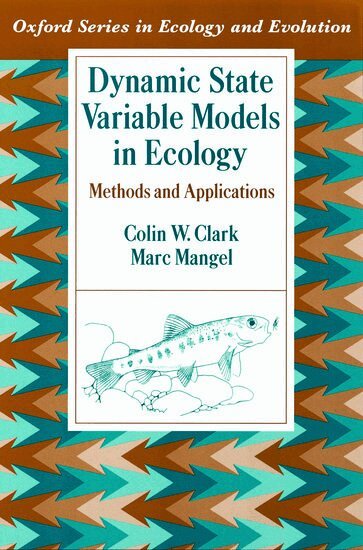
This book introduces readers to a set of powerful and extremely flexible modelling techniques, starting at "square one" and continuing with carefully chosen applications. Some of these applications of methodology include insect oviposition behavior, overwinter survival of birds and fish, avian migration, resource management, conservation biology, agroecology, and human behaviour. This book also explains how to construct, test, and use dynamic state variable models in a wide range of contexts in evolutionary ecology. And its complete and up-to-date coverage allows readers to immediately begin using the described techniques. Dynamic State Variable Models in Ecology is designed for self-instruction or for use in upper division undergraduate or graduate courses. It is ideal for students and scientists interested in behaviour, ecology, anthropology, conservation biology, and related fields.
Häftad, Engelska, 2000
1 101 kr
Skickas inom 5-8 vardagar
This book introduces readers to a set of powerful and extremely flexible modelling techniques, starting at "square one" and continuing with carefully chosen applications. Some of these applications of methodology include insect oviposition behavior, overwinter survival of birds and fish, avian migration, resource management, conservation biology, agroecology, and human behaviour. This book also explains how to construct, test, and use dynamic state variable models in a wide range of contexts in evolutionary ecology, and its complete and up-to-date coverage allows readers to immediately begin using the described techniques. Dynamic State Variable Models in Ecology is designed for self-instruction or for use in upper division undergraduate or graduate courses. It is ideal for students and scientists interested in behaviour, ecology, anthropology, conservation biology, and related fields.
E-bok
PDF, Engelska, 2000748 kr
Läs direkt efter köp
This book introduces readers to a set of powerful and extremely flexible modeling techniques, starting at "square one" and continuing with carefully chosen applications. Some of these applications of methodology include insect oviposition behavior, overwinter survival of birds and fish, avian migration, resource management, conservation biology, agroecology, and human behavior. This book also explains how to construct, test, and use dynamic state variable models in a wide range of contexts in evolutionary ecology, and its complete and up-to-date coverage allows readers to immediately begin using the described techniques. Dynamic State Variable Models in Ecology is designed for self-instruction or for use in upper division undergraduate or graduate courses. It is ideal for students and scientists interested in behavior, ecology, anthropology, conservation biology, and related fields.
Del 91 - Pure and Applied Mathematics: A Wiley Series of Texts, Monographs and Tracts
Mathematical Bioeconomics
The Mathematics of Conservation
Inbunden, Engelska, 2010
1 446 kr
Skickas inom 5-8 vardagar
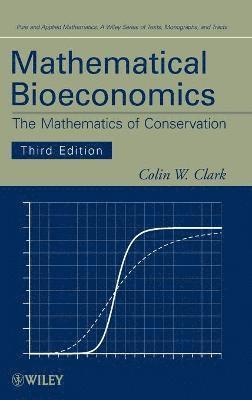
Overall, this is an appealing work for students and professionals, and is certain to remain as one of the key works in natural resource analysis.—Mathematical Reviews Biological renewable resources, essential to the survival of mankind, are increasingly overexploited by individuals and corporations that often sacrifice long-term economic health and sustainability for short-term gains. Mathematical Bioeconomics: The Mathematics of Conservation, Third Edition analyzes the economic forces underlying these misuses of renewable resources and discusses more effective methods of resource management. Promoting a complete understanding of general principles, the book allows readers to discover how rigorous mathematical models that incorporate both economic and biological factors should replace intuitive arguments for conservation and sustainability.This Third Edition continues to combine methodologies from the fields of economics, biology, and mathematics to explain how analytic models are essential for developing a complete understanding of complex resource systems. The book has been updated to address the need for incorporating individual economic incentives, the value of diversity, and the overriding importance of uncertainty in mathematical models. Coverage of game theory, overcapacity, uncertainty, and risk analysis has been added as well a expanded treatment of topics such as: Models of individual harvest behavior and economic incentivesResponse of individual harvester to various types of harvesting regulationsReasons underlying excess harvesting capacityExternalities in resource harvesting industriesDecision analysis in biological resource managementFundamental concepts of population dynamics and economics are utilized throughout the book while mathematical techniques are incorporated in an accessible manner. Relevant data from current research sheds light on the presented material, and exercises provide readers with an opportunity to test comprehension of discussed mathematical methods and techniques.Continuing to provide a complete and modernized presentation of the fundamental principles of the topic, Mathematical Bioeconomics, Third Edition is an excellent book for courses on applied mathematics, resource management, and environmental studies at the upper-undergraduate and graduate levels. It also serves as an insightful reference for resource managers, ecologists, biologists, and other professionals who work to improve the management of renewable resources and develop sustainable practices in the environmental sciences.
Häftad, Engelska, 2007
986 kr
Skickas inom 11-20 vardagar
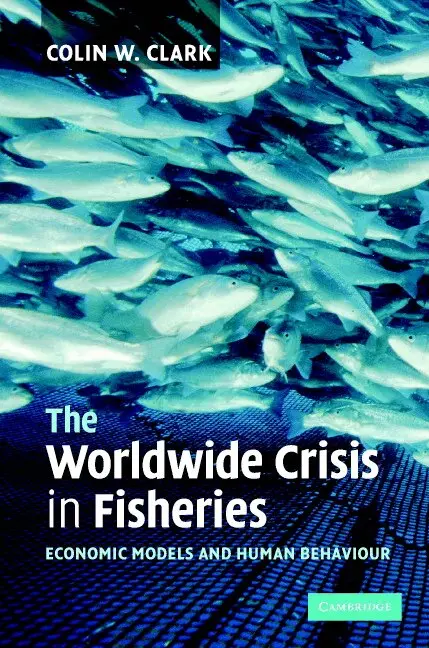
The world's marine fisheries are in trouble, as a direct result of overfishing and the overcapacity of fishing fleets. Despite intensive management efforts, the problems still persist in many areas, resulting in many fisheries being neither sustainable nor profitable. Using bio-economic models of commercial fisheries, this book demonstrates that new management methods, based on individual or community catch quotas, are required to resolve the overfishing problem. Uncertainty about marine systems may be another factor contributing to overfishing. Methods of decision analysis and Bayesian inference are used to discuss risk management and the precautionary principle, arguing that extensive marine reserves may be the best way to protect fisheries, alongside a controlled catch quota system. This book will be of interest to environmental scientists, economists and fisheries managers, providing novel insights into many well-known but poorly understood aspects of fisheries management.
Inbunden, Engelska, 2007
1 648 kr
Skickas inom 7-10 vardagar
The world's marine fisheries are in trouble, as a direct result of overfishing and the overcapacity of fishing fleets. Despite intensive management efforts, the problems still persist in many areas, resulting in many fisheries being neither sustainable nor profitable. Using bio-economic models of commercial fisheries, this book demonstrates that new management methods, based on individual or community catch quotas, are required to resolve the overfishing problem. Uncertainty about marine systems may be another factor contributing to overfishing. Methods of decision analysis and Bayesian inference are used to discuss risk management and the precautionary principle, arguing that extensive marine reserves may be the best way to protect fisheries, alongside a controlled catch quota system. This book will be of interest to environmental scientists, economists and fisheries managers, providing novel insights into many well-known but poorly understood aspects of fisheries management.
Del 98 - Lecture Notes in Biomathematics
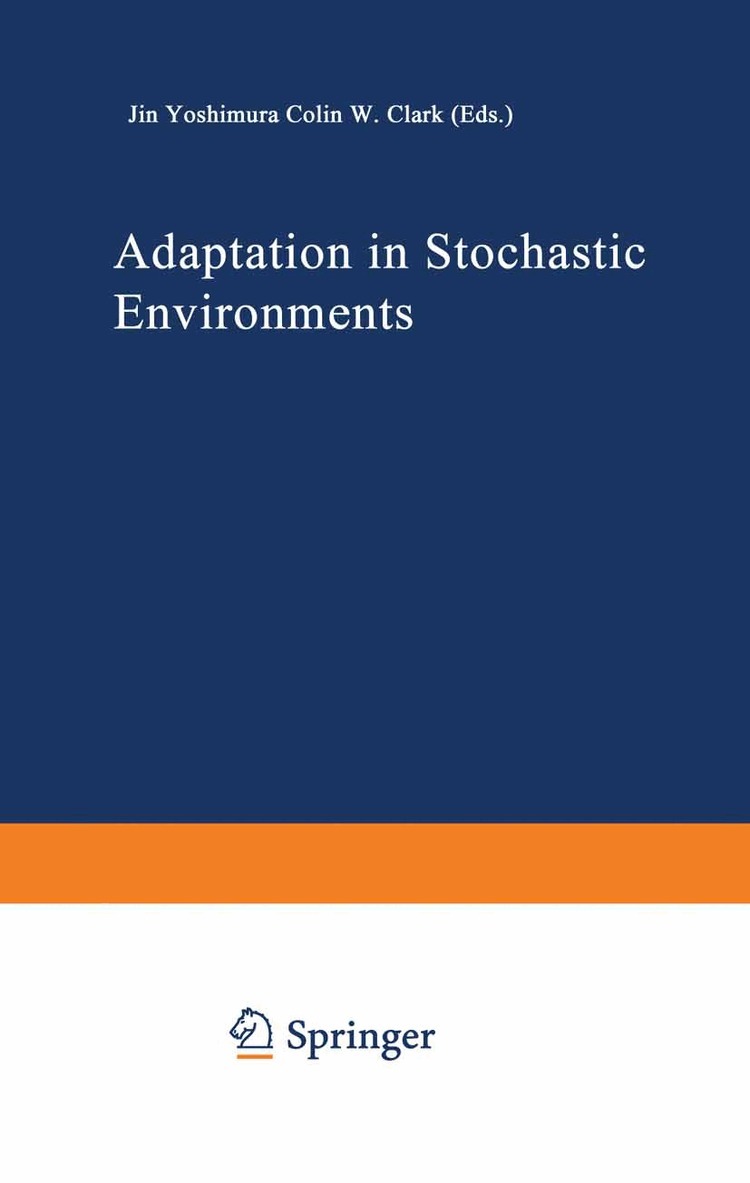
Adaptation in Stochastic Environments
Häftad, Engelska, 1993
546 kr
Skickas inom 10-15 vardagar
The classical theory of natural selection, as developed by Fisher, Haldane, and 'Wright, and their followers, is in a sense a statistical theory. By and large the classical theory assumes that the underlying environment in which evolution transpires is both constant and stable - the theory is in this sense deterministic. In reality, on the other hand, nature is almost always changing and unstable. We do not yet possess a complete theory of natural selection in stochastic environ ments. Perhaps it has been thought that such a theory is unimportant, or that it would be too difficult. Our own view is that the time is now ripe for the development of a probabilistic theory of natural selection. The present volume is an attempt to provide an elementary introduction to this probabilistic theory. Each author was asked to con tribute a simple, basic introduction to his or her specialty, including lively discussions and speculation. We hope that the book contributes further to the understanding of the roles of "Chance and Necessity" (Monod 1971) as integrated components of adaptation in nature.
E-bok
PDF, Engelska, 2012712 kr
Läs direkt efter köp
The classical theory of natural selection, as developed by Fisher, Haldane, and ''Wright, and their followers, is in a sense a statistical theory. By and large the classical theory assumes that the underlying environment in which evolution transpires is both constant and stable - the theory is in this sense deterministic. In reality, on the other hand, nature is almost always changing and unstable. We do not yet possess a complete theory of natural selection in stochastic environ ments. Perhaps it has been thought that such a theory is unimportant, or that it would be too difficult. Our own view is that the time is now ripe for the development of a probabilistic theory of natural selection. The present volume is an attempt to provide an elementary introduction to this probabilistic theory. Each author was asked to con tribute a simple, basic introduction to his or her specialty, including lively discussions and speculation. We hope that the book contributes further to the understanding of the roles of "Chance and Necessity" (Monod 1971) as integrated components of adaptation in nature.