Marc Mangel - Böcker
Visar alla böcker från författaren Marc Mangel. Handla med fri frakt och snabb leverans.
8 produkter
8 produkter
1 722 kr
Skickas inom 5-8 vardagar
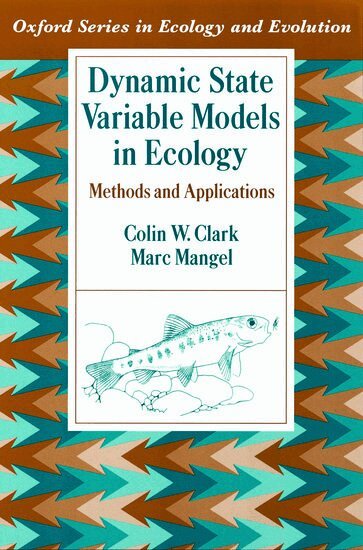
This book introduces readers to a set of powerful and extremely flexible modelling techniques, starting at "square one" and continuing with carefully chosen applications. Some of these applications of methodology include insect oviposition behavior, overwinter survival of birds and fish, avian migration, resource management, conservation biology, agroecology, and human behaviour. This book also explains how to construct, test, and use dynamic state variable models in a wide range of contexts in evolutionary ecology. And its complete and up-to-date coverage allows readers to immediately begin using the described techniques. Dynamic State Variable Models in Ecology is designed for self-instruction or for use in upper division undergraduate or graduate courses. It is ideal for students and scientists interested in behaviour, ecology, anthropology, conservation biology, and related fields.
1 078 kr
Skickas inom 5-8 vardagar
This book introduces readers to a set of powerful and extremely flexible modelling techniques, starting at "square one" and continuing with carefully chosen applications. Some of these applications of methodology include insect oviposition behavior, overwinter survival of birds and fish, avian migration, resource management, conservation biology, agroecology, and human behaviour. This book also explains how to construct, test, and use dynamic state variable models in a wide range of contexts in evolutionary ecology, and its complete and up-to-date coverage allows readers to immediately begin using the described techniques. Dynamic State Variable Models in Ecology is designed for self-instruction or for use in upper division undergraduate or graduate courses. It is ideal for students and scientists interested in behaviour, ecology, anthropology, conservation biology, and related fields.
The Theoretical Biologist's Toolbox
Quantitative Methods for Ecology and Evolutionary Biology
Häftad, Engelska, 2006
656 kr
Skickas inom 7-10 vardagar
Mathematical modelling is widely used in ecology and evolutionary biology and it is a topic that many biologists find difficult to grasp. In this new textbook Marc Mangel provides a no-nonsense introduction to the skills needed to understand the principles of theoretical and mathematical biology. Fundamental theories and applications are introduced using numerous examples from current biological research, complete with illustrations to highlight key points. Exercises are also included throughout the text to show how theory can be applied and to test knowledge gained so far. Suitable for advanced undergraduate courses in theoretical and mathematical biology, this book forms an essential resource for anyone wanting to gain an understanding of theoretical ecology and evolution.
825 kr
Skickas inom 7-10 vardagar
The modern ecologist usually works in both the field and laboratory, uses statistics and computers, and often works with ecological concepts that are model-based, if not model-driven. How do we make the field and laboratory coherent? How do we link models and data? How do we use statistics to help experimentation? How do we integrate modeling and statistics? How do we confront multiple hypotheses with data and assign degrees of belief to different hypotheses? How do we deal with time series (in which data are linked from one measurement to the next) or put multiple sources of data into one inferential framework? These are the kinds of questions asked and answered by The Ecological Detective. Ray Hilborn and Marc Mangel investigate ecological data much as a detective would investigate a crime scene by trying different hypotheses until a coherent picture emerges. The book is not a set of pat statistical procedures but rather an approach. The Ecological Detective makes liberal use of computer programming for the generation of hypotheses, exploration of data, and the comparison of different models. The authors' attitude is one of exploration, both statistical and graphical.The background required is minimal, so that students with an undergraduate course in statistics and ecology can profitably add this work to their tool-kit for solving ecological problems.
692 kr
Skickas inom 7-10 vardagar
This book describes a powerful and flexible technique for the modeling of behavior, based on evolutionary principles. The technique employs stochastic dynamic programming and permits the analysis of behavioral adaptations wherein organisms respond to changes in their environment and in their own current physiological state. Models can be constructed to reflect sequential decisions concerned simultaneously with foraging, reproduction, predator avoidance, and other activities. The authors show how to construct and use dynamic behavioral models. Part I covers the mathematical background and computer programming, and then uses a paradigm of foraging under risk of predation to exemplify the general modeling technique. Part II consists of five "applied" chapters illustrating the scope of the dynamic modeling approach. They treat hunting behavior in lions, reproduction in insects, migrations of aquatic organisms, clutch size and parental care in birds, and movement of spiders and raptors. Advanced topics, including the study of dynamic evolutionarily stable strategies, are discussed in Part III.
Resource Management
Proceedings of the Second Ralf Yorque Workshop held in Ashland, Oregon, July 23–25, 1984
Häftad, Engelska, 1985
536 kr
Skickas inom 10-15 vardagar
These are the proceedings of the Second R. Yorque Workshop on Resource Management which took place in Ashland, Oregon on July 23-25, 1984. The purpose of the workshop is to provide an informal atmosphere for the discussion of resource assessment and management problems. Each participant presented a one hour morning talk; afternoons were reserved for informal chatting. The workshop was successful in stimulating ideas and interaction. The papers by R. Deriso, R. Hilborn and C. Walters all address the same basic issue, so they are lumped together. Other than that, the order to the papers in this volume was determined in the same fashion as the order of speakers during the workshop -- by random draw. Marc Mangel Department of Mathematics University of California Davis, California June 1985 TABLE OF CONTENTS A General Theory for Fishery Modeling Jon Schnute Data Transformations in Regression Analysis with Applications to Stock-Recruitment Relationships David Ruppert and Raymond J. Carroll ••••••. ••. ••. . •••••••••••••••. • 29 A Conceptual Model for Multispecies, Multifleet Fisheries Wayne M. Getz, Gordon L. Swartzman, and Robert C. Francis . ••. •••. ••• 49 Risk Adverse Harvesting Strategies Richard Der iso . . •. . ••••. . •. . . . . . . . ••••••. •. . . . . •. ••. •••••••••. •. ••• 65 A Comparison of Harvest Policies for Mixed Stock Fisheries Ray Hilborn . . •••••••. ••. ••. ••••••. ••••••••••••. . ••••••. . . . . ••••••. . • 75 Pathological Behavior of Managed Populations When Production Relationships are Assessed from Natural Experiments Carl J. Walters••••••. ••••••••••. •. ••. ••••••. •. ••••••••••. •••••. . .
1 578 kr
Skickas inom 10-15 vardagar
These are the proceedings of an Advanced Research Workshop (ARW), sponsored by the NATO Science Panel, entitled "Pest Control: Operations and Systems Analysis in Fruit Fly Management". The ARW was held in Bad Windsheim, Germany during the week of 5 August 1985. The purpose of the ARW was to bring together scientists who are interested in fruit fly problems, but who usually do not have an opportunity to speak with each other, for an intense week of interdisciplinary collaboration. In particular, the group present at the ARW contained a mix of biologists, field ecologists, mathematical modellers, operational program managers, economists and social scientists. Each group has its own professional meetings at which fruit fly problems are discussed, but the point of the ARW was to learn about the problem from the perspective of other fields, which are equally important for the ultimate management of the fruit fly problems. (A list of attendees follows this preface. ) It appears that the ARW successfully met its objective of bringing together a group for interdisciplinary considerations of the problems; I hope that the proceedings do as well. The ARW was structured with formal lectures in the mornings and workshops in the afternoons. For the morning lectures, four different topics were chosen: 1) basic biology and ecology, 2) trapping and detection, 3) control and eradication, and 4) policy issues. Each morning, one lecture from each area was presented.
1 546 kr
Skickas inom 3-6 vardagar
Many of the words used to describe disease ('infection', 'transmission', 'virus') are also used to characterize cyber security (for example: a computer is infected by a virus that can be transmitted to other current uninfected computers). This correspondence is much more than a convenient metaphor, and the aim of this book is to show how the models developed to understand the dynamics of infection, recovery, and possible reinfection in disease can be applied to understand attack, compromise, and recovery of components of a cyber system and how such attacks affect performance of the cyber system or its dependent enabled physical system.