Committee on Achieving Sustainable Global Capacity for Surveillance and Response to Emerging Diseases of Zoonotic Origin – författare
485 kr
Läs direkt efter köp
One of the biggest threats today is the uncertainty surrounding the emergence of a novel pathogen or the re-emergence of a known infectious disease that might result in disease outbreaks with great losses of human life and immense global economic consequences. Over the past six decades, most of the emerging infectious disease events in humans have been caused by zoonotic pathogens—those infectious agents that are transmitted from animals to humans.
In June 2008, the Institute of Medicine''s and National Research Council''s Committee on Achieving Sustainable Global Capacity for Surveillance and Response to Emerging Diseases of Zoonotic Origin convened a workshop. This workshop addressed the reasons for the transmission of zoonotic disease and explored the current global capacity for zoonotic disease surveillance.
624 kr
Läs direkt efter köp
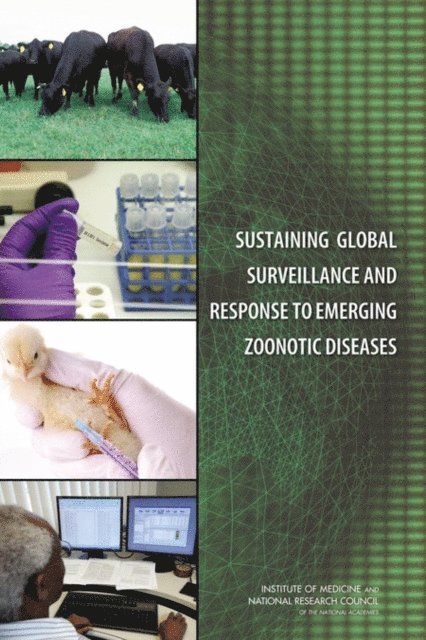
H1N1 ("swine flu"), SARS, mad cow disease, and HIV/AIDS are a few examples of zoonotic diseases-diseases transmitted between humans and animals. Zoonotic diseases are a growing concern given multiple factors: their often novel and unpredictable nature, their ability to emerge anywhere and spread rapidly around the globe, and their major economic toll on several disparate industries.Infectious disease surveillance systems are used to detect this threat to human and animal health. By systematically collecting data on the occurrence of infectious diseases in humans and animals, investigators can track the spread of disease and provide an early warning to human and animal health officials, nationally and internationally, for follow-up and response. Unfortunately, and for many reasons, current disease surveillance has been ineffective or untimely in alerting officials to emerging zoonotic diseases.Sustaining Global Surveillance and Response to Emerging Zoonotic Diseases assesses some of the disease surveillance systems around the world, and recommends ways to improve early detection and response. The book presents solutions for improved coordination between human and animal health sectors, and among governments and international organizations.Parties seeking to improve the detection and response to zoonotic diseases—including U.S. government and international health policy makers, researchers, epidemiologists, human health clinicians, and veterinarians—can use this book to help curtail the threat zoonotic diseases pose to economies, societies, and health.
866 kr
Läs direkt efter köp
H1N1 ("swine flu"), SARS, mad cow disease, and HIV/AIDS are a few examples of zoonotic diseases-diseases transmitted between humans and animals. Zoonotic diseases are a growing concern given multiple factors: their often novel and unpredictable nature, their ability to emerge anywhere and spread rapidly around the globe, and their major economic toll on several disparate industries.Infectious disease surveillance systems are used to detect this threat to human and animal health. By systematically collecting data on the occurrence of infectious diseases in humans and animals, investigators can track the spread of disease and provide an early warning to human and animal health officials, nationally and internationally, for follow-up and response. Unfortunately, and for many reasons, current disease surveillance has been ineffective or untimely in alerting officials to emerging zoonotic diseases.Sustaining Global Surveillance and Response to Emerging Zoonotic Diseases assesses some of the disease surveillance systems around the world, and recommends ways to improve early detection and response. The book presents solutions for improved coordination between human and animal health sectors, and among governments and international organizations.Parties seeking to improve the detection and response to zoonotic diseases—including U.S. government and international health policy makers, researchers, epidemiologists, human health clinicians, and veterinarians—can use this book to help curtail the threat zoonotic diseases pose to economies, societies, and health.
693 kr
Läs direkt efter köp
One of the biggest threats today is the uncertainty surrounding the emergence of a novel pathogen or the re-emergence of a known infectious disease that might result in disease outbreaks with great losses of human life and immense global economic consequences. Over the past six decades, most of the emerging infectious disease events in humans have been caused by zoonotic pathogens—those infectious agents that are transmitted from animals to humans.
In June 2008, the Institute of Medicine''s and National Research Council''s Committee on Achieving Sustainable Global Capacity for Surveillance and Response to Emerging Diseases of Zoonotic Origin convened a workshop. This workshop addressed the reasons for the transmission of zoonotic disease and explored the current global capacity for zoonotic disease surveillance.
704 kr
Tillfälligt slut
838 kr
Tillfälligt slut