Comrie Bernard Comrie – författare
Visar alla böcker från författaren Comrie Bernard Comrie. Handla med fri frakt och snabb leverans.
6 produkter
6 produkter
E-bok
Engelska, 20171 305 kr
Läs direkt efter köp
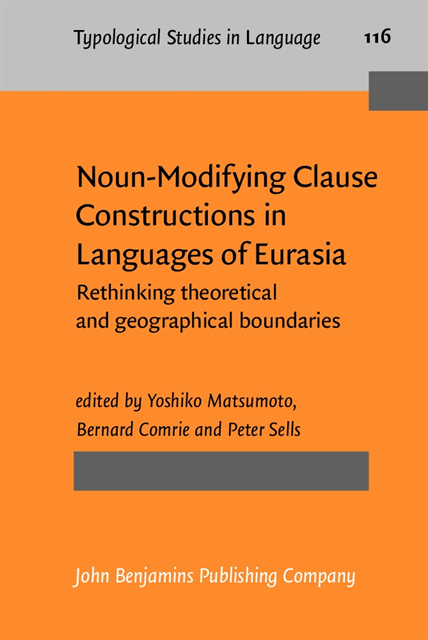
This volume presents a cross-linguistic investigation of clausal noun-modifying constructions in genetically varied languages of Eurasia. Contrary to a common premise that, in any language, adnominal clauses that share some features of relative clauses constitute a structurally distinct construction, some languages of Eurasia exhibit a General Noun-Modifying Clause Construction (GNMCC) -- a single construction covering a wide range of semantic relations between the head noun and the clause. Through in-depth examination of naturally-occurring and elicited data from Ainu, languages of the Caucasus (e.g. Ingush, Georgian, Bezhta, Hinuq), Japanese, Korean, Marathi, Nenets, Sino-Tibetan languages (e.g. Cantonese, Mandarin, Rawang), and Turkic languages (e.g. Turkish, Sakha), the chapters discuss whether or not the language in question exhibits a GNMCC and the range of noun modification covered by such a construction. The findings afford us new facts, new theoretical perspectives and the first step toward a more global assessment of the possibilities for GNMCCs.
E-bok
PDF, Engelska, 20131 447 kr
Läs direkt efter köp
The question of how language emerged is one of the most fascinating and difficult problems in science. In recent years, a strong resurgence of interest in the emergence of language from an evolutionary perspective has been helped by the convergence of approaches, methods, and ideas from several disciplines. The selection of contributions in this volume highlight scenarios of language origin and the prerequisites for a faculty of language based on biological, historical, social, cultural, and paleontological forays into the conditions that brought forth and favored language emergence, augmented by insights from sister disciplines. The chapters all reflect new speculation, discoveries and more refined research methods leading to a more focused understanding of the range of possibilities and how we might choose among them. There is much that we do not yet know, but the outlines of the path ahead are ever clearer.
E-bok
PDF, Engelska, 20121 305 kr
Läs direkt efter köp
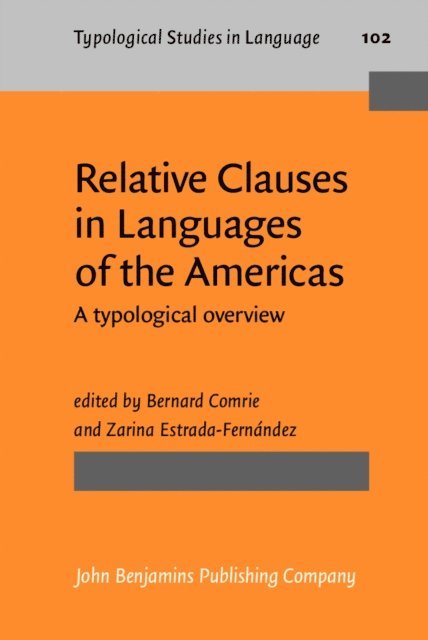
Patterns of relative clause formation tend to vary according to the typological properties of a language. Highly polysynthetic languages tend to have fully nominalized relative clauses and no relative pronouns, while other typologically diverse languages tend to have relative clauses which are similar to main or independent clauses. Languages of the Americas, with their rich genetic diversity, have all been under the influence of European languages, whether Spanish, English or Portuguese, a situation that may be expected to have influenced their grammatical patterns. The present volume focuses on two tasks: The first deals with the discussion of functional principles related to relative clause formation: diachrony and paths of grammaticalization, simplicity vs. complexity, and formalization of rules to capture semantic-syntactic correlations. The second provides a typological overview of relative clauses in nine different languages going from north to south in the Americas.
E-bok
PDF, Engelska, 20121 305 kr
Läs direkt efter köp
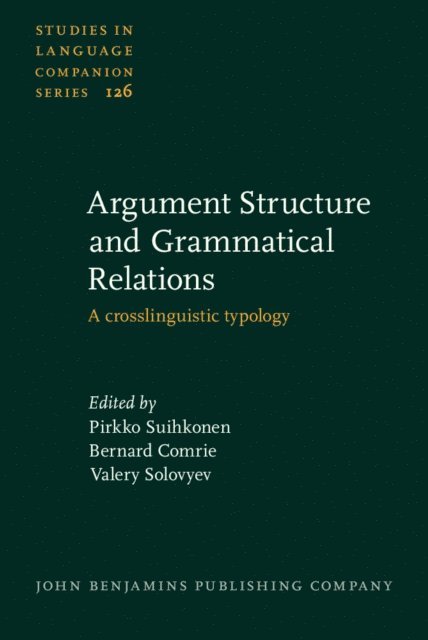
This book is a collection of articles dealing with various aspects of grammatical relations and argument structure in the languages of Europe and North and Central Asia (LENCA). Topics covered with respect to individual languages are: split-intransitivity (Basque), causativization (Agul), transitives and causatives (Korean and Japanese), aspectual domain and quantification (Finnish and Udmurt), head-marking principles (Athabaskan languages), and pragmatics (Eastern Khanty and Xibe). Typology of argument-structure properties of ‘give’ (LENCA), typology of agreement systems, asymmetry in argument structure, typology of the Amdo Sprachbund, spatial realtors (Northeastern Turkic), core argument patterns (languages of Northern California), and typology of grammatical relations (LENCA) are the topics of articles based on cross-linguistic data. The broad empirical sweep and the fine-tuned theoretical analysis highlight the central role of argument structure and grammatical relations with respect to a plethora of linguistic phenomena.
E-bok
PDF, Engelska, 19911 447 kr
Läs direkt efter köp
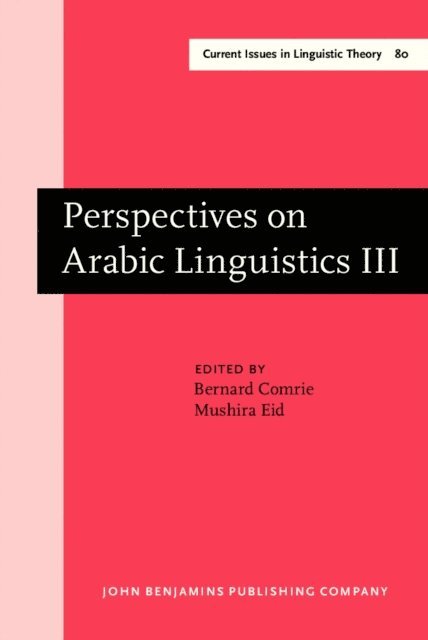
This is the third in a continuing series of papers presented at the annual meetings of the Arabic Linguistic Society whose primary purpose is to provide a forum for the study of Arabic within current approaches in linguistics. The volume includes a section on Arabic in relation to other languages, with papers ranging from the importance of Arabic to general linguistic theory, and guttural phonology to Arabic loanwords in Acehnese, verbless sentences in Arabic and Hebrew, and a contrastive study of middle and unaccusative constructions in Arabic and English. In the second section of the book, “Grammatical perspectives on Arabic”, topics ranging from causatives in Moroccan Arabic and epenthesis in Makkan Arabic to a computer analysis of Modern Standard Arabic morphology are discussed. The third section, “Socio- and psycholinguistic perspectives”, includes papers on women, men, and linguistic variation, code switching and linguistic accommodation, and agrammatism.
E-bok
PDF, Engelska, 20091 384 kr
Läs direkt efter köp
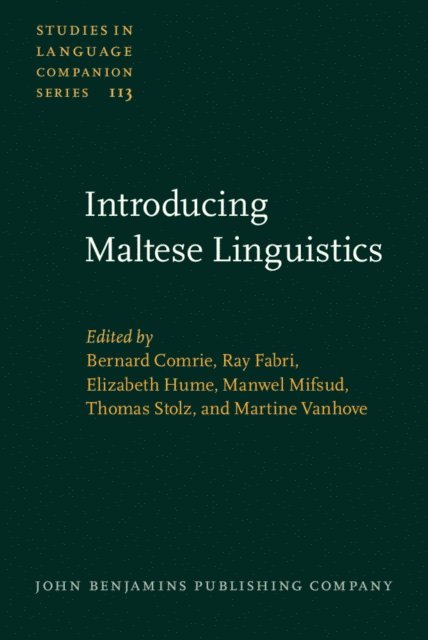
This collection of articles highlights a selection of on-going research projects. Phonological, morphological, and syntactic issues are addressed by international experts on Maltese. The diachronic development of Maltese, its age-long contact with Italo-Romance, and the present diglossic situation with co-official English are the topics of a variety of contributions to this volume. The repercussions that the promotion of Maltese to the status of official working language of the EU has on the Maltese lexicon are discussed. A project on the sociolinguistics of non-native Maltese-English is presented. The problems posed by the creation of electronic resources for Maltese are equally focused upon. The papers amply demonstrate that Maltese Linguistics can stand on its own outside the traditional field of Oriental Studies.