Constantin Fasolt - Böcker
Visar alla böcker från författaren Constantin Fasolt. Handla med fri frakt och snabb leverans.
3 produkter
3 produkter
282 kr
Skickas inom 7-10 vardagar
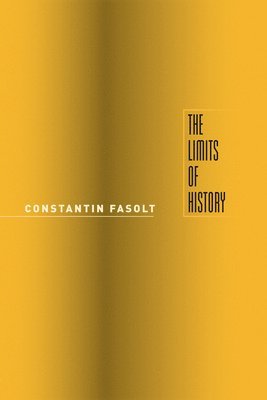
History casts a spell on our minds more powerful than science or religion. It does not root us in the past at all, but instead flatters us with the belief in our ability to recreate the world in our image. It is a form of self-assertion that brooks no opposition or dissent and shelters us from the experience of time. So argues Constantin Fasolt in The Limits of History, an ambitious and path-breaking study that conquers history's power by carrying the fight into the center of its domain. Fasolt considers the work of Hermann Conring (1606-81) and Bartolus of Sassoferrato (1313/1457), two antipodes in early modern battles over the principles of European thought and action that ended with the triumph of historical consciousness. Proceeding according to the rules of normal historical analysis-gathering evidence, putting it in context, and analyzing its meaning - Fasolt uncovers limits that no kind of history can cross. He concludes that history is a ritual designed to maintain the modern faith in the autonomy of states and individuals. God wants it - the old crusaders would have said. The truth, Fasolt insists, only begins where that illusion ends.With its probing look at the ideological underpinnings of historical practice, The Limits of History demonstrates that history presupposes highly political assumptions about free will, responsibility, and the relationship between the past and the present.
806 kr
Skickas inom 7-10 vardagar
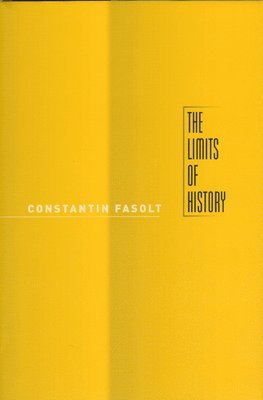
History casts a spell on our minds more powerful than science or religion. It does not root us in the past at all. It rather flatters us with the belief in our ability to recreate the world in our image. It is a form of self-assertion that brooks no opposition or dissent and shelters us from the experience of time. So argues Constantin Fasolt in The Limits of History, an ambitious and pathbreaking study that conquers history's power by carrying the fight into the center of its domain. Fasolt considers the work of Hermann Conring (1606-81) and Bartolus of Sassoferrato (1313/14-57), two antipodes in early modern battles over the principles of European thought and action that ended with the triumph of historical consciousness. Proceeding according to the rules of normal historical analysis—gathering evidence, putting it in context, and analyzing its meaning—Fasolt uncovers limits that no kind of history can cross. He concludes that history is a ritual designed to maintain the modern faith in the autonomy of states and individuals. God wants it, the old crusaders would have said. The truth, Fasolt insists, only begins where that illusion ends.With its probing look at the ideological underpinnings of historical practice, The Limits of History demonstrates that history presupposes highly political assumptions about free will, responsibility, and the relationship between the past and the present. A work of both intellectual history and historiography, it will prove invaluable to students of historical method, philosophy, political theory, and early modern European culture.
Del 16 - Cambridge Studies in Medieval Life and Thought: Fourth Series
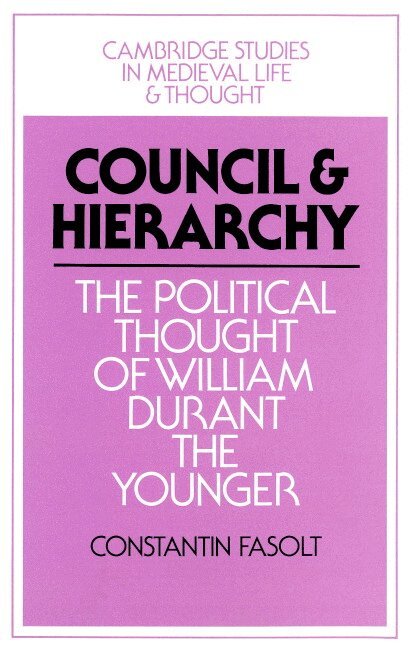
Council and Hierarchy
The Political Thought of William Durant the Younger
Häftad, Engelska, 2002
428 kr
Skickas inom 7-10 vardagar
In 1311, at the council of Vienne, William Durant the Younger (c. 1266-1330), the French bishop and count, demanded that general councils ought to meet every ten years in order to place effective limits on the papal plenitude of power because 'what touches all must be approved by all'. This is the first systematic interpretation of William Durant's remarkable project to transfer supreme legislative authority from the papacy to general councils. It suggests that the conciliar theory has a more ambivalent complexion than is sometimes recognized. It confirms, on the one hand, that constitutional ideas were deeply embedded in the tradition of the church, which enabled Durant to anticipate the council of Constance by more than a hundred years. On the other hand, Durant attributed an authority to ancient law that overrode his republican ideas, sapped their vitality, and launched him on a pursuit of the true meaning of the law that could end only in his transformation into an historian and a reluctant champion of monarchy. William Durant the Younger's ideas thus help us to understand both the origins of the conciliar theory and the transition from late medieval reform movements to early modern humanism and princely sovereignty.