Contini-Morava Ellen Contini-Morava – författare
Visar alla böcker från författaren Contini-Morava Ellen Contini-Morava. Handla med fri frakt och snabb leverans.
2 produkter
2 produkter
E-bok
PDF, Engelska, 20041 651 kr
Läs direkt efter köp
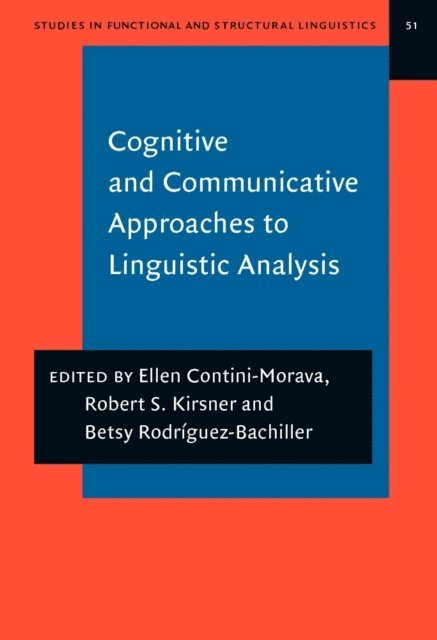
This volume is the product of a Columbia School Linguistics Conference held at Rutgers University in October 1999, where the plenary speaker was Ronald W. Langacker, a founder of Cognitive Linguistics. The goal of the book is to promote two kinds of dialogue. First, dialogue between Cognitive Grammar and the particular sign-based approach to language known as the Columbia School. While they share certain basic assumptions, the "e;maximalist"e; CG and the "e;minimalist"e; CS differ both theoretically and methodologically. Given that philosophers from Mill to Kuhn to Feyerabend have stressed the importance to any discipline of dialogue between opposing views, the dialogue begun here cannot fail to bear fruit. The second kind of dialogue is that among several sign-based approaches themselves and also between them and two competitors: grammaticalization theory and generic functionalism. Topics range from phonology to discourse. Analytical problems are taken from a wide range of languages including English, German, Guarani, Hebrew, Hualapai, Japanese, Korean, Macedonian, Mandarin, Polish, Russian, Serbian, Spanish, Urdu, and Yaqui.
E-bok
PDF, Engelska, 20001 651 kr
Läs direkt efter köp
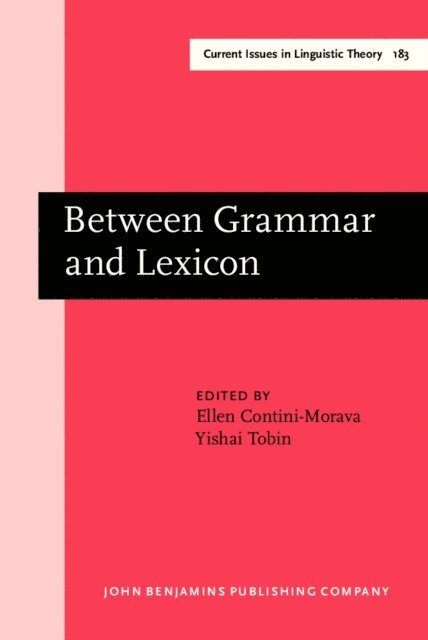
This volume has its origins in a theme session entitled: “Lexical and Grammatical Classification: Same or Different?” from the Fifth International Cognitive Linguistics Conference. It includes theme session presentations, additional papers from that conference, and several invited contributions. All the articles explore the relationship between lexical and grammatical categories, both illustrating the close interaction, as well as questioning the strict dichotomy, between them. This volume promotes a holistic view of classification reflecting functional, cognitive, communication, and sign-oriented approaches to language which have been applied to both the grammar and the lexicon.The volume is divided into two parts. Part I, Number and Gender Systems Across Languages, is further subdivided into three sections: (1) Noun Classification; (2) Number Systems; and (3) Gender Systems. Part II, Verb Systems and Parts of Speech Across Languages, is divided into two sections: (1) Tense and Aspect and (2) Parts of Speech. The analyses represent a diverse range of languages and language families: Bantu (Swahili), Guaykuruan (Pilagá), Indo-European (English, Russian, Polish, Bulgarian, Macedonian, Spanish) and Semitic (Hebrew).