Couper-Kuhlen Elizabeth Couper-Kuhlen – författare
Visar alla böcker från författaren Couper-Kuhlen Elizabeth Couper-Kuhlen. Handla med fri frakt och snabb leverans.
4 produkter
4 produkter
E-bok
Engelska, 20171 305 kr
Läs direkt efter köp
In middle-class Anglo-speaking circles imperatives are considered impolite forms that command another to do something; etiquette manuals recommend avoiding them. The papers in this collection de-construct such lay beliefs. Through the empirical examination of everyday and institutional interaction across a range of languages, they show that imperatives are routinely used for constructing turns that further sociality in interactional situations. Moreover, they show that for understanding the use of an imperatively formatted turn, its specific design (whether it contains, e.g., an overt subject, object, modal particles, or diminutives), and its sequential and temporal positioning in verbal and embodied activities are crucial. The fact that the same type of imperative turn is appropriate under the same circumstances across linguistically diverse cultures suggests that there are common aspects of imperative turn design and common pragmatic dimensions of situations warranting their use. The volume provides new insights into the resources and processes involved when social actors try to get another to do something.
E-bok
PDF, Engelska, 20141 384 kr
Läs direkt efter köp
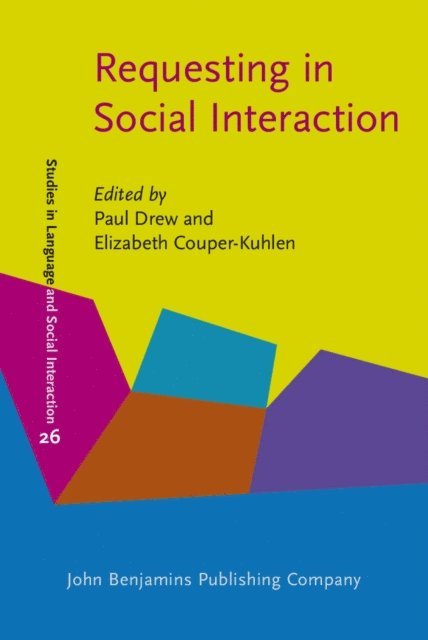
There has been a remarkable revival of interest in how we conduct social actions in interaction – particularly in requesting, where recent research into video-recorded face-to-face interaction has taken our understanding in novel directions. This collection brings together some of the latest, cutting-edge research into requesting by leading international practitioners of Conversation Analysis. The studies trace a line of conceptual development from ‘directive’ to ‘recruitment’, and explore the acquisitional, cultural, situational and species-specific differentiation of forms for requesting in human social interaction.They represent the latest explorations into the complexities and controversies associated with the apparently simple but essential matter of how we ask another to do something for us.
E-bok
PDF, Engelska, 20041 714 kr
Läs direkt efter köp
This collection of original papers by eminent phoneticians, linguists and sociologists offers the most recent findings on phonetic design in interactional discourse available in an edited collection. The chapters examine the organization of phonetic detail in relation to social actions in talk-in-interaction based on data drawn from diverse languages: Japanese, English, Finnish, and German, as well as from diverse speakers: children, fluent adults and adults with language loss. Because similar methodology is deployed for the investigation of similar conversational tasks in different languages, the collection paves the way towards a cross-linguistic phonology for conversation. The studies reported in the volume make it clear that language-specific constraints are at work in determining exactly which phonetic and prosodic resources are deployed for a given purpose and how they articulate with grammar in different cultures and speech communities.
E-bok
PDF, Engelska, 20011 651 kr
Läs direkt efter köp
Current interactional linguistic research appears to be crystallizing around systematic themes, which are all represented in this collection of papers. In the first section, where the relation between language and interaction is viewed from the perspective of language structure, several articles deal with the potential of a single structure for both turn and sequence construction, revealing a play-off between planned and occasioned syntax with potentially far-reaching consequences for language development. Other articles deal with lexical expressions as resources for the conduct of interaction, showing how they are heavily dependent on turn position and sequential context for their meaning potential. In the second section, with a view from the perspective of the interactional order, a systematic focus of interest lies on three different conversational tasks: projecting turn and turn-unit completion, starting up turns with 'non-beginnings' and self-repairing. The cross-linguistic studies here all agree that common interactional tasks may well be carried out by quite different linguistic practices and that these practices are dependent to a certain extent on language features which are typologically distinct.