Selting Margret Selting – författare
Visar alla böcker från författaren Selting Margret Selting. Handla med fri frakt och snabb leverans.
4 produkter
4 produkter
E-bok
PDF, Engelska, 20111 305 kr
Läs direkt efter köp
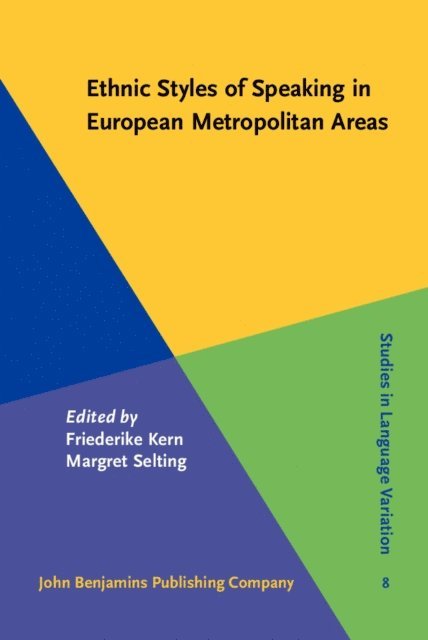
In recent years, ethnic ways of speaking by young people with migrant background have become an important research object in sociolinguistics; work on these ways of speaking has been prospering in many European countries. This work is continued in the present volume, with the aim of bringing together various research designs which explore the phenomenon from different perspectives: correlational methodology of sociolinguistic research, conversation analytical and interactional linguistic methodology, and an ethnographic perspective on language use and the construction of social identities and social relations. The aim of the volume is to explore the scope of these different methodologies and to provide a basis for the discussion and evaluation of the theories of language variation associated with them. All papers focus on the description of the linguistic characteristics that constitute the non-standard structures of ethnic styles of speaking, and look into their various functions in discourse.
E-bok
PDF, Engelska, 20101 305 kr
Läs direkt efter köp
Prosody is constitutive for spoken interaction. In more than 25 years, its study has grown into a full-fledged and very productive field with a sound catalogue of research methods and principles. This volume presents the state of the art, illustrates current research trends and uncovers potential directions for future research. It will therefore be of major interest to everyone studying spoken interaction. The collection brings together an impressive range of internationally renowned scholars from different, yet closely related and compatible research traditions which have made a significant contribution to the field. They cover issues such as the units of language, the contextualization of actions and activities, conversational modalities and genres, the display of affect and emotion, the multimodality of interaction, language acquisition and aphasia. All contributions are based on empirical, audio- and/or video-recorded data of natural talk-in-interaction, including languages such as English, German and Japanese. The methodologies employed come from Ethnomethodology, Conversation Analysis and Interactional Linguistics.
E-bok
PDF, Engelska, 20051 651 kr
Läs direkt efter köp
This volume is a collection of current work at the interface of linguistics and conversation analysis. The focus is on linguistic items in their action contexts: syntactic structures and lexical items in data from natural conversations in six European languages: Danish, English, Finnish, German, Italian and Swedish. Some of the studies deal with similar practices in two different languages, which enables cross-linguistic comparisons. The notion of 'construction' is brought together with an interactional perspective; the fact that constructions cannot always be clearly analysed as either syntactic or lexico-semantic has its reflection in this volume. So far, there have been fewer attempts at interactionally oriented work on lexical and semantic phenomena than on syntactic constructions. In this volume, several papers show the interactional relevance of word selection and lexical semantic issues. In the future, studies on syntax and lexico-semantics in interaction will enrich realistic grammars of our languages, and cross-linguistic description of comparable practices of organizing talk in interaction will be invaluable for the study of both inter-European and international communication.
E-bok
PDF, Engelska, 20011 651 kr
Läs direkt efter köp
Current interactional linguistic research appears to be crystallizing around systematic themes, which are all represented in this collection of papers. In the first section, where the relation between language and interaction is viewed from the perspective of language structure, several articles deal with the potential of a single structure for both turn and sequence construction, revealing a play-off between planned and occasioned syntax with potentially far-reaching consequences for language development. Other articles deal with lexical expressions as resources for the conduct of interaction, showing how they are heavily dependent on turn position and sequential context for their meaning potential. In the second section, with a view from the perspective of the interactional order, a systematic focus of interest lies on three different conversational tasks: projecting turn and turn-unit completion, starting up turns with 'non-beginnings' and self-repairing. The cross-linguistic studies here all agree that common interactional tasks may well be carried out by quite different linguistic practices and that these practices are dependent to a certain extent on language features which are typologically distinct.