Reber Elisabeth Reber – författare
Visar alla böcker från författaren Reber Elisabeth Reber. Handla med fri frakt och snabb leverans.
2 produkter
2 produkter
E-bok
PDF, Engelska, 20121 195 kr
Läs direkt efter köp
How do participants display affectivity in social interaction? Based on recordings of authentic everyday conversations and radio phone-ins, this study offers a fine-grained analysis of how recipients of affect-laden informings deploy sound objects, i.e. interjections (oh, ooh and ah) and paralinguistic signals (whistle and clicks), for responsive displays of affectivity. Examining the use of such sound objects across a number of interactional activities including news telling, troubles talk, complaining, assessments and repair, the study provides evidence that the sound pattern and sequential placement of sound objects systematically contribute to their specific meaning-making in interaction, i.e. the management of sequence organisation and interactional relevancies (e.g. affiliation). Presenting an in-depth analysis of a little researched area of language use from an interactional linguistic perspective, the book will be of theoretical and methodological interest to an audience with a background in linguistics, sociology and conversational studies.
E-bok
PDF, Engelska, 20101 305 kr
Läs direkt efter köp
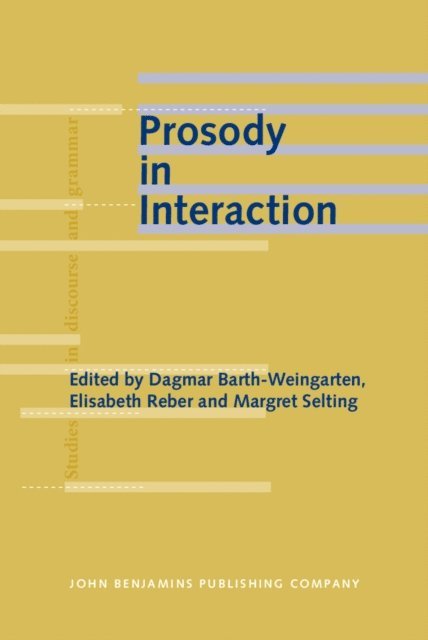
Prosody is constitutive for spoken interaction. In more than 25 years, its study has grown into a full-fledged and very productive field with a sound catalogue of research methods and principles. This volume presents the state of the art, illustrates current research trends and uncovers potential directions for future research. It will therefore be of major interest to everyone studying spoken interaction. The collection brings together an impressive range of internationally renowned scholars from different, yet closely related and compatible research traditions which have made a significant contribution to the field. They cover issues such as the units of language, the contextualization of actions and activities, conversational modalities and genres, the display of affect and emotion, the multimodality of interaction, language acquisition and aphasia. All contributions are based on empirical, audio- and/or video-recorded data of natural talk-in-interaction, including languages such as English, German and Japanese. The methodologies employed come from Ethnomethodology, Conversation Analysis and Interactional Linguistics.