Cynthia Geppert – författare
Visar alla böcker från författaren Cynthia Geppert. Handla med fri frakt och snabb leverans.
5 produkter
5 produkter
Inbunden, Engelska, 2024
1 259 kr
Skickas inom 10-15 vardagar
Twenty-first century neuroscience has discovered that in some severe cases, addiction may so constrain human freedom that the will is only able to choose to use substances of abuse. At this advanced stage, substance use has become the primary driver of salience, co-optingand subsuming other moral priorities and human rewards. Scholars have investigated Aristotle’s concept of akrasia as an ancient mirror of this understanding and there have been some preliminary discussions of Augustine’s concept of the divided will as it bears on addiction. No detailed and comprehensive exploration of the work of Augustine has yet been undertaken as it relates to three contemporary models of addiction: the choice, learning, and brain disease models. Augustine’s psychological awareness, his mastery of ancient theological and philosophical thinking, and his enormous and enduring influence on both Catholic and Protestant theology, make him an ideal subject for such research. This incisive book argues that Augustine’s doctrine of the captive will offers a theological parallel of each of these contemporary models of addiction.
E-bok
PDF, Engelska, 2024424 kr
Läs direkt efter köp
Twenty-first century neuroscience has discovered that in some severe cases, addiction may so constrain human freedom that the will is only able to choose to use substances of abuse. At this advanced stage, substance use has become the primary driver of salience, co-optingand subsuming other moral priorities and human rewards. Scholars have investigated Aristotle''s concept of akrasia as an ancient mirror of this understanding and there have been some preliminary discussions of Augustine''s concept of the divided will as it bears on addiction. No detailed and comprehensive exploration of the work of Augustine has yet been undertaken as it relates to three contemporary models of addiction: the choice, learning, and brain disease models. Augustine''s psychological awareness, his mastery of ancient theological and philosophical thinking, and his enormous and enduring influence on both Catholic and Protestant theology, make him an ideal subject for such research. This incisive book argues that Augustine''s doctrine of the captive will offers a theological parallel of each of these contemporary models of addiction.
E-bok
Engelska, 2024439 kr
Läs direkt efter köp
Twenty-first century neuroscience has discovered that in some severe cases, addiction may so constrain human freedom that the will is only able to choose to use substances of abuse. At this advanced stage, substance use has become the primary driver of salience, co-optingand subsuming other moral priorities and human rewards. Scholars have investigated Aristotle''s concept of akrasia as an ancient mirror of this understanding and there have been some preliminary discussions of Augustine''s concept of the divided will as it bears on addiction. No detailed and comprehensive exploration of the work of Augustine has yet been undertaken as it relates to three contemporary models of addiction: the choice, learning, and brain disease models. Augustine''s psychological awareness, his mastery of ancient theological and philosophical thinking, and his enormous and enduring influence on both Catholic and Protestant theology, make him an ideal subject for such research. This incisive book argues that Augustine''s doctrine of the captive will offers a theological parallel of each of these contemporary models of addiction.
Häftad, Engelska, 2025
410 kr
Skickas inom 10-15 vardagar
Twenty-first century neuroscience has discovered that in some severe cases, addiction may so constrain human freedom that the will is only able to choose to use substances of abuse. At this advanced stage, substance use has become the primary driver of salience, co-optingand subsuming other moral priorities and human rewards. Scholars have investigated Aristotle’s concept of akrasia as an ancient mirror of this understanding and there have been some preliminary discussions of Augustine’s concept of the divided will as it bears on addiction. No detailed and comprehensive exploration of the work of Augustine has yet been undertaken as it relates to three contemporary models of addiction: the choice, learning, and brain disease models. Augustine’s psychological awareness, his mastery of ancient theological and philosophical thinking, and his enormous and enduring influence on both Catholic and Protestant theology, make him an ideal subject for such research. This incisive book argues that Augustine’s doctrine of the captive will offers a theological parallel of each of these contemporary models of addiction.
E-bok
Engelska, 2009233 kr
Läs direkt efter köp
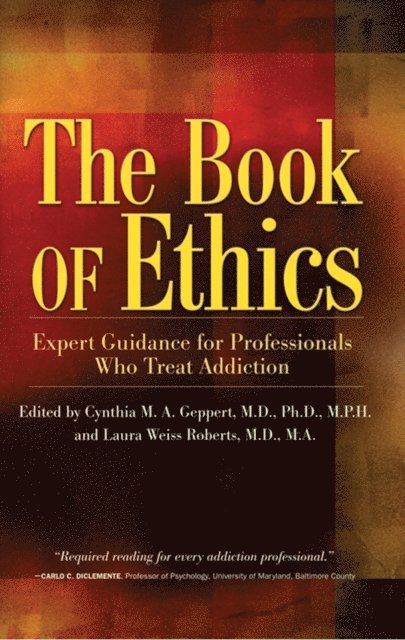
The definitive book on ethics for chemical dependency treatment professionals.The treatment of addiction as a biological, psychological, social, and spiritual disease requires a high standard of ethical knowledge and professional skill. This groundbreaking, reader-friendly guide to contemporary ethical issues informs and challenges health care professionals, students, and faculty with a thorough and compassionate examination of the dilemmas faced when providing care for individuals suffering from substance use problems or addiction. Renowned psychiatric ethicists Cynthia Geppert and Laura Weiss Roberts tackle issues of autonomy, respect for persons, confidentiality, truth telling and non-maleficence--setting the standard for contemporary ethical practices. These challenges are illuminated with real-world case examples that show potential effects on diverse patient populations.