Dag Wilhelmsen – författare
Visar alla böcker från författaren Dag Wilhelmsen. Handla med fri frakt och snabb leverans.
6 produkter
6 produkter
Del 308 - Springer International Series in Engineering and Computer Science
Planning and Architectural Design of Integrated Services Digital Networks
Civil and Military Applications
Inbunden, Engelska, 1995
2 174 kr
Skickas inom 10-15 vardagar
Planning and Architectural Design of Integrated Services Digital Networks: Civil and Military Applications provides a comprehensive treatment of ISDNs: how to plan and design them architecturally and how to implement them so that they meet certain given user requirements ranging from a variety of service demands to transmission performance, security, reliability/availability, capability for growth, interoperability with other ISDN and non-ISDN networks and, of course, cost. The book concentrates on the application of ISDN concepts and standards to the planning and design of real costed networks to meet certain specified user requirements. Where there are multiple options, considerations and rationale on the choice of network aspects and standards are discussed. The unique feature of the book, compared with other books on ISDN, is that it expounds an original methodology which starts from an assumed or given set of complete user requirements and proceeds to designing a complete network taking into account the technology and standards of ISDN, as well as some constraints including cost which may be imposed. Planning and Architectural Design of Integrated Services Digital Networks describes computer-aided design tools employed for dimensioning the network for various traffic loads and for assessing its traffic carrying performance for assessing different precedence categories and network configurations, transmission conditions and routing algorithms which may be static-deterministic or dynamic-adaptive. Aspects such as surveillance and control, security, survivability and EMP protection are also addressed. Planning and Architectural Design of Integrated Services Digital Networks: Civil and Military Applications is an excellent reference source and may be used as a text for advanced courses on the subject.
Inbunden, Engelska, 1997
2 174 kr
Skickas inom 10-15 vardagar
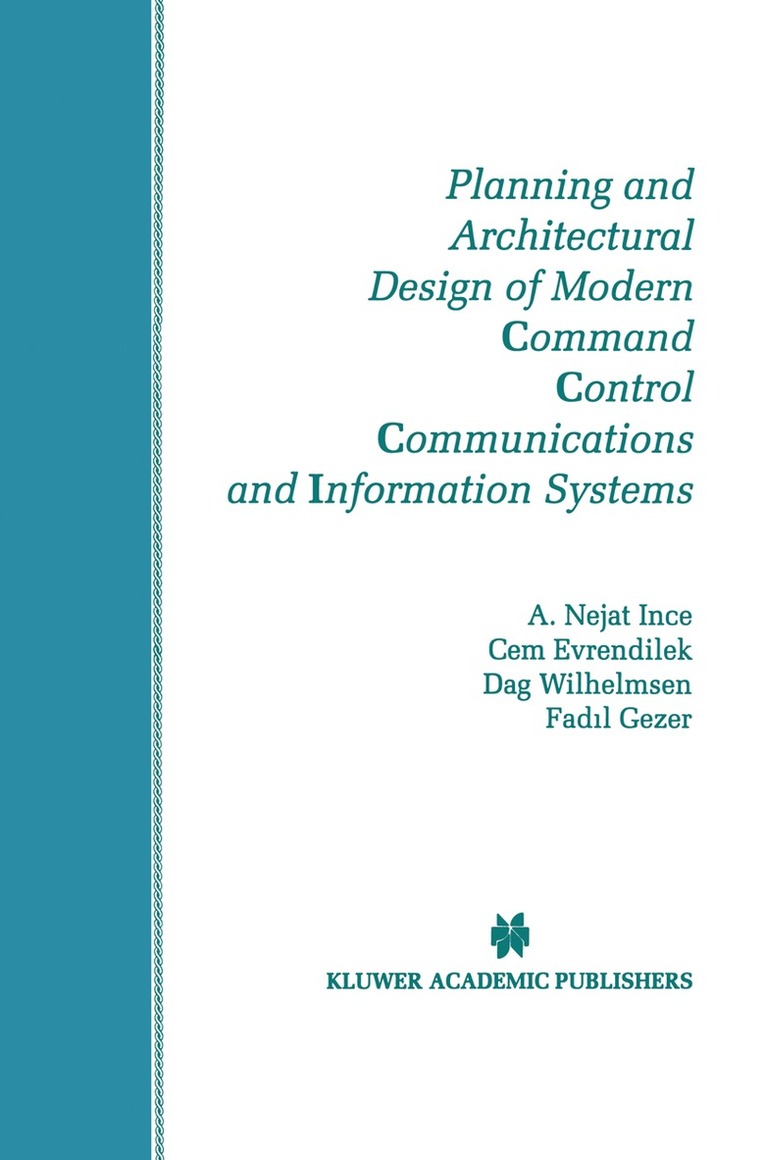
The subject of this book is Command Control Communication and Information 3 (C I) which is the management infrastructure for any large or complex dynamic resource systems. Here command means the determination of what to do, and control means the ongoing managementofthe execution ofa command. 3 Decision making is the essence of C I which is accomplished through a phased implementation of a set of facilities, communications, personnel, equipment and procedures for monitoring, forecasting, planning, directing, allocating resources, and generating options to achieve specific and general objectives. 3 The C I system that is in question here is for a strategic military command including its subordinate commands. Although the design methodology that will be expounded in the book is for a military system, it can, to a large extent, apply also to tactical military as well as to civilian management information systems (MIS). 3 A C I system is a decision making network that reflects a hierarchical organization 3 of C I nodes. Each node is responsible for the management of some portion ofthe available resources, where the higher level nodes are responsible for a 3 correspondingly greater portion of the resources. Within a C I system both command and control decision making occur at every level of the hierarchy. Command decisions at one level determine how to satisfy the management decisions at a higher level.
Del 308 - Springer International Series in Engineering and Computer Science
Planning and Architectural Design of Integrated Services Digital Networks
Civil and Military Applications
Häftad, Engelska, 2013
2 174 kr
Skickas inom 10-15 vardagar
Planning and Architectural Design of Integrated Services Digital Networks: Civil and Military Applications provides a comprehensive treatment of ISDNs: how to plan and design them architecturally and how to implement them so that they meet certain given user requirements ranging from a variety of service demands to transmission performance, security, reliability/availability, capability for growth, interoperability with other ISDN and non-ISDN networks and, of course, cost. The book concentrates on the application of ISDN concepts and standards to the planning and design of real costed networks to meet certain specified user requirements. Where there are multiple options, considerations and rationale on the choice of network aspects and standards are discussed. The unique feature of the book, compared with other books on ISDN, is that it expounds an original methodology which starts from an assumed or given set of complete user requirements and proceeds to designing a complete network taking into account the technology and standards of ISDN, as well as some constraints including cost which may be imposed. Planning and Architectural Design of Integrated Services Digital Networks describes computer-aided design tools employed for dimensioning the network for various traffic loads and for assessing its traffic carrying performance for assessing different precedence categories and network configurations, transmission conditions and routing algorithms which may be static-deterministic or dynamic-adaptive. Aspects such as surveillance and control, security, survivability and EMP protection are also addressed. Planning and Architectural Design of Integrated Services Digital Networks: Civil and Military Applications is an excellent reference source and may be used as a text for advanced courses on the subject.
Häftad, Engelska, 2012
2 174 kr
Skickas inom 10-15 vardagar
The subject of this book is Command Control Communication and Information 3 (C I) which is the management infrastructure for any large or complex dynamic resource systems. Here command means the determination of what to do, and control means the ongoing managementofthe execution ofa command. 3 Decision making is the essence of C I which is accomplished through a phased implementation of a set of facilities, communications, personnel, equipment and procedures for monitoring, forecasting, planning, directing, allocating resources, and generating options to achieve specific and general objectives. 3 The C I system that is in question here is for a strategic military command including its subordinate commands. Although the design methodology that will be expounded in the book is for a military system, it can, to a large extent, apply also to tactical military as well as to civilian management information systems (MIS). 3 A C I system is a decision making network that reflects a hierarchical organization 3 of C I nodes. Each node is responsible for the management of some portion ofthe available resources, where the higher level nodes are responsible for a 3 correspondingly greater portion of the resources. Within a C I system both command and control decision making occur at every level of the hierarchy. Command decisions at one level determine how to satisfy the management decisions at a higher level.
E-bok
PDF, Engelska, 20122 741 kr
Läs direkt efter köp
Planning and Architectural Design of Integrated Services Digital Networks: Civil and Military Applications provides a comprehensive treatment of ISDNs: how to plan and design them architecturally and how to implement them so that they meet certain given user requirements ranging from a variety of service demands to transmission performance, security, reliability/availability, capability for growth, interoperability with other ISDN and non-ISDN networks and, of course, cost. The book concentrates on the application of ISDN concepts and standards to the planning and design of real costed networks to meet certain specified user requirements. Where there are multiple options, considerations and rationale on the choice of network aspects and standards are discussed. The unique feature of the book, compared with other books on ISDN, is that it expounds an original methodology which starts from an assumed or given set of complete user requirements and proceeds to designing a complete network taking into account the technology and standards of ISDN, as well as some constraints including cost which may be imposed. Planning and Architectural Design of Integrated Services Digital Networks describes computer-aided design tools employed for dimensioning the network for various traffic loads and for assessing its traffic carrying performance for assessing different precedence categories and network configurations, transmission conditions and routing algorithms which may be static-deterministic or dynamic-adaptive. Aspects such as surveillance and control, security, survivability and EMP protection are also addressed. Planning and Architectural Design of Integrated Services Digital Networks: Civil and Military Applications is an excellent reference source and may be used as a text for advanced courses on the subject.
E-bok
PDF, Engelska, 20122 765 kr
Läs direkt efter köp
The subject of this book is Command Control Communication and Information 3 (C I) which is the management infrastructure for any large or complex dynamic resource systems. Here command means the determination of what to do, and control means the ongoing managementofthe execution ofa command. 3 Decision making is the essence of C I which is accomplished through a phased implementation of a set of facilities, communications, personnel, equipment and procedures for monitoring, forecasting, planning, directing, allocating resources, and generating options to achieve specific and general objectives. 3 The C I system that is in question here is for a strategic military command including its subordinate commands. Although the design methodology that will be expounded in the book is for a military system, it can, to a large extent, apply also to tactical military as well as to civilian management information systems (MIS). 3 A C I system is a decision making network that reflects a hierarchical organization 3 of C I nodes. Each node is responsible for the management of some portion ofthe available resources, where the higher level nodes are responsible for a 3 correspondingly greater portion of the resources. Within a C I system both command and control decision making occur at every level of the hierarchy. Command decisions at one level determine how to satisfy the management decisions at a higher level.