Dale L. Perry - Böcker
Visar alla böcker från författaren Dale L. Perry. Handla med fri frakt och snabb leverans.
10 produkter
10 produkter
1 064 kr
Skickas inom 10-15 vardagar
One area of science that has shown an explosive growth over the last few decades is materials science. Inherently by nature products of both basic and applied research, materials make possible life and society as we know it today. Materials, ranging from ceramics to semiconductors to composites, are such that new ones must not only be designed and made ... they must also be characterized in terms of their physical, chemical, and mechanical properties. Thus, many new state of-the-art techniques involving spectroscopy, microscopy, and other approaches are now routinely used. Modem materials have wide applications in many sectors of technology. Films, for example, constitute an enormous area of materials and are used extensively. Films in tum can be integrated with other systems such as superconducting metal oxides and organic superconductors. Additionally, ceramics can also be synthesized and fabricated as films for different applications. Catalysts, too, can vary widely in both composition and form. The number of applications for catalysts in industry must easily rank as one of the highest number of applications for any class of materials. Catalysis is impOltant for a wide range of activities in industry, from petroleum refining to the synthesis of a large number of industrial feedstock materials. Researchers in this area of materials are constantly trying to unravel new approaches to making better catalysts.
656 kr
Skickas inom 10-15 vardagar
This updated edition of the Handbook of Inorganic Compounds is the perfect reference for anyone that needs property data for compounds, CASRN numbers for computer or other searches, a consistent tabulation of molecular weights to synthesize inorganic materials on a laboratory scale, or data related to physical and chemical properties. Fully revised, the second edition includes new data on inorganic optical materials, radiation detection inorganics, thermochromic compounds, piezochromic compounds, catalysts, superconductors, and luminescent (fluorescent and phosphorescent) inorganics.Compiled for chemists, chemical engineers, materials scientists, and other scientists, this handbook provides:Basic, essential property data for compounds that they wish to use in their database compilations, research, and applications workAmerican Chemical Society (ACS) Chemical Abstract Registry Numbers (RNs, or CAS numbers) for computer and other searches. An effort has been made to include CAS numbers for both hydrated chemical compounds and their parent anhydrous compoundsA tabulation of molecular weights for calculations. In this handbook, molecular weights have been calculated to three decimal places in all casesTextbook and inorganic chemistry resource booksThe Handbook of Inorganic Compounds: Second Edition consists of data for 3,326 selected gas, liquid, and solid compounds, including representative compounds of several different classes of compounds. Choices of compounds were based on criteria such as inclusion of the compounds in various handbooks of laboratory chemicals, discussion in recent research publications, compounds important to inorganic materials chemistry, and comments of the Advisory Committee guiding the production of the first edition of the handbook.
Applications of Synchrotron Radiation Techniques to Materials Science V: Volume 590
Häftad, Engelska, 2014
363 kr
Skickas inom 7-10 vardagar
Each year synchrotron facilities, both in the United States and in other countries, are utilized for more applications of synchrotron radiation as they pertain to materials science. Both basic and applied research possibilities are manyfold, including studies of materials mentioned below and those that are yet to be discovered. The combination of synchrotron-based spectroscopic techniques with ever-increasing high-resolution microscopy allows researchers to study very small domains of materials in an attempt to understand their chemical and electronic properties. This is especially important for composites and related materials involving material bonding interfaces. This book brings together the materials science community and the characterization techniques that use synchrotron radiation. Topics include surfaces, interfaces, electronic materials, metal oxides, metal sulfides, radiation detector materials, thin films, carbides, polymers, alloys, nanoparticles, and metal composites. Results reported in the volume address recent advances in X-ray absorption and scattering, imaging, tomography, microscopy, and diffraction methods.
Spectroscopy of Emerging Materials
Proceedings of the NATO ARW on Frontiers in Spectroscopy of Emergent Materials: Recent Advances toward New Technologies, Sudak, Crimea, Ukraine, from 14 to 18 September 2003.
Inbunden, Engelska, 2004
3 178 kr
Skickas inom 10-15 vardagar
A comprehensive discussion of the key role of modern spectroscopic investigations in interdisciplinary materials science and engineering, covering emerging materials that are either absolutely novel or well-known materials with recently discovered, exciting properties. The types of spectroscopy discussed include optical, electronic and magnetic, UV-Visible absorption, Rayleigh scattering, photoluminescence, vibrational, magnetic resonance, electron energy loss, EXAFS, XANES, optical tomography, time-resolved spectroscopy, and point contact spectroscopy. The materials studied are highly topical, with a focus on carbon and silicon nanomaterials including nanotubes, fullerenes, nanoclusters, metallic superconducting phases, molecular materials, magnetic and charge-stripe oxides, and biomaterials. Theoretical treatments are presented of molecular vibrational dynamics, vibration-induced decay of electronic excited states, nanoscale spin-orbit coupling in 2D Si-based structures, and the growth of semiconductor clusters.
3 178 kr
Skickas inom 10-15 vardagar
A comprehensive discussion of the key role of modern spectroscopic investigations in interdisciplinary materials science and engineering, covering emerging materials that are either absolutely novel or well-known materials with recently discovered, exciting properties. The types of spectroscopy discussed include optical, electronic and magnetic, UV-Visible absorption, Rayleigh scattering, photoluminescence, vibrational, magnetic resonance, electron energy loss, EXAFS, XANES, optical tomography, time-resolved spectroscopy, and point contact spectroscopy. The materials studied are highly topical, with a focus on carbon and silicon nanomaterials including nanotubes, fullerenes, nanoclusters, metallic superconducting phases, molecular materials, magnetic and charge-stripe oxides, and biomaterials. Theoretical treatments are presented of molecular vibrational dynamics, vibration-induced decay of electronic excited states, nanoscale spin-orbit coupling in 2D Si-based structures, and the growth of semiconductor clusters.
3 185 kr
Skickas inom 10-15 vardagar
This updated edition of the Handbook of Inorganic Compounds is the perfect reference for anyone that needs property data for compounds, CASRN numbers for computer or other searches, a consistent tabulation of molecular weights to synthesize inorganic materials on a laboratory scale, or data related to physical and chemical properties. Fully revised, the second edition includes new data on inorganic optical materials, radiation detection inorganics, thermochromic compounds, piezochromic compounds, catalysts, superconductors, and luminescent (fluorescent and phosphorescent) inorganics.Compiled for chemists, chemical engineers, materials scientists, and other scientists, this handbook provides: Basic, essential property data for compounds that they wish to use in their database compilations, research, and applications workAmerican Chemical Society (ACS) Chemical Abstract Registry Numbers (RNs, or CAS numbers) for computer and other searches. An effort has been made to include CAS numbers for both hydrated chemical compounds and their parent anhydrous compoundsA tabulation of molecular weights for calculations. In this handbook, molecular weights have been calculated to three decimal places in all casesTextbook and inorganic chemistry resource booksThe Handbook of Inorganic Compounds: Second Edition consists of data for 3,326 selected gas, liquid, and solid compounds, including representative compounds of several different classes of compounds. Choices of compounds were based on criteria such as inclusion of the compounds in various handbooks of laboratory chemicals, discussion in recent research publications, compounds important to inorganic materials chemistry, and comments of the Advisory Committee guiding the production of the first edition of the handbook.
1 064 kr
Skickas inom 10-15 vardagar
One area of science that has shown an explosive growth over the last few decades is materials science. Inherently by nature products of both basic and applied research, materials make possible life and society as we know it today. Materials, ranging from ceramics to semiconductors to composites, are such that new ones must not only be designed and made ... they must also be characterized in terms of their physical, chemical, and mechanical properties. Thus, many new state of-the-art techniques involving spectroscopy, microscopy, and other approaches are now routinely used. Modem materials have wide applications in many sectors of technology. Films, for example, constitute an enormous area of materials and are used extensively. Films in tum can be integrated with other systems such as superconducting metal oxides and organic superconductors. Additionally, ceramics can also be synthesized and fabricated as films for different applications. Catalysts, too, can vary widely in both composition and form. The number of applications for catalysts in industry must easily rank as one of the highest number of applications for any class of materials. Catalysis is impOltant for a wide range of activities in industry, from petroleum refining to the synthesis of a large number of industrial feedstock materials. Researchers in this area of materials are constantly trying to unravel new approaches to making better catalysts.
1 271 kr
Skickas inom 7-10 vardagar
The scope of detector materials for semiconductors and scintillators includes a wide variety of molecular compounds such as cadmium zinc telluride (CZT), lanthanum halides, and others. An additional class of scintillators is based on organic compounds and glasses. Ideally, attributes of materials used for radiation detection include appropriate-range bandgaps, high atomic numbers of the central element, high densities, performance at room temperature, strong mechanical properties, and low production cost. Unfortunately, there are significant gaps in the knowledge required to produce radiation detection materials of higher quality - in terms of reproducible purity, homogeneity and mechanical integrity. This book explores results in radiation detection materials from both experimental and theoretical standpoints, as both are needed to grow and characterize materials that will produce better detectors in the future.
1 363 kr
Skickas inom 7-10 vardagar
Detector materials include semiconductors and scintillators, which are represented by a variety of binary molecular compounds such as lanthanum halides (LaX3), zinc oxide (ZnO) and mercuric iodide (HgI2). Ideally, these materials possess appropriate range bandgaps, high atomic numbers of the central element and high densities. They also perform at room temperature, have strong mechanical properties and low production costs. There are significant gaps, however, in the information needed to improve the quality of these materials - in terms of reproducible purity, homogeneity and mechanical integrity. This book features the latest advances in radiation detection materials, both from experimental and theoretical standpoints, as both are needed to grow and characterize materials that will produce enhanced detectors of the future. Topics include: CdTe and CdZnTe detectors; neutron detectors and scintillators.
758 kr
Skickas inom 7-10 vardagar
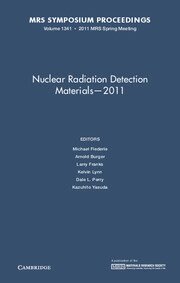
Symposium U, 'Nuclear Radiation Detection Materials', held April 26–28 at the 2011 MRS Spring Meeting in San Francisco, California was a continuation of the 2009 symposium and provided the latest research in nuclear radiation detection materials. Types of detector materials include semiconductors and scintillators, which are represented by a variety of new scintillator materials; novel semiconductors; and traditional detection materials. There is a strong need for new materials and methods for a variety of radiation detection applications in this rapidly growing field. The symposium gave an overview of the crystal growth of radiation detector materials and the characterization and technology issues and moved on to discuss several important improvements for the development of future radiation detectors.