Dan Binkley - Böcker
Visar alla böcker från författaren Dan Binkley. Handla med fri frakt och snabb leverans.
8 produkter
8 produkter
1 531 kr
Skickas inom 7-10 vardagar
Forest soils are the foundation of the entire forest ecosystem and complex, long-term interactions between trees, soil animals, and the microbial community shape soils in was that are very distinct from agricultural soils. The composition, structure, and processes in forest soils at any given time reflect current conditions, as well as the legacies of decades (and even millennia) of interactions that shape each forest soil. Reciprocal interactions are fundamental; vegetation alters soil physical properties, which influence soil biology and chemistry, which in turn influence the growth and success of plants. These dynamic systems may be strongly influenced by intentional and unintentional management, ranging from fire to fertilization. Sustaining the long-term fertility of forest soils depends on insights about a diverse array of soil features and changes over space and time. Since the third edition of this successful book many new interests in forest soils and their management have arisen, including the role of forest soils in sequestering carbon, and how management influences rates of carbon accumulation. This edition also expands the consideration of how soils are sampled and characterized, and how tree species differ in their influence on soil development. Clearly structured throughout, the book opens with the origins of forest soil science and ends with the application of soil science principles to land management. This new edition provides: A completely revised and updated Fourth Edition of this classic textbook in the fieldA coherent overview of the major issues surrounding the ecology and management of forest soils Global in scope with coverage of soil types ranging from the tropical rainforest soils of Latin America to the boreal forest soils of SiberiaNew chapters on Management: Carbon sequestration; Evidence-based approaches and applications of geostatistics, GIS and taxonomiesA clear overview of each topic, informative examples/case studies, and an overall context for helping readers think clearly about forest soilsAn introduction to the literature of forest soil science and to the philosophy of forest soil science researchThis coherent overview of the major issues surrounding the ecology and management of forest soils will be particularly useful to students taking courses in soil science, forestry, agronomy, ecology, natural resource management, environmental management and conservation, as well as professionals in forestry dealing with the productivity of forests and functioning of watersheds.
3 771 kr
Skickas inom 7-10 vardagar
An integrated treatment of forest nutrition management that draws on the fields of silviculture, soil studies, ecology, and economics to provide broad-based information on how to enhance the nutritional status of forest soils in order to increase their long-term stand productivity. Covers the use of fertilizers to enhance biological nitrogen fixation and how the nutrition status of forests is affected by other operations, such as harvesting and site preparation. Includes methods for assessing nutrient status, the economics of nutrition management, and models to aid in decision making. Written for the non-specialist needing a clear conceptual base for applying forest nutrition science to management. Numerous examples of successful forest management illustrate concepts.
1 088 kr
Skickas inom 7-10 vardagar
Contemporary soil science and conservation methods of effective forestryForests and the soils that serve as their foundation cover almost a third of the world’s land area. Soils influenced by forest cover have different properties than soils cultivated for agricultural use. Ecology and Management of Forest Soils provides a clear and comprehensive overview of the composition, structure, processes, and management of the largest terrestrial ecosystem. From composition and biogeochemistry to dynamics and management, this essential text enables readers to understand the vital components of sustainable, long-term forest soil fertility. The interaction of trees, animals, microbes, and vegetation alter the biology and chemistry of forest soils—these dynamics are also subject to human management, requiring conservationists to be conversant in the philosophy and methods of soil science.Now in its fifth edition, this classic text includes new coverage of uptake of organic nitrogen in forests, 15N retention studies, the effects of N additions on C accumulation, evidence-based examples of the dynamics of soils, and more. Extensive updates and revisions to topics such as spatial implications of megafires, long‐term organic matter accumulation, soil characterization, and molecular soil measurement techniques reflect contemporary research and practices in the field.This informative overview of forest soils integrates clear and accurate descriptions of central concepts and logically organized chapters to provide readers with foundational knowledge of major soil features, processes, measurement techniques, and management methods. This authoritative survey of the management and ecology of forest soils: Offers full-color photographs and illustrations, real-world examples and case studies, and clear overviews to each topicPresents up-to-date and accessible coverage of contemporary forest science literature and researchAddresses topical issues relevant to areas such as ecology, forest management, conservation, and government policyProvides a comprehensive, global perspective on forest soils, from tropical to temperate to borealPresents balanced coverage of soil science principles and their practical application to forest managementEcology and Management of Forest Soils offers students in areas of soil science and forestry, natural resource and environmental management, ecology, agronomy, and conservation an invaluable overview of the field, while providing forestry professionals an efficient and current work of reference.
883 kr
Skickas inom 7-10 vardagar
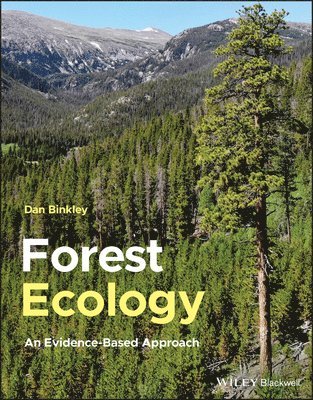
Forest Ecology Forest Ecology An Evidence-Based Approach Forest ecology is the science that deals with everything in forests, including plants and animals (and their interactions), the features of the environment that affect plants and animals, and the interactions of humans and forests. All of these components of forests interact across scales of space and time. Some interactions are constrained, deterministic, and predictable; but most are indeterminant, contingent, and only broadly predictable. Forest Ecology: An Evidence-Based Approach examines the features common to all forests, and those unique cases that illustrate the importance of site-specific factors in determining the structure, function, and future of a forest. The author emphasizes the role of evidence in forest ecology, because appealing, simple stories often lead to misunderstandings about how forests work. A reliance on evidence is central to distinguishing between appealing stories and stories that actually fit real forests. The evidence-based approach emphasizes the importance of real-world, observable science in forests. Classical approaches to ecology in the twentieth century often over-emphasized appealing concepts that were not sufficiently based on real forests. The vast amount of information now available on forests allows a more complete coverage of forest ecology that relies on a strong, empirical foundation. Forest Ecology: An Evidence-Based Approach is the ideal companion text for the teaching of upper-level undergraduate and graduate courses in forest ecology.
Tree Species Effects on Soils: Implications for Global Change
Proceedings of the NATO Advanced Research Workshop on Trees and Soil Interactions, Implications to Global Climate Change, August 2004, Krasnoyarsk, Russia
Inbunden, Engelska, 2005
1 578 kr
Skickas inom 10-15 vardagar
Almost 50% of the total area of Austria is forested, and the forests are dominated by commercially valuable stands of Norway spruce ( (Picea abies).
1 578 kr
Skickas inom 10-15 vardagar
Almost 50% of the total area of Austria is forested, and the forests are dominated by commercially valuable stands of Norway spruce ( (Picea abies). The few remaining forests that resemble the natural vegetation composition are located in forest reserves with restricted management. These natural forests are used as reference systems for evaluating silvicultural research on sustainable forest management. Natural forests are expected to have high biodiversity, where the structural richness of the habitat enables complex relationships between fauna, flora, and microflora. They also provide refugia for rare plants and animals found only in natural forest types. Austria had 180 of these forest reserves up to the year 2003. Most of these forests are privately owned, and owners are compensated by the government for loss of income associated with conservation status. The Ministerial Conference for the Protection of Forest Ecosystems (MCPFE) has launched a world-wide network of protected forest areas which should cover all major forest types (MCPFE and UNECE/FAO, 2003). The sites selected for our investigation of soil conditions and communities were chosen by vegetation ecologists and soil scientists. The stands have developed under natural competition conditions with no management interventions. All sites were well documented with known forest history. Our set of sites spans gradients of environmental conditions as well as species composition, providing a realistic evaluation of the interactions of biotic and abiotic factors.
536 kr
Skickas inom 10-15 vardagar
John Sculley In the short history of personal computing, the task of the software programmer has been one of the least recognized-but one of the most significant-in the industry. In addition to defining the prob lems, and presenting the solutions, the software programmer is con fronted with the challenge of having to predict what combination of ideas and technologies will move the industry forward in the most compelling way. Even though we've seen the development of tremendous applications in a surprisingly short period of time, the most difficult problems often surface when we try to elevate a suc cessful local idea to the international arena. In the case of Apple Computer, these challenges become especially profound when you consider that Apple sells Macintosh not just in the United States, but in Japan, China, the Middle East, Africa, East ern Europe, and even to the United Nations itself. Of course, this means that the personal computer must work everywhere around the world. But more significantly, it also means that the software must reflect the uniqueness of a given culture, its language, morals, and even its sense of humor. To step away from a narrowly-defined, nationally-based paradigm for software development, programmers, management, and entire corporations must learn to recognize what elements of an interface, problem solving technique, documentation illustration, package de sign, and advertisement are local, and which elements are appro priate for global markets.
Acidic Deposition and Forest Soils
Context and Case Studies of the Southeastern United States
Häftad, Engelska, 2011
1 064 kr
Skickas inom 10-15 vardagar
Knowledge in the field of acidic deposition is expanding rapidly, and both ex perts and non-experts are challenged to keep up with the latest information. We designed our assessment to include both the basic foundation needed by non experts and the detailed information needed by experts. Our assessment in cludes background information on acidic deposition (Chapter 1), an in-depth discussion of the nature of soil acidity and ecosystem H+ budgets (Chapter 2), and a summary of rates of deposition in the Southeastern U.S. (Chapter 3). A discussion of the nature of forest soils in the region (Chapter 4) is followed by an overview of previous assessments of soil sensitivity to acidification (Chapter 5). The potential impacts of acidic deposition on forest nutrition are described in the context of the degree of current nutrient limitation on forest productivity (Chap ter 6). The results of simulations with the MAGIC model provided evaluations of the likely sensitivity of a variety of soils representative of forest soils in the South (Chapter 7), as well as a test of soil sensitivity criteria. Our synthesis and recommendations for research (Chapter 8) also serve as an executive summary. A complementary volume in the Springer-Verlag Ecological Studies series should be consulted for information on European forests. This volume, Acidic Deposition and Forest Decline in the Fictelgebirge, edited by E.-D. Schultze and O.L. Lange, also provides greater detail on the physiologic responses of trees than we present in our regional assessment.