Dan Smyer YA – författare
757 kr
Läs direkt efter köp
Environmental Humanities in the New Himalayas: Symbiotic Indigeneity, Commoning, Sustainability showcases how the eco-geological creativity of the earth is integrally woven into the landforms, cultures, and cosmovisions of modern Himalayan communities.
Unique in scope, this book features case studies from Bhutan, Assam, Sikkim, Tibet, Nepal, Pakistan, and Sino-Indian borderlands, many of which are documented by authors from indigenous Himalayan communities. It explores three environmental characteristics of modern Himalayas: the anthropogenic, the indigenous, and the animist. Focusing on the sentient relations of human-, animal-, and spirit-worlds with the earth in different parts of the Himalayas, the authors present the complex meanings of indigeneity, commoning and sustainability in the Anthropocene. In doing so, they show the vital role that indigenous stories and perspectives play in building new regional and planetary environmental ethics for a sustainable future.
Drawing on a wide range of expert contributions from the natural sciences, social sciences, and humanist disciplines, this book will be of great interest to students and scholars of environmental humanities, religion and ecology, indigenous knowledge and sustainable development more broadly.
757 kr
Läs direkt efter köp
Environmental Humanities in the New Himalayas: Symbiotic Indigeneity, Commoning, Sustainability showcases how the eco-geological creativity of the earth is integrally woven into the landforms, cultures, and cosmovisions of modern Himalayan communities.
Unique in scope, this book features case studies from Bhutan, Assam, Sikkim, Tibet, Nepal, Pakistan, and Sino-Indian borderlands, many of which are documented by authors from indigenous Himalayan communities. It explores three environmental characteristics of modern Himalayas: the anthropogenic, the indigenous, and the animist. Focusing on the sentient relations of human-, animal-, and spirit-worlds with the earth in different parts of the Himalayas, the authors present the complex meanings of indigeneity, commoning and sustainability in the Anthropocene. In doing so, they show the vital role that indigenous stories and perspectives play in building new regional and planetary environmental ethics for a sustainable future.
Drawing on a wide range of expert contributions from the natural sciences, social sciences, and humanist disciplines, this book will be of great interest to students and scholars of environmental humanities, religion and ecology, indigenous knowledge and sustainable development more broadly.
690 kr
Läs direkt efter köp
This book explores the historical interconnections between Bengal, Burma, and Yunnan (China), and views the corridor as a transregion that exhibits mobility, connectivity and diversity as well as place-based ecogeological uniqueness. With a focus on the concept of corridor geographies that have shared human and environmental histories beyond sharply demarcated territorial sovereignties of modern individual nation-states, it presents the variety and complexity of premodern and modern pathways, corridors, borders, and networks of livelihood-making, local political alliances, trade and commerce, religions, political systems, and colonial encounters. The book discusses crucial themes including environmental edgings of human-nonhuman habitats, transregional migratory routes and habitats of megafauna, elephant corridors in Yunnan–Myanmar–Bengal landscape, framing spaces between India and China, Tibetan–Myanmar corridors, transboundary river systems, narratives of a Rohingya jade trader, cross-border flow of De’ang’s fermented tea, householding in upland Laos, cultural identities, and trans-border livelihoods.
Comprehensive and topical, with its wide-ranging case studies, this book will be of interest to scholars and researchers of history, routes and border studies, sociology and social anthropology, South East Asian history, South Asian history, Chinese studies, environmental history, human geography, international relations, ecology, and cultural studies.
690 kr
Läs direkt efter köp
This book explores the historical interconnections between Bengal, Burma, and Yunnan (China), and views the corridor as a transregion that exhibits mobility, connectivity and diversity as well as place-based ecogeological uniqueness. With a focus on the concept of corridor geographies that have shared human and environmental histories beyond sharply demarcated territorial sovereignties of modern individual nation-states, it presents the variety and complexity of premodern and modern pathways, corridors, borders, and networks of livelihood-making, local political alliances, trade and commerce, religions, political systems, and colonial encounters. The book discusses crucial themes including environmental edgings of human-nonhuman habitats, transregional migratory routes and habitats of megafauna, elephant corridors in Yunnan–Myanmar–Bengal landscape, framing spaces between India and China, Tibetan–Myanmar corridors, transboundary river systems, narratives of a Rohingya jade trader, cross-border flow of De’ang’s fermented tea, householding in upland Laos, cultural identities, and trans-border livelihoods.
Comprehensive and topical, with its wide-ranging case studies, this book will be of interest to scholars and researchers of history, routes and border studies, sociology and social anthropology, South East Asian history, South Asian history, Chinese studies, environmental history, human geography, international relations, ecology, and cultural studies.
622 kr
Läs direkt efter köp
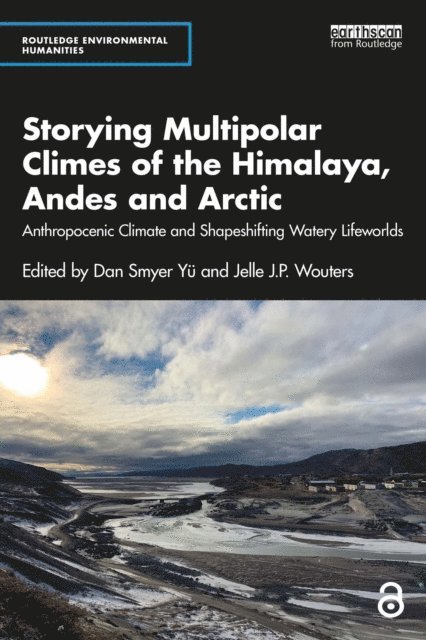
This book initiates multipolar climate/clime studies of the world’s altitudinal and latitudinal highlands with terrestrial, experiential, and affective approaches. Framed in the environmental humanities, it is an interdisciplinary, comparative study of the mutually-embodied relations of climate, nature, culture, and place in the Himalaya, Andes, and Arctic.
Innovation-driven, the book offers multipolar clime case studies through the contributors’ historical findings, ethnographic documentations, and diverse conceptualizations and applications of clime, an overlooked but returning notion of place embodied with climate history, pattern, and changes. The multipolar clime case studies in the book are geared toward deeper, lively explorations and demonstrations of the translatability, interchangeability, and complementarity between the notions of clime and climate. "Multipolar" or "multipolarity" in this book connotes not only the two polar regions and the tectonically shaped highlands of the earth but also diversely debated perspectives of climate studies in the broadest sense. Contributors across the twelve chapters come from diverse fields of social and natural sciences and humanities, and geographically specialize, respectively, in the Himalayan, Andean, and Arctic regions.
The first comparative study of climate change in altitudinal and latitudinal highlands, this will be an important read for students, academics, and researchers in environmental humanities, anthropology, climate science, indigenous studies, and ecology.
Chapters 8 and 9 of this book are freely available as a downloadable Open Access PDF at http://www.taylorfrancis.com/books/e/10.4324/9781003347026 under a Creative Commons Attribution-Non Commercial-No Derivatives (CC-BY-NC-ND) 4.0 license.
723 kr
Läs direkt efter köp
Woven together as a text of humanities-based environmental research outcomes, Himalayan Climes and Multispecies Encounters hosts a collection of historical and fieldwork-based case studies and conceptual discussions of climate change in the greater Himalayan region.
The collective endeavour of the book is expressed in what the editors characterize as the clime studies of the Himalayan multispecies worlds. Synonymous with place embodied with weather patterns and environmental history, clime is understood as both a recipient of and a contributor to climate change over time. Supported by empirical and historical findings, the chapters showcase climate change as clime change that concurrently entails multispecies encounters, multifaceted cultural processes, and ecologically specific environmental changes in the more-than-human worlds of the Himalayas.
As the case studies complement, enrich, and converse with natural scientific understandings of Himalayan climate change, this book offers students, academics, and the interested public fresh approaches to the interdisciplinary field of climate studies and policy debates on climate change and sustainable development.
723 kr
Läs direkt efter köp
Woven together as a text of humanities-based environmental research outcomes, Himalayan Climes and Multispecies Encounters hosts a collection of historical and fieldwork-based case studies and conceptual discussions of climate change in the greater Himalayan region.
The collective endeavour of the book is expressed in what the editors characterize as the clime studies of the Himalayan multispecies worlds. Synonymous with place embodied with weather patterns and environmental history, clime is understood as both a recipient of and a contributor to climate change over time. Supported by empirical and historical findings, the chapters showcase climate change as clime change that concurrently entails multispecies encounters, multifaceted cultural processes, and ecologically specific environmental changes in the more-than-human worlds of the Himalayas.
As the case studies complement, enrich, and converse with natural scientific understandings of Himalayan climate change, this book offers students, academics, and the interested public fresh approaches to the interdisciplinary field of climate studies and policy debates on climate change and sustainable development.